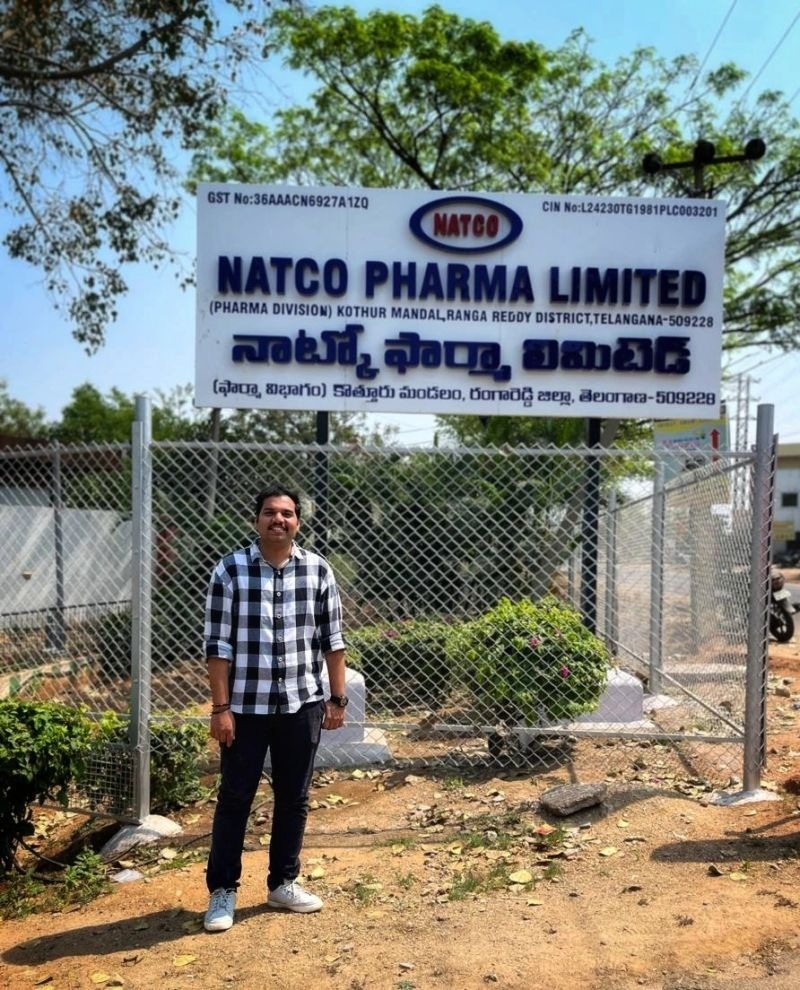
Natco Pharma FY26: The Revlimid Cliff and What Lies Beneath
General information and entertainment, not investment advice. The author is not a SEBI-registered adviser or research analyst. No recommendation, no promised returns. Markets carry risk including loss of capital. Figures may not be current. Consult a registered adviser before acting.
1. At a Glance
Natco’s FY26 net profit crashed 25%, from ₹1,885 Cr to ₹1,418 Cr. The culprit: lenalidomide (Revlimid), the blockbuster oncology drug whose profit share was drying up as patent exclusivity eroded in the US.
Revenue slipped 8%, from ₹4,430 Cr to ₹4,078 Cr. Operating margin compressed to 35% from 50% the prior year. The company is not broken—it’s reorganizing after a windfall.
Q4 was uglier: sales halved YoY to ₹739 Cr, profit fell 34%. The quarter included a one-time tax benefit of ₹115 Cr (shifting to the new tax regime), which masked an otherwise severe operational step-down.
Management expects FY27 revenue of ₹3,400–3,500 Cr and PAT of ₹700–750 Cr—deliberately cutting guidance in half to reset investor expectations. The message: Revlimid is gone, and the base business is now the scorecard.
The stock price (₹846 on June 11, 2026) sits at a 10.6x P/E on FY26 earnings. Peer median P/E is 31.7x. Why the discount? Earnings volatility and concentration risk—the company admits it has been “jackpot driven” and is now trying to build something less cyclical.
2. Introduction
Natco Pharma is a vertically integrated, R&D-focused pharmaceutical company headquartered in Hyderabad. It operates across three broad segments: export formulations (oncology and specialty generics), domestic formulations (branded oncology), and active pharmaceutical ingredients (APIs).
The company has transformed itself from a domestic player into a complex-generic powerhouse, particularly in the US market. It manufactures in seven facilities across India and has established front-end subsidiaries in Brazil, Canada, the US, and several other markets. As of March 2026, it had 17.9 Cr equity shares outstanding (face value ₹2 each).
Recent moves define the moment. In November 2025, Natco acquired a 35.75% stake in Adcock Ingram Holdings, a South African pharmaceutical company, for ₹2,000 Cr—a bet on geographic diversification outside the volatile US generics space. In March 2026, it approved a demerger of its agrochemicals business (Natco Crop Health Sciences), which had grown from ₹60 Cr revenue in FY25 to ₹140 Cr in FY26.
The ICRA credit rating stands at [ICRA]AA (Stable)/A1+. The company maintains a net cash position of roughly ₹2,400 Cr.
3. Business Model: WTF Do They Even Do?
Export Formulations (74% of FY26 revenue, ₹2,994 Cr in absolute terms). Natco manufactures finished-dosage generics in oncology, cardiovascular, neurology, and immunology—complex molecules with high barriers to entry. It ranks among the top 10 generic companies by sales in Canada and has partnerships with front-end players like Sun Pharma, Alvogen, Teva, Mylan, and others for US distribution. The company is also building its own front-end presence through subsidiaries (Brazil, Canada, US).
The Revlimid profit share was the crown jewel here. In FY24 and FY25, this single molecule (a complex oncology drug) turbo-charged margins and earnings. Patent expiry in Q2 FY26 removed it from the windfall column—management now treats this as a “learning” that the company must not be hostage to a few molecules.
Domestic Formulations (10% of revenue, ₹448 Cr). Natco is the market leader in branded oncology in India. It sells tablets, capsules, and injections for oncology, cardiology, and specialty conditions. Margins here are lower than exports but more stable.
Active Pharmaceutical Ingredients (6% of revenue, ₹235 Cr). Natco manufactures APIs for oncology, CNS, and pain management. The company holds 49 active US DMF (Drug Master File) registrations and has capabilities in multi-step synthesis, semi-synthetic fusion, and peptides.
Crop Health Sciences (3% of revenue, ₹140 Cr). A recent growth platform offering pesticides, insecticides, and bio-stimulants. Management sees this as a long-cycle build (3–4 years commercial presence, last 2 years mostly market learning). The demerger in FY27 is designed to let it grow independently without diluting pharma focus.
4. Financials Overview
Figures are consolidated, in ₹ crore.
Metric
Latest (FY26)
YoY Change
YoY %
Revenue
4,078
-352
-8%
EBITDA
1,436
-760
-35%
PAT
1,418
-467
-25%
EPS
79.20
-26.1
-25%
FY26 revenues came in at ₹4,078 Cr versus ₹4,430 Cr in FY25. EBITDA fell to ₹1,436 Cr from ₹2,196 Cr (OPM compressed to 35% from 50%). Net profit tumbled to ₹1,418 Cr from ₹1,885 Cr. EPS stood at ₹79.20 versus ₹105.26 in the prior year.
Q4 Performance. The final quarter was particularly weak. Sales slid to ₹739 Cr (Q4 FY25: ₹1,221 Cr), a 39% YoY drop. Operating profit collapsed to ₹128 Cr from ₹548 Cr. Net profit came to ₹268 Cr (before extraordinary items) but swung higher to ₹269 Cr after adding a ₹115 Cr one-time deferred-tax benefit from the new tax regime election. Stripping that, the quarter was deeply loss-making on operations—a ₹173 Cr statutory profit on ₹739 Cr sales.
Concall Context. Management attributed the decline primarily to Revlimid normalization and pricing pressure in the US and domestic markets. They also noted higher R&D spend (positioned as long-cycle investment) and engineering-related write-downs (~₹20–30 Cr). Middle East logistics disruptions added freight cost pressure. Margin recovery is not expected in FY27; the company is guiding for an 8–9% R&D spend (versus 9.1% in FY25) and acknowledging that exclusivity-driven earnings will remain episodic. The Adcock Ingram acquisition (November 2025 closing) is expected to contribute ₹35–40 Cr to FY26 earnings (partial-year) and a larger base in FY27.
5. Market Expectations & Historical Multiples
This section describes how the market is currently pricing the company and how that compares with its own history and peer group. It is descriptive, not predictive.
Metric
Current
Historical Average (5Y)
Peer Median
P/E
10.6x
16.3x
31.7x
EV/EBITDA
8.3x
—*
—*
P/B
1.66x
—*
3.62x
ROE
16.9%
19%
12.49%
ROCE
17.1%
—*
15.16%
The market currently pays 10.6x earnings here versus a peer median of 31.7x. The 200 basis-point spread