General information and education, not investment advice. The author is not a SEBI-registered adviser or research analyst. No recommendation, no promised returns. Markets carry risk including loss of capital. Figures may not be current. Always consult a SEBI-registered adviser.
1. At a Glance
Modis Navnirman develops premium homes in Mumbai, largely by redeveloping ageing housing societies. Revenue from operations in the three months to June 2026 was ₹58.26 crore. That is 27.92% above the ₹45.54 crore booked a year earlier. It is 13.15% above the ₹51.49 crore of the March quarter. Consolidated profit after tax came in at ₹8.54 crore, 25.81% higher year on year. Against the March quarter the same figure rose 92.04%. Basic consolidated earnings per share were ₹4.36, against ₹3.47 a year earlier.
The company’s own presentation puts operating profit before interest, tax and depreciation at ₹11.65 crore. That is up 14.25%, a slower pace than revenue managed. The margin on that measure, other income included, moved from 22.33% to 19.83%. Management attributed the squeeze to costlier materials, panic buying, material shortages and labour shortages in April and May. It said the “major hit was because of the war” and that things had “stabilized now.”
Area sold in the quarter was about 44,000 sq ft. Management frames that figure as its most on-the-ground indicator of demand. One new redevelopment project was secured, Neel Kiran Society in Santacruz West. The stated footprint is now 6 ongoing projects and 14 completed ones. Another 5 are upcoming. That makes 25 premium residential schemes, all in and around Mumbai, and all named Rashmi something.
Screener, a data service, puts trailing twelve-month sales growth at 84%. Borrowings at March 2026 stood at ₹6.31 crore against net worth of ₹156.70 crore. Net worth is the shareholders’ own funds left in the business.
2. Introduction
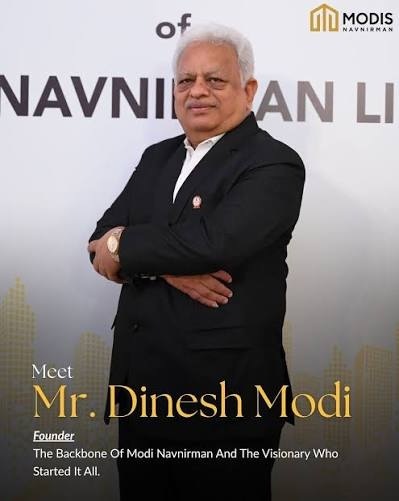
Modis Navnirman was incorporated in 2010 and its business is real estate development. The investor presentation dates the founding to 2009, under Mr Dinesh C. Modi. The corporate identity number carries a 2022 registration year. That is what happens when a family construction business grows up and files its paperwork in stages.
FY26 was the year the corporate structure got a haircut. The NCLT, the tribunal that hears company matters, approved a merger at its Mumbai bench. Shree Modis Navnirman Pvt. Ltd., a wholly owned subsidiary, was folded into the parent. Authorised share capital went from ₹20 crore to ₹20.05 crore. The rise of ₹5 lakh was announced with all the ceremony of a full restructuring. The Ministry of Corporate Affairs order came on 16 October 2025, effective from 1 April 2025. Shareholder approval for the fast-track merger exceeded 90%.
The same year the company left the BSE SME Platform for the main boards. Listing on both BSE and NSE took effect on 14 November 2025. In FY26 it also set up Modis Navnirman Foundation on 20 January 2026. That is a Section 8 company, the form Indian law reserves for non-profit work, for social and charitable initiatives. The subsidiary reported total revenue of ₹0.04 lakh in the three months to June 2026. Four thousand rupees sat in a consolidated statement beside a parent earning ₹58 crore. The auditors reviewed it, because materiality thresholds do not exempt anyone from being counted.
The company adopted Ind AS, India’s accounting standards, with effect from 1 April 2025. Prior-year comparatives were restated under Ind AS 101. Revenue is recognised on the percentage of completion method rather than on handover. Sales therefore enter the books as construction progresses, not when keys change hands.
Mandates disclosed over the preceding year run to four. The BOI Staff Sheetal society came in January 2026, with gross development value of ₹250 crore. Gross development value is the expected sale value of everything a project will build. That plot measures 3,924.91 sq m. A Borivali mandate of the same value followed in February 2026. New Chitra Society in Kandivali West arrived in March 2026 at about ₹160 crore. Neel Kiran CHSL in Khar West came in June 2026 at ₹250 crore, subject to approvals.
US
Now live
US Stocks terminal is live
13,000+ US tickers · EDGAR fundamentals · screener and filings feed — the same terminal, for American markets.
Explore →
3. Business Model: WTF Do They Even Do?
Modis Navnirman is a Mumbai developer working on premium residential and redevelopment projects. It builds through MHADA and SRA schemes and through direct society redevelopment. MHADA and SRA are the state housing and slum rehabilitation authorities. The stated logic is to partner with housing societies rather than bid for land in the open market. That keeps land cost low and puts capital into construction instead of an idle landbank. In practice the business development job means persuading a committee of existing residents. No MBA syllabus has fully mapped that form of stakeholder management.
The geography is tight: Malad, Kandivali, Borivali and Dahisar. Goregaon is on the list, and now Khar. Tenders are under evaluation in Vile Parle, and discussions are running in Ghatkopar. The presentation describes residential towers of 14 to 18 storeys. Individual project pages list 17 to 21 storeys, three podiums with near-religious regularity, and shops and offices at the base.
Six projects are ongoing. Rashmi Square on Linking Road in Borivali West runs to 21 storeys and 130 flats. It also carries 10 shops and 7 offices. Rashmi Signature on S.V. Road in Malad West has 18 storeys across three wings. It holds 210 flats over 2,70,000 sq ft. Rashmi Delight in Kandivali West is 17 storeys, with 53 flats and 3 shops. Rashmi Manorath at Datta Pada in Borivali East is 17 storeys and 87 flats. Rashmi Icon on Shankar Lane in Malad West is 20 storeys with 201 flats. It adds 16 shops and 9 offices across 3,50,000 sq ft. Rashmi Avenue in Dahisar West is 21 storeys with 225 flats. It carries 18 shops across 3,00,000 sq ft.