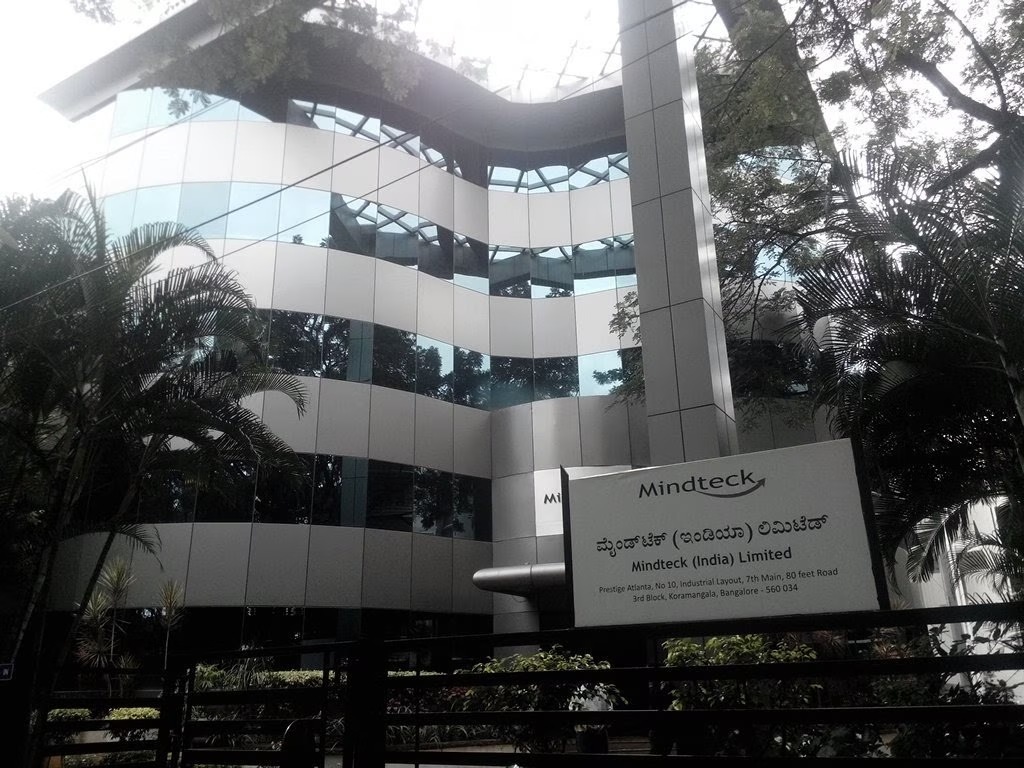
A deceleration in key revenue generators often exposes structural weaknesses that operational cost-cutting can only temporarily mask. For Mindteck (India) Ltd, the fiscal year ending March 2026 delivered an alarming disconnect: annual consolidated sales contracted by 4.03% to ₹407.30 crore. Yet, net profit managed to expand by 9.90% to ₹31.52 crore , primarily salvaged by a sharp reduction in operating overheads as total expenses declined from ₹389.13 crore to ₹369.01 crore. While the market reacts to the immediate margin expansion, sophisticated investors are focusing heavily on the underlying operational shrinkage and severe management instability.
The primary catalyst drawing investor scrutiny is a structural overhaul of corporate leadership, juxtaposed against a debt-free balance sheet that boasts cash and bank balances of ₹134.21 crore. However, anxiety is mounting over a structural revenue ceiling, a prolonged 87-day cash conversion cycle, and the sudden departures of the company’s highest-ranking executives within a single fiscal year. When a service-oriented IT enterprise experiences top-line decay during an era of global digital transformation, it signals either a loss of pricing power or an intensifying client churn. The critical question moving forward is whether a newly assembled leadership team can revive client acquisition before the company’s core business model undergoes further erosion.
Section 2 — Introduction
Mindteck (India) Ltd occupies a niche, yet increasingly contested, corner of the global technology ecosystem, operating as a specialized product engineering and embedded systems service provider. Established in 1991, the company caters to Fortune 1000 clients, universities, and government entities through software development centers located in Bengaluru and Kolkata.
This analysis is prompted by the publication of Mindteck’s full-year audited financial results for the fiscal year ending March 2026. Over the last twelve months, the company has transformed into a case study of corporate governance drama, featuring the rapid resignation of its CEO, the appointment and subsequent exit of a Managing Director, and the hiring of an overseas chief executive. As the boardroom chairs spin, the business faces a defining moment: its core service lines are generating less revenue, placing the responsibility on newly appointed independent directors to stabilize corporate strategy and arrest the operational drift.
Section 3 — Business Model: WTF Do They Even Do?
Mindteck essentially acts as a high-end outsourced research and development lab for global technology giants who lack the time or talent to program their own chips and equipment. The company divides its operations into product engineering—which involves writing firmware and electronic designs for semiconductor fab equipment, medical instruments, and data storage devices—and enterprise application maintenance.
For an organization that claims expertise in advanced artificial intelligence, deep learning, and complex data engineering platforms like Apache Spark and Snowflake, its operational reality remains highly dependent on legacy models. The business relies on a high-cost human capital pool, with employee costs consistently consuming over 59% of total operational revenues. Furthermore, its geographic exposure is heavily concentrated, with the United States accounting for approximately 47% of its total revenue mix. This creates a vulnerability where any slowdown in North American tech spending directly impacts the company’s financial performance.
Section 4 — Financials Overview
Figures are consolidated, in ₹ crore.
Quarterly Comparison Table
Metric
Latest Quarter (Mar 2026)
YoY
QoQ
Revenue
103.91
0.11%
3.43%
EBITDA / Operating Profit
10.66
24.39%
2.01%
PAT
10.16
49.41%
101.19%
EPS (₹)
3.18
55.88%
101.27%
The quarterly numbers highlight a volatile trajectory. While the March 2026 quarter