General information and education, not investment advice. The author is not a SEBI-registered adviser or research analyst. No recommendation, no promised returns. Markets carry risk including loss of capital. Figures may not be current. Always consult a SEBI-registered adviser.
1 — At a Glance
Meenakshi (India) makes trousers, and has done so from Chennai since 1982. On 22 July 2026 it listed on the BSE mainboard by direct listing. A direct listing means existing shares simply start trading and no new money is raised. There was no public offer, no roadshow and no grey market. The company moved up from the Calcutta Stock Exchange to a bigger board.
Two weeks later came its first quarter as a mainboard company. Revenue from operations was ₹32.25 crore for the three months to June 2026. That is 3.44% below the ₹33.40 crore of a year earlier. Net profit was ₹7.13 crore against ₹2.82 crore a year earlier. That is a rise of 153%.
Operating profit was ₹1.10 crore, a margin of 3.41%. Other income was ₹7.11 crore. Of that, ₹3.73 crore was an unrealised fair-value gain on investments, meaning paper gains on holdings not yet sold. Another ₹2.26 crore was a net gain on foreign currency forward contracts, which fix an exchange rate for a future date. The company’s own filing states these gains are linked to market prices and exchange rates. The filing adds that they may vary significantly from quarter to quarter and may not recur.
The effective tax rate for the quarter was 6.68%. The filing explains that unrealised fair-value gains attract minimal current tax until they are realised.
The textile segment posted profit of ₹3.43 crore against ₹0.28 crore, on broadly similar revenue. Borrowings stand at ₹4.36 crore against net worth of ₹142.65 crore, the shareholders’ own funds in the business. Promoters are nine Goenka-linked entities and individuals, holding 71.22%. There are 1,137 shareholders on the register.
2 — Introduction
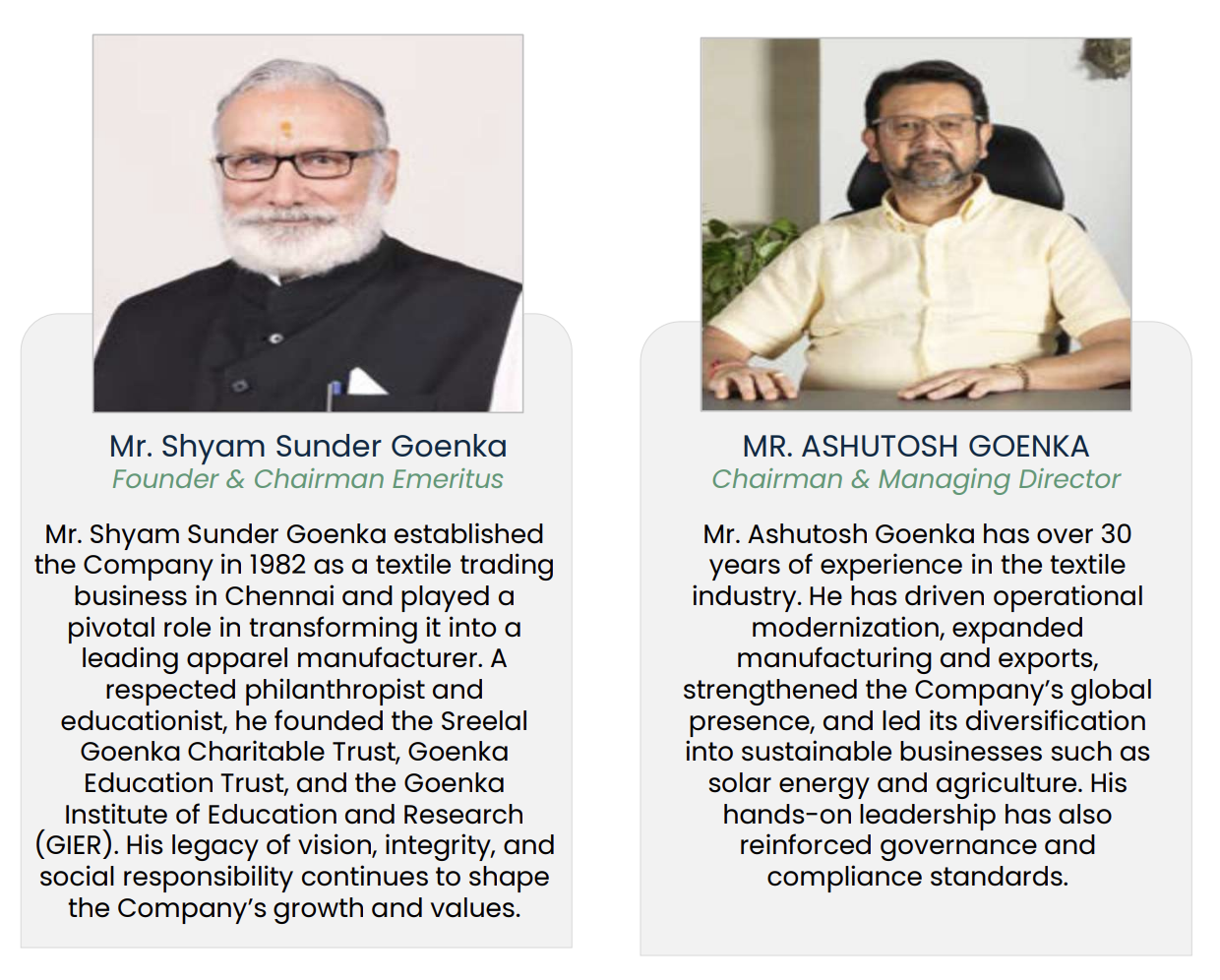
Meenakshi (India) Limited began in 1982 as a textile trading business in Chennai, founded by Shyam Sunder Goenka. Manufacturing followed in 1991, with a first factory at Ambattur. In 1993 the company bought 280 acres of farmland at Sirumalai, Dindigul, for coffee, pepper and seasonal fruit. That agriculture arm would matter to the accounts three decades later.
Manufacturing moved to Salem in 1996, and Unit 2 followed in 2001. Capacity doubled in 2006, with expansion into bottom wear and outerwear. The same step added washing, laundry and embroidery in-house. Unit 3 arrived in 2011, taking capacity to 100,000 garments a month across three Salem sites. Turnover crossed ₹50 crore in 2013 and ₹100 crore in 2018. A 248 KW rooftop solar plant went up on the largest facility in 2023, covering half its energy needs. Unit 3 was expanded by half the same year, to 150,000 garments a month, and athleisure joined the range.
A corporate reshuffle followed in 2025. The company issued 75,00,000 bonus shares in a 2:1 ratio, which are free shares handed to existing holders in proportion to what they already own. Authorised capital rose from ₹5 crore to ₹15 crore, and paid-up capital to ₹11.25 crore. Certain bonus shares belonging to holders without valid demat details sit in the company’s Unclaimed Securities Suspense Escrow Account. They are claimable once formalities are complete.
In July 2026 the equity shares listed on BSE Limited by the direct listing route. The Calcutta Stock Exchange listing continues alongside it. The board met on 5 August 2026 and approved the June quarter results. Chaturvedi & Co LLP, the company’s auditor, issued a Limited Review Report on them. The 44th annual general meeting was convened for 28 September 2026, by video conferencing.
Recent filings are largely housekeeping. One is a newspaper notice on the special window for transferring and dematerialising physical shares into electronic form. Another is the earnings call transcript from 7 August. A third confirms that Regulation 32 does not apply, as there were no issue proceeds during the quarter. That is the tidiest possible consequence of listing without raising a rupee.
Ashutosh Goenka, chairman and managing director, has over 30 years in the textile industry. Shubhang Goenka, whole-time director, holds an MBA from Saïd Business School. Vivek Bahety, the chief financial officer, is a qualified chartered accountant and company secretary with over 14 years of experience.
US
Now live
US Stocks terminal is live
13,000+ US tickers · EDGAR fundamentals · screener and filings feed — the same terminal, for American markets.
Explore →
3 — Business Model: WTF Do They Even Do?
The company makes trousers. Premium ones. Woven bottom wear for global brands, out of Salem.
That sentence undersells about four decades of specialisation. Management’s stated positioning is that it never tried to be the lowest-cost maker. The stated aim is to be the most trusted manufacturing partner instead. Management names its competitive ground as quality, wash effects, product complexity and compliance. Bottomwear specialisation began under the quota era before 2005. When the quotas went, the company doubled down rather than diversifying.
The wash is the party trick. There are three comprehensive treatment washing machines, two hydra extractors and four high-capacity dryers. Sixteen specialised wash types run across them. In-house washing is common in the trade. Management’s claim is that the effects are distinct, and that a Meenakshi fade has a signature. Somewhere in Salem sits a machine whose whole job is making new denim look like it survived a decade it never lived through.
Annual stitching capacity is 18 lakh pieces across three facilities, running at 65% use. There are 1,200 skilled workers, and on-time delivery is reported at 98%. The company supplies more than 20 global and domestic brands and exports to 12 countries. Exports are 83% of revenue, and more than 350,000 organic cotton garments leave each year. Half the energy at the largest plant comes from solar.
Geography in the year to March 2026 was led by Europe at 58.66% and the United States at 27.12%. Asia Pacific took 10.86%, Oceania 3.14% and other markets 0.23%. Management says the historical split runs closer to half Europe and half the United States. Management attributes the current tilt towards Europe to a slowdown in the United States.
Concentration is the shape of the business rather than a footnote to it. The top five customers are around 70% of revenue, and the top ten above 95%. There are roughly 12