1. At a Glance – Blink and You’ll Miss the Drama
Mangal Credit & Fincorp Ltd is that quiet NBFC sitting in the corner of the financial party, sipping cutting chai, growing steadily, and refusing to shout. As of the latest close, the stock trades at ₹158, with a market cap of ₹336 Cr, a P/E of ~26.6, and a price-to-book of 2.1x. In the last three months, the stock is down about 12%, which honestly feels more like mood swings than a business collapse.
The latest Q3 FY26 (December 2025 quarter) numbers show revenue of ₹18.31 Cr, up 44.4% YoY, while PAT came in at ₹3.83 Cr, up 10% YoY. That gap between revenue growth and profit growth? Yes, we’ll talk about it — that’s where the masala is.
Return ratios remain modest: ROE ~9.9%, ROCE ~12.2%, and debt-to-equity at 1.75x. This isn’t a Ferrari NBFC. It’s more like a well-maintained WagonR that just refuses to break down. The question is: is that enough at 26x earnings?
2. Introduction – Small NBFC, Big Ambitions, Average Returns
Incorporated in 2012, Mangal Credit & Fincorp is a non-deposit taking, non-systemically important NBFC. Translation for normal humans: RBI doesn’t lose sleep over it, but still keeps an eye.
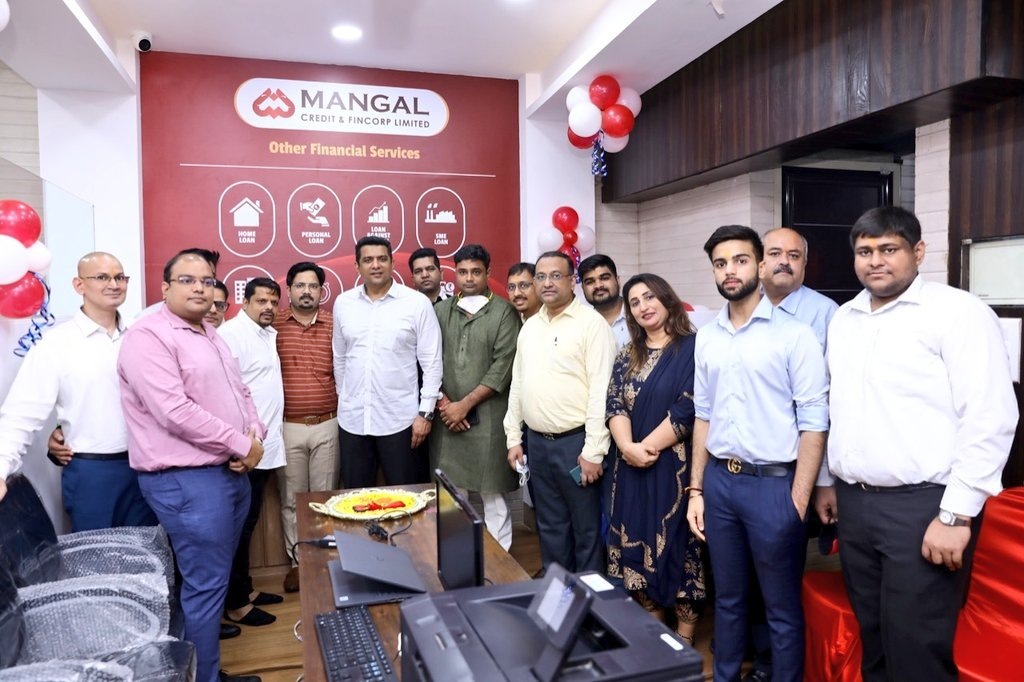
The company operates through 8 branches — 6 in Maharashtra and 2 in Gujarat — with recent additions in Panvel and Badlapur, and expansion plans in Odisha and West Bengal. This is not blitz-scaling like fintech bros on LinkedIn. This is old-school, branch-by-branch grinding.
Over the years, MCFL has transitioned from being a tiny lender into a ₹450 Cr balance sheet NBFC. Revenue has compounded at 25% over 5 years, while profits… well… profits have been a bit moody. Five-year profit CAGR is barely 4%, though the last three years look healthier at ~30%.
So yes, growth is visible. But consistency? That still needs attendance.
3. Business Model – WTF Do They Even Do?
Think of Mangal Credit as a secured-loan-heavy neighbourhood financier with ambition issues (in a good way). The loan book is diversified across four products:
- Business Loans (~49%) – MSME-focused, ticket sizes meaningful, yields decent, but credit risk always lurking like a stray dog.
- Gold Loans (~25%) – The safest kid in the class. Short tenure, liquid collateral, instant liquidity if things go wrong.
- Loan Against Property (~24%) – Long-term secured loans, lower yields, but stable.
- Personal Loans (~2%) – Almost irrelevant, and honestly, thank God.
The company has consciously increased its secured loan mix to ~50%+, up from 38% in FY22. That’s a very NBFC-auditor-approved move.
Revenue-wise, interest income contributes ~93%, with negligible dependence on fees or other income. No fancy financial engineering here — lend money, collect interest, repeat.
The real differentiator?