Keerthi Industries Ltd Q2 FY26 – The Cement Maker That Wanted To Be a Tech Start-up (and a Power Generator, and a Sugar Baron)
1. At a Glance
Welcome to the curious case of Keerthi Industries Ltd, a company that’s been in cement since 1982 but has since tried almost every business under the Indian sun — from printed circuit boards to windmills, and even sugar and distillery dreams. If diversification was a sport, Keerthi would be an Olympic contender.
As of 03 December 2025, the stock trades at ₹73, giving it a market cap of ₹58.5 crore. The past 3-month return? A polite -5.7%, which is market-speak for “nothing’s working, boss.”
Financials aren’t exactly a love story either — Sales of ₹22.5 crore this quarter, PAT of -₹5.43 crore, and Operating Profit Margin of -15.6%. The ROE stands at a jaw-dropping -44% and ROCE at -24.5% — the kind of numbers that make even auditors reach for black coffee. Debt sits at ₹55 crore, which gives a Debt-to-Equity of 1.68 — quite the load for a company barely making operating profits.
Promoters hold 67.2%, though they’ve pledged 44.6% of that — a red flag waving harder than an IPL cheerleader.
So, what’s the story? Keerthi just sold its Electronics Division to Hyderabad Bottling Co. for ₹36 crore, supposedly to clean up the debt mess. Let’s find out if this “slump sale” will be the redemption arc, or just another chapter in the company’s tragicomic diversification diary.
2. Introduction
Keerthi Industries started in 1982 with a straightforward dream — make cement, sell it, make money. Simple. Then, like every Indian uncle who thinks he can run three side businesses at once, Keerthi thought: “Why stop there?”
So it went from cement to wind power, printed circuit boards, and is now building a sugar-cum-distillery project in Karnataka. Because, obviously, nothing says synergy like mixing cement dust with ethanol fumes.
For four decades, the company’s journey has been like an episode of Shark Tank where the entrepreneur keeps pivoting mid-pitch. From Suvarna Cement to Hyderabad Flextech PCBs, Keerthi’s management has explored everything except consistency.
And now, 2025 marks another pivot — the slump sale of its Electronics Division for ₹36 crore. Maybe it’s the “back to basics” moment. Or maybe it’s the classic “sell one arm to keep the other waving” strategy. Either way, this quarter gives us plenty of data and drama to unpack.
3. Business Model – WTF Do They Even Do?
Let’s break it down, because Keerthi’s business model is like a buffet — wide, confusing, and you’ll probably regret trying everything.
a) Cement Division: This is the core bread and butter (or rather, dust and clinker). Keerthi makes 43 & 53-grade OPC and PPC Cement under the brand Suvarna. It’s sold mainly in South India, through distributors in Andhra Pradesh, Telangana, and Tamil Nadu.
b) Power Division: They had a 1,500 KVA wind power plant in Hassan, Karnataka, managed by Suzlon. Sounds great, right? Except it didn’t work. Operational issues piled up, and the company finally sold this division in February 2023. Farewell, windmills.
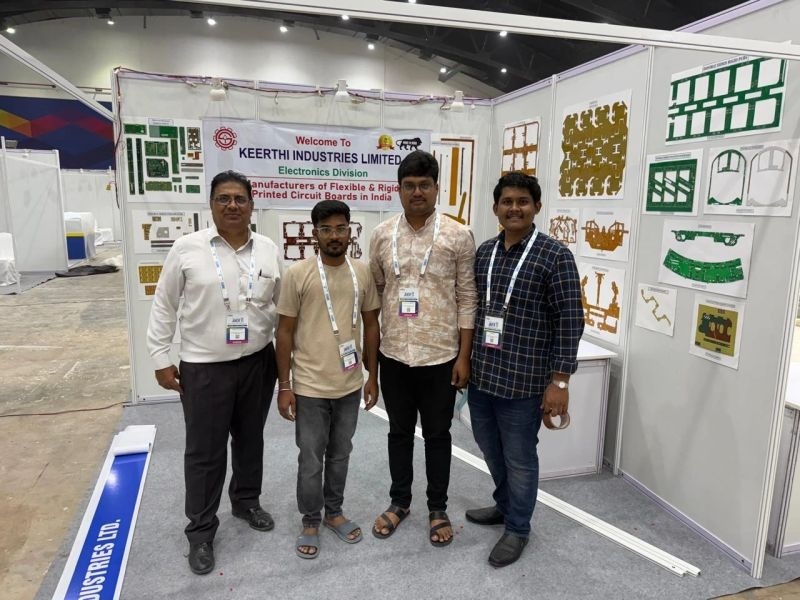
c) Electronics Division: Originally part of Hyderabad Flextech Ltd, this arm made Flexible and Rigid PCBs for export markets. Modernization projects worth ₹10 crore were underway, but in 2025, Keerthi decided to sell it for ₹36 crore. Apparently, the circuit wasn’t connecting financially.
d) Sugar Division: An “integrated sugar project” with 3,500 TCD capacity, 26 MW co-gen plant, and 50 KLPD distillery is being set up in Yadagir, Karnataka. Land’s bought, plans made — but still under setup. Translation: “Coming soon, maybe.”
e) Oilfield & Natural Gas Division: No progress. Which is corporate speak for: “We just put it in the brochure.”
If diversification kills focus, Keerthi is living proof.