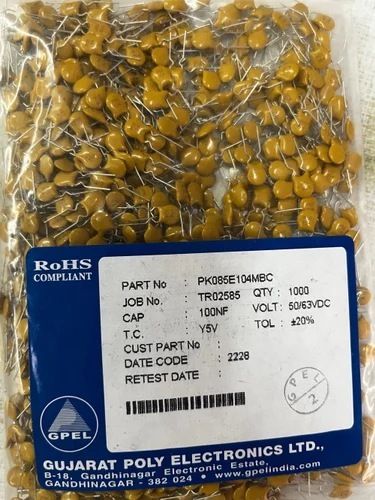
If you thought ceramic capacitors were boring, Gujarat Poly Electronics Ltd (BSE: 517288) is here to prove you wrong. With a market cap of ₹58.9 crore and a stock that recently tumbled 6.78% to ₹68.9, this tiny capacitor maker from Gandhinagar is suddenly trending — and not for new product launches, but for a juicy ₹29 crore land deal that’s shaking up its balance sheet harder than its capacitors ever could.
The stock trades at a P/E of 13.6, a decent discount to the industry P/E of 32.8, suggesting either hidden value or hidden drama. Return on Equity (ROE) stands tall at 20.8%, but sales growth is crawling at 5.52% over five years — like a capacitor trying to charge with a dying battery.
Last quarter (Q2 FY26), the company reported sales of ₹4.47 crore, down 4.69% QoQ, and a PAT of ₹0.42 crore, down 25% QoQ. But here’s the kicker — despite its mini-size, the company’s interest coverage ratio is 117. Translation: it doesn’t owe much, and whatever it owes, it can pay easily.
It’s not every day a company with ₹17 crore annual sales sells property worth ₹29 crore — and that’s why every analyst with a calculator suddenly has GPEL on their radar.
2. Introduction
Back in 1992, Gujarat Poly Electronics Ltd (GPEL) entered the world of ceramic capacitors — those tiny, cylindrical, unglamorous bits that make your phone, TV, and washing machine actually work. Thirty-three years later, they’re still doing the same thing, except now they’ve added a dash of trading, a sprinkle of property monetization, and a few boardroom twists that would make any finance soap opera proud.
In FY10, the company was literally declared “sick” by the BIFR (Board for Industrial and Financial Reconstruction). But instead of becoming a corporate ghost, it turned around through a rehabilitation scheme that wrote off ₹29 crore in interest dues — the kind of forgiveness most humans only dream of.
Fast forward to FY26, and the once “sick” company is flipping factory plots like a pro real estate developer. The ₹29 crore land sale to Tirex, followed by a ₹3.65 crore new factory acquisition, shows that this management knows how to do asset yoga — sell on one side, buy on the other, and keep the books balanced.
But the key question is: are these transactions part of a serious restructuring plan, or just balance sheet fireworks before Diwali? Let’s crack open the capacitor casing and find out.
3. Business Model – WTF Do They Even Do?
At its heart, Gujarat Poly Electronics makes ceramic capacitors and varistors — the electrical world’s equivalent of silent warriors. They store, release, and regulate current like zen monks keeping voltage tantrums under control.
Trading portfolio – Diodes and other components, sourced from import suppliers.
Their customers? OEMs (Original Equipment Manufacturers) and EMS (Electronic Manufacturing Services) firms that make everything from computers to telecom equipment, industrial automation systems, and consumer gadgets.
Now, before you get too excited — the company isn’t exactly a domestic MLCC powerhouse like Murata or TDK. In fact, GPEL imports much of its portfolio, rebrands, and trades it in India. It’s like a capacitor middleman — a merchant navy officer in the electronics world, moving cargo between factories.
And yes, they’re a dealer for Diotec Semiconductors, because when you can’t build billion-dollar fabs, you can at least sell diodes with a smile.
4. Financials Overview
Here’s how the company performed in Q2 FY26 (Sep 2025) versus the same quarter last year and the previous one:
Metric
Latest Qtr (Sep’25)
YoY Qtr (Sep’24)
Prev Qtr (Jun’25)
YoY %
QoQ %
Revenue
₹4.47 Cr
₹4.69 Cr
₹4.67 Cr
-4.7%
-4.3%
EBITDA
₹0.37 Cr
₹0.50 Cr
₹0.50 Cr
-26%
-26%
PAT
₹0.42 Cr
₹0.56 Cr
₹2.83 Cr
-25%
-85%
EPS (₹)
0.49
0.65
3.31
-25%
-85%
The quarterly EPS of ₹0.49 annualizes to ₹1.96, giving a forward