General information and education, not investment advice. The author is not a SEBI-registered adviser or research analyst. No recommendation, no promised returns. Markets carry risk including loss of capital. Figures may not be current. Always consult a SEBI-registered adviser.
1. At a Glance
KEC International builds power transmission lines, railway systems, cables and buildings. Revenue for the three months to June 2026 was ₹5,024 crore. A year earlier it was ₹5,023 crore, a movement of about one crore. On a base that size, the company stood perfectly still and held its breath.
Operating profit was ₹291 crore, against ₹350 crore a year earlier. That is a fall of 17 per cent. Profit after tax came in at ₹72.6 crore, against ₹124.6 crore. That is a fall of 42 per cent. Earnings per share, the profit attached to a single share, was ₹2.73 against ₹4.68.
Management said performance could have been better but for the West Asia crisis, a shortage of labour and slower execution in water projects. The results presentation chose the word resilient for its headline.
The order book stood at ₹37,697 crore at the end of June. Adding work where KEC is the lowest bidder but not yet awarded, the figure passes ₹40,000 crore. Management puts the tender pipeline it is chasing at over ₹2 lakh crore. Order intake for the three months was ₹6,303 crore, more than the revenue booked.
Net debt, including acceptances, fell by more than ₹150 crore to ₹6,568 crore. Acceptances are short-term, bank-backed payments owed to suppliers. That figure is as on 30 June 2026. Interest cost for the quarter was ₹164 crore, or 3.3 per cent of sales. Management’s stated expectation for the full year is about 2.3 per cent.
Cables and conductors revenue grew 57 per cent to ₹601 crore. Transportation revenue fell 45 per cent to ₹259 crore. Section 4 carries the full segment story.
2. Introduction
KEC International is the flagship company of the RPG Group. The group traces its business history back to 1820, in banking, textiles, jute and tea, and was founded in its current form in 1979. It now reports annual gross revenues of 5.2 billion US dollars. Those revenues span infrastructure, tyres, pharmaceuticals and information technology, alongside plantations and speciality businesses. One group company sells tea and another builds 765 kV substations, filed under the same annual report.
KEC itself carries what the company calls eight-plus decades of experience. It reports a footprint in more than 110 countries and over 250 ongoing projects. It employs more than 7,800 people across over 40 nationalities. The auditor’s annexure lists 41 branches, among them Abu Dhabi, Afghanistan, Algeria and Armenia, and the roll continues through Bangladesh, Benin and Burkina Faso. Alongside those sit 34 jointly controlled operations and 16 subsidiaries. Price Waterhouse, the auditor, relied on branch auditors and other auditors to cover that set.
The recent stretch has been eventful in ways that show up in the filings. On 26 June 2026, PGCIL, the state-owned power grid company, revoked KEC’s exclusion order, and the company was free to bid again immediately. India Ratings, a credit-rating agency, had noted that the exclusion ran nine months from 18 November 2025. The same agency noted that order inflow during the year to March 2026 still reached roughly ₹25,000 crore.
In May 2026 the board approved the results for the year to March 2026. It also approved a dividend of ₹5.50 a share and the merger of wholly owned subsidiary KEC Spur Infrastructure into KEC International.
The auditor’s limited review report for this quarter draws attention to Note 6. A government agency is investigating a matter connected with a transmission project, involving one official of a public sector company and one KEC employee. A chargesheet has been filed and the court has taken cognizance, meaning it has agreed to hear the case. The company states that the matter is sub-judice, or before a court, and says it will have no material impact on operations or financial results. The auditor’s conclusion is not modified in respect of the matter.
The year to March 2026 closed with revenue of ₹23,506 crore and profit after tax of ₹606 crore. The order book at that date stood at ₹36,267 crore.
US
Now live
US Stocks terminal is live
13,000+ US tickers · EDGAR fundamentals · screener and filings feed — the same terminal, for American markets.
Explore →
3. Business Model: WTF Do They Even Do?
KEC builds the things electricity travels along and the things trains travel along. Increasingly it also builds the buildings inside which everything else happens.
Transmission and distribution is the anchor, at 68 per cent of revenue in the year to March 2026. The year before, the same segment accounted for 59 per cent. The work covers transmission lines, underground cabling, substations of several kinds and HVDC systems, which move power over long distances as direct current. Air-insulated substations run up to 1150 kV, a measure of voltage, while gas-insulated ones reach 765 kV. Hybrid substations go up to 220 kV. The voltage ceiling drops as the technology gets more compact.
Civil work was 16 per cent of revenue in the year to March 2026. It spans factories, buildings, public spaces and water pipelines, and extends to water treatment plants, data centres, hospitals, logistics and warehouses. The company is currently constructing roughly 80 high-rise buildings across the major metros. A business that started life making transmission towers now counts marquee automobile clients and high-rise residential among its work.
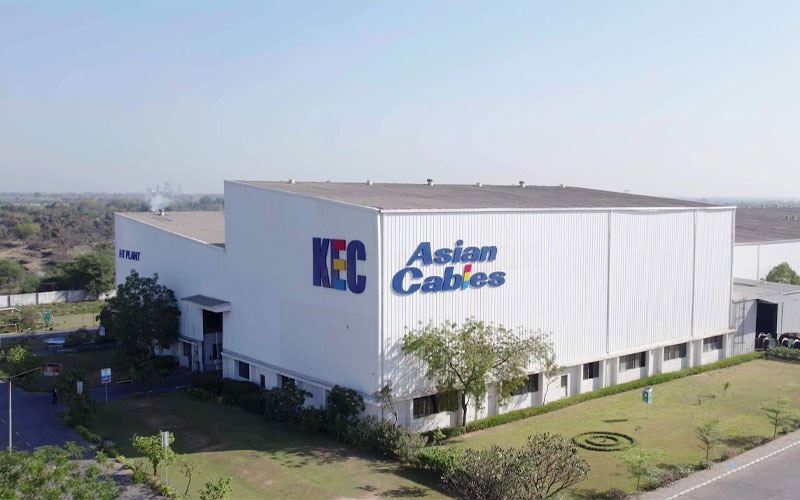
Cables took 9 per cent and run through the subsidiary KEC Asian Cables. The catalogue covers extra-high, high and low voltage power cables, telecom and optical fibre. It adds control and instrumentation cables, railway