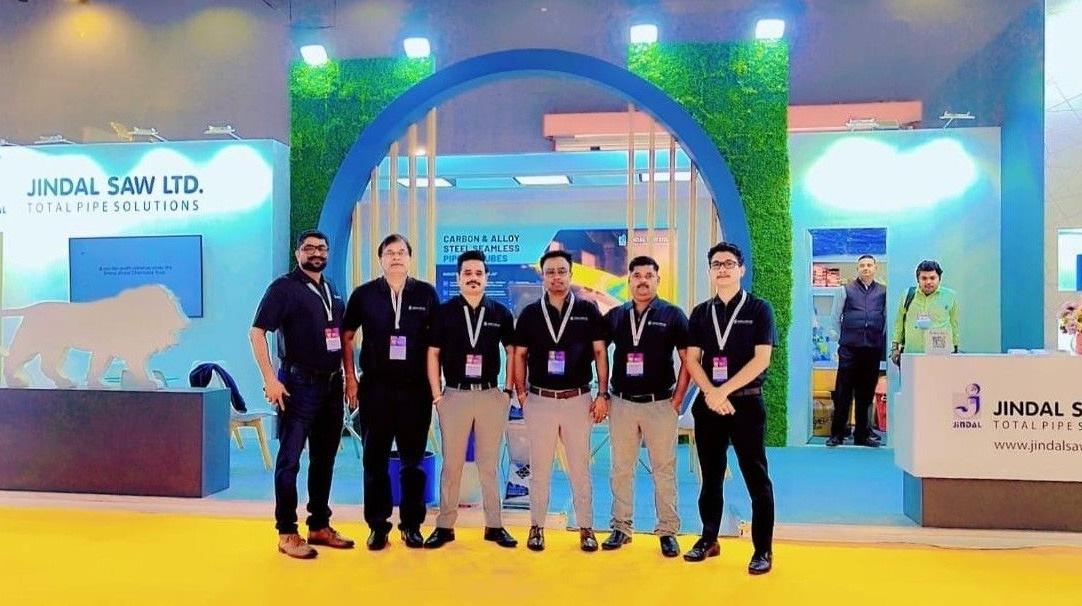
Jindal Saw Ltd Q4 FY26: Earnings Halved as MENA Blockade and API License Suspension Choke High-Margin Execution
1. At a Glance
The capital goods and steel pipeline landscape is unforgiving. Jindal Saw Ltd, a prominent player in the global coated and bare pipe market and the world’s third-largest producer of rust-free iron pipes, is experiencing a sharp shift in its operating reality. Investors tracking the company’s multi-year structural upcycle have been hit with a stark reminder of geopolitical and regulatory vulnerabilities.
The consolidated financial statements for the quarter ended March 31, 2026, reveal a notable contraction. Quarterly profits halved, with Net Profit plunging 52.1% year-on-year to ₹123.68 crore, down from ₹248 crore in the preceding quarter.
This drop is not driven by a lack of demand. The company is backed by a standalone order book of $1,317 million (~₹12,180 crore) and an independent UAE order book of $180 million. Instead, the current challenges stem from an inability to execute and deliver high-margin volumes.
A severe logistical blockade in the MENA region, triggered by conflict escalation in February 2026, led to the invocation of force majeure clauses. This effectively halted all seaborne export shipments from March 2026 onward. Because export orders historically yield superior margins compared to price-sensitive domestic infrastructure contracts, this disruption severely impacted profitability.
Compounding this external shock, an internal compliance failure emerged at the Nashik seamless pipe unit. Following an American Petroleum Institute (API) audit, critical non-compliances led to the temporary suspension of the prestigious API monogram license. This barred Jindal Saw from supplying high-value carbon seamless pipes to premium oil and gas drillers, forcing a less profitable shift toward non-API alternative grades.
Meanwhile, domestic ductile iron (DI) operations are dealing with a sluggish execution cycle under the Jal Jeevan Mission (JJM). This has left massive capacities underutilized amidst an emerging domestic oversupply.
With escalating inventory days, a sharp ₹48 crore unhedged foreign exchange revaluation hit from a depreciating rupee, and a notable drop in return metrics, the company’s financial momentum is facing clear headwinds. This raises a key question for the market: Is this a temporary delivery delay, or is it a sign of a structural shift in the company’s risk profile?
2. Introduction
Jindal Saw Ltd, the industrial anchor of the PR Jindal Group, operates a complex global manufacturing network. It produces longitudinal submerged arc welded (LSAW) pipes, helical submerged arc welded (HSAW) pipes, ductile iron (DI) water mains, seamless industrial tubes, and iron ore pellets.
The company’s footprint spans 12 manufacturing plants across seven Indian states, backed by low-grade iron ore mines in Bhilwara, Rajasthan, held under a 50-year lease. This domestic integration is paired with an international processing footprint, including the Jindal Saw Gulf LLC operations in Abu Dhabi and active joint ventures in Saudi Arabia.
For multiple quarters, the narrative surrounding the stock focused on margin expansion, driven by India’s water transmission spending and global oil and gas capex. However, cyclical commodity businesses often face sudden reversals.
The latest financial results show a clear break from past growth trends. Consolidated Total Income for FY26 fell 14.1% to ₹17,895 crore, down from ₹20,958 crore in FY25. The impact on profitability was even more pronounced, as consolidated EBITDA contracted 35% to ₹2,306 crore, down from ₹3,548 crore in the previous year.
The core issue is that industrial pipe manufacturing involves high fixed costs and complex logistics. When critical maritime choke points in the Persian Gulf close, inventory builds up at the ports, and cash becomes tied up in working capital.
Management emphasizes that 30,000 to 40,000 tons of high-margin export orders are sitting ready for shipment, framing the drop as a deferment rather than a loss of business. However, the financial reality remains: fixed operating overheads continue to accumulate, while cash collections are delayed.
Furthermore, structural capacity additions in the domestic DI pipe segment across the industry have outpaced real-time ground execution by engineering, procurement, and construction (EPC) contractors, shifting pricing power away from manufacturers.
3. Business Model – What Do They Do?
To understand Jindal Saw’s business model, one must look past the complex engineering terminology. The company essentially functions as a large-scale structural plumbing operator for heavy industry, global energy providers, and national water utilities.
They extract low-grade iron ore from their Rajasthan mines, upgrade it via a beneficiation plant into iron ore pellets, and feed it into manufacturing lines to produce various types of pipe.
The portfolio is divided into two main categories: water infrastructure and energy/industrial applications. For water networks, they manufacture DI and HSAW lines designed to handle regional distribution pressures. For the oil, gas, and petrochemical sectors, they produce high-specification LSAW and seamless tubes engineered to withstand corrosive environments and deepwater pressures.
The company aims to balance its portfolio between domestic public sector infrastructure and international commercial energy contracts. The domestic water business is stable but lower-margin, heavily reliant on government budgets and state-level EPC spending.
Conversely, the international oil and gas segment offers higher margins but carries geopolitical risks. When international energy capital flows freely, order books expand quickly. However, shipping these heavy steel structures requires open, stable maritime lanes.
The company’s current challenges highlight the vulnerabilities in this setup. A pipe manufacturer cannot easily pivot to air freight when shipping lanes are disrupted.
Similarly, production lines designed for high-margin API-certified seamless pipes cannot be easily reconfigured for alternative industrial uses without a significant drop in realisable margins. This leaves the company holding substantial buyer-supplied raw materials, such as the 2 lakh tons of steel held for a Saudi water order, which cannot be processed or shipped due to prevailing logistics constraints.
4. Financials Overview
A detailed review of Jindal Saw’s recent financial performance highlights the extent of the margin pressure across its operations.
Consolidated Financial Performance Comparison
The following table outlines the company’s key financial metrics, comparing the latest quarter with the same period last year and the immediate preceding quarter.
Metric
Latest Quarter (Q4 FY26)
Same Quarter Last Year (Q4 FY25)
YoY Change (%)
Previous Quarter (Q3 FY26)
QoQ Change (%)
Revenue
₹4,633.48 cr
₹5,046.70 cr
-8.19%
₹4,943.00 cr
-6.26%
EBITDA
₹504.20 cr
₹757.10 cr
-33.40%
₹632.20 cr
-20.25%
PAT
₹123.68 cr
₹258.40 cr
-52.14%
₹248.00 cr
-50.13%
Reported EPS
₹2.18
₹4.55
-52.09%
₹4.03
-45.91%
Annualised EPS
₹8.72
₹18.20
-52.09%
₹16.12
-45.91%
Historical Earnings and Management Commitments
The annualised EPS of ₹8.72, calculated directly from the latest official quarterly disclosure, marks a significant drop from the full-year FY25 EPS of ₹27.18.
Analyzing past conference calls shows where management’s expectations diverged from actual performance. In late 2025, leadership projected that Q4 FY26 would show a sequential recovery over Q3, driven by a strong pipeline of export orders and steady domestic dispatches.
Instead, the escalating conflict in the MENA region disrupted these plans. The suspension of seaborne export