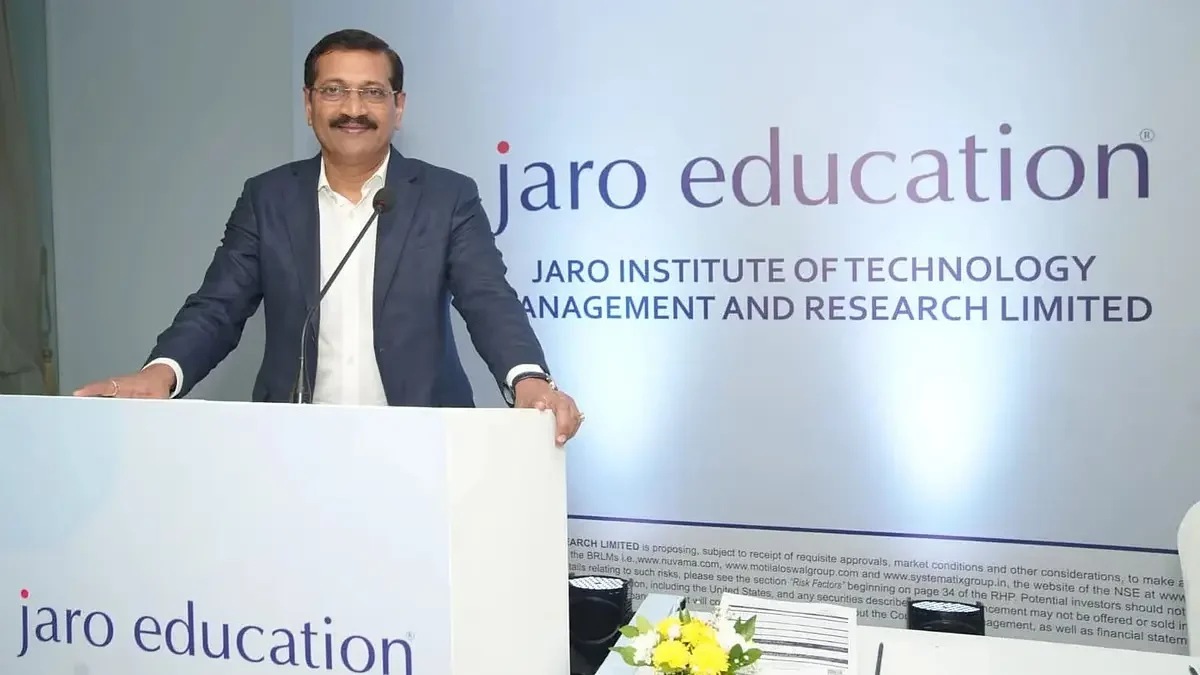
Jaro Institute of Technology Management and Research Ltd is trying to prove that you can sell elite education without burning the house down for “valuation.” Having listed on September 30, 2025, the company just closed its first full financial year as a public entity. The numbers are out, and they paint a picture of a business that is growing its top line but feeling the weight of its own expansion.
The headline for FY26 is a Revenue from operations of ₹273.88 cr, a modest growth over the previous year, but the real story lies in the quarterly volatility and the massive jump in working capital days. While management talks about “strong execution,” the cash flow statement shows they are fighting a battle to keep the money coming in as fast as they spend it on marketing and new centers.
1. At a Glance
Jaro Institute operates in the high-stakes world of online higher education and upskilling. Unlike the venture-funded “EdTech” giants that went up in smoke, Jaro has branded itself as a profitable, bootstrapped survivor. It serves as a bridge between Tier-1 institutions like 7 IIMs and 7 IITs and working professionals looking to add a “brand” to their CV.
However, the “At a Glance” view for FY26 shows some emerging cracks in the armor. While the company reported a Net Profit of ₹52.92 cr, the growth rate has cooled down significantly compared to the triple-digit explosions seen in the past. The Market Cap of ₹883 cr reflects a market that is skeptical, especially with the stock trading significantly below its IPO highs.
Investors are watching two things: the ARPU (Average Revenue Per User) which has climbed to ₹84,000, and the Working Capital Days which have ballooned to a staggering 388 days. That is over a year of revenue locked up in the system. If you are an investor, you should be asking why a “tech-enabled” platform is behaving like a slow-moving construction company when it comes to cash cycles.
The company has expanded into Tier-2 and Tier-3 markets with new centers in Kolkata and Indore, but this “reach” comes at a cost. The Learner Acquisition Cost (LAC) is rising as they onboard new partnerships. Management claims this is “calibrated investment,” but in plain English, it means the easy growth is over and they are now paying more to find the next student.
2. Introduction
Jaro Institute is not a content creator; it is a high-end distributor. It handles the “peripheral” work—marketing, sales, technology, and student support—while the likes of IIT Madras and IIM Ahmedabad handle the curriculum and the degrees. It’s a middleman model that relies on the prestige of the partner institution.
The company has a pan-India presence with 22 learning centers and 17 tech studios inside IIM campuses. This physical infrastructure is their “moat,” or so they claim. It allows them to offer a hybrid experience that pure-play online apps can’t match.
In FY26, the company shifted its focus toward higher-fee programs. The logic is simple: it takes the same amount of effort to sell a ₹2 lakh program as it does a ₹3 lakh program. By pushing the “premium” programs, they hope to protect their margins from the rising costs of digital advertising.
But the competition is stiff. With players like Physicswallah and Veranda Learning expanding their reach, Jaro is no longer the only game in town for professionals. The recent exclusive partnership with J.K. Shah for online commerce coaching is a move to diversify away from just MBAs, targeting a massive pool of 4.2 million learners.
3. Business Model – WTF Do They Even Do?
Jaro is essentially the “Apple Store” for executive education. They don’t write the books; they just make the experience of buying the education very smooth.