General information and education, not investment advice. The author is not a SEBI-registered adviser or research analyst. No recommendation, no promised returns. Markets carry risk including loss of capital. Figures may not be current. Always consult a SEBI-registered adviser.
1. At a Glance
Inox Green Energy Services looks after wind turbines and solar plants that other companies own. Revenue from operations for the three months to June 2026 was ₹43.3 crore. The same quarter a year earlier brought ₹56.2 crore. Operating profit was negative ₹0.94 crore.
Net profit was ₹40.7 crore, against ₹22.0 crore in the June 2025 quarter. Earnings per share were ₹1.01, against ₹0.60. Other income for the quarter was ₹57.9 crore, which is larger than revenue from operations. For one quarter, the footnote out-earned the business it is a footnote to. Management’s own explanation for part of that line appears in the financials section.
The quarter also carried corporate events, which is not guaranteed at a company this size. The demerger of the power evacuation business became effective, with a record date of 1 August 2026. NCLT Ahmedabad, the tribunal that hears company restructuring cases, approved the acquisition of Wind World India’s roughly 4.5 GW wind maintenance portfolio. Machine availability across the fleet stood at 96.3%.
The company states a maintenance portfolio of about 13.3 GWp as of June 2026. GWp means gigawatt peak, the maximum output the machines are rated for. The comparable figure was about 3.2 GW as on March 2024, so the number has grown for two years. Depreciation for the quarter was ₹0.42 crore. The balance sheet carried ₹704 crore of net block a year before the demerger.
2. Introduction
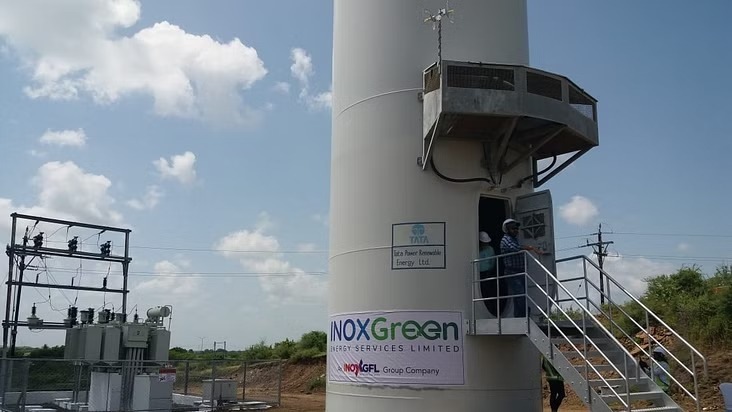
Inox Green was incorporated in 2012 as a wholly owned subsidiary of Inox Wind Ltd. It was built to do the unglamorous half of the wind business. Somebody else cuts the ribbon, and Inox Green keeps the turbines spinning afterwards. Fourteen years on, it describes itself as India’s only listed pure-play renewable operations and maintenance service provider. That is a category with exactly one listed member.
The parent sits inside the INOXGFL group. The company’s own presentation calls the group a USD 16 billion conglomerate with a legacy of over nine decades. The presentation lists its businesses as fluoropolymers, fluorochemicals, battery chemicals and wind turbines. It adds EPC, renewable operations and maintenance, solar cells and modules, and renewable power generation. EPC means engineering, procurement and construction: designing and building the plant itself.
Inox Green’s slot in that group is narrow and clearly drawn. Inox Wind builds and sells the turbines. Inox Renewable Solutions does the EPC and the evacuation infrastructure, which carries power from the plant to the grid. Inox Clean Energy owns and operates renewable assets. Inox Green maintains what the others put in the ground.
Recent history has been structural rather than operational. In November 2024 the board approved the demerger of the power evacuation business into Inox Renewable Solutions. NCLT Ahmedabad sanctioned the scheme on 13 March 2026, and it became effective on 4 May 2026. Shareholders on the record date of 1 August 2026 received shares in the resulting company. The ratio was 122 IRSL shares for every 1,000 Inox Green shares held.
In February 2026 an INOXGFL consortium was declared successful resolution applicant for Wind World (India) Ltd. Inox Green takes the roughly 4.5 GW maintenance portfolio out of that process. In July 2026 the board approved a fund raise of up to ₹600 crore. Through all the rearranging, the turbines carried on turning, which is the actual job. The 26th extraordinary general meeting, held on 13 August 2026, passed fund-raising and related-party transaction resolutions.
US
Now live
US Stocks terminal is live
13,000+ US tickers · EDGAR fundamentals · screener and filings feed — the same terminal, for American markets.
Explore →
3. Business Model: WTF Do They Even Do?
Inox Green signs long-term contracts to operate and maintain wind turbine generators and solar plants. It also maintains the common infrastructure that connects those plants to the grid. Contracts run 5 to 20 years, with tenors stated up to 25 years. The revenue arrives as an annuity: a fee per megawatt, escalating, for as long as the machine runs.
The company splits maintenance into two approaches. Reactive maintenance means a component fails and somebody then fixes it, which produces long downtime. Predictive maintenance means detecting the failure before it happens. Inox Green describes itself as focused on the second. It lists round-the-clock centralised monitoring, SCADA analysis, an SAP HANA upgrade in progress and a mobile maintenance tool under development. SCADA is the software that watches machines remotely and records what they are doing.
On top of the base contracts sit value-added services. These include refurbishment, booster sales, overhauls and life extension. Carbon credit trading is on the same list. Management’s life-extension pitch is to push turbine life from around 25 years towards 35. The machine already sold to a customer is then sold to them again, slowly, over a decade.
The disclosed portfolio spreads across eleven states. Gujarat, Rajasthan, Madhya Pradesh and Maharashtra carry part of it. Andhra Pradesh, Karnataka, Tamil Nadu and Kerala carry more. Uttar Pradesh, Uttarakhand and Haryana complete the list. Kerala holds 16 MW of wind, which is a keychain in a portfolio measured in gigawatts.
Customers are independent power producers, state-owned firms and corporates. The company’s disclosures name Gujarat Fluorochemicals, Torrent Power, Shree Cement and Gujarat Industries Power among them.
The stated portfolio of about 13.3 GWp as of June 2026 includes