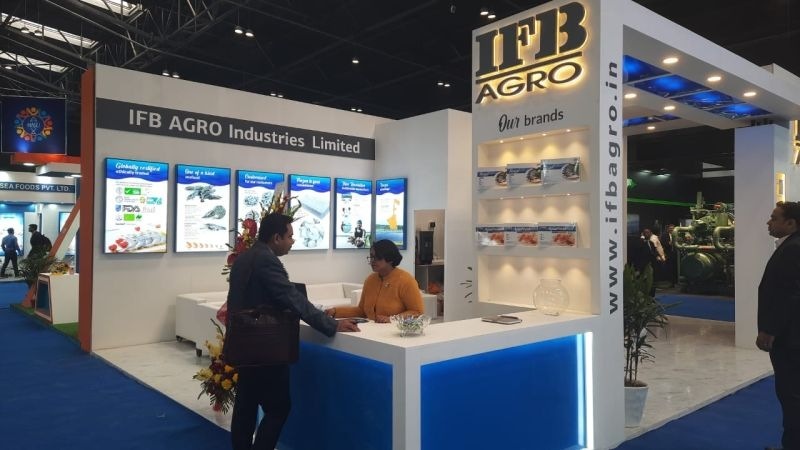
IFB Agro Industries FY2026: ₹60.9 Cr PAT on ₹1,404 Cr Revenue, Multiple Compression Amid Margin Squeeze
General information and entertainment, not investment advice. The author is not a SEBI-registered adviser or research analyst. No recommendation, no promised returns. Markets carry risk including loss of capital. Figures may not be current. Consult a registered adviser before acting.
1. At a Glance
IFB Agro reported FY2026 revenue of ₹1,404 Cr, up 33% YoY from ₹1,059 Cr in FY2025.
Net profit landed at ₹60.9 Cr versus ₹25.5 Cr last year—a 139% jump.
The Cargill fish-feed acquisition (₹353 Cr, closed Aug 2025) added a beachhead in aquaculture; the company paid ₹14,477 lakhs for manufacturing assets in Andhra Pradesh.
The multiple compressed to 14.5x FY2026 EPS, half a hair below the peer median of 23x. Yet margins contracted: PAT margins stood at 4.3% (FY2025: 2.4%), operating margins at 7.4% (FY2025: 3.9%). The stock has swung ₹1,118 from 52-week low (₹677) to high (₹1,795).
Can IFB sustain this profit jump, or is it a one-off bulge from a half-year acquisition windfall?
2. Introduction
Founded in 1982, IFB Agro operates dual businesses: spirits and spirituous beverages (66% FY2026 segment revenue: ₹118.4 Cr for the year) and marine products—fish feed, processed seafood, and allied goods (34% segment revenue: ₹72.9 Cr annualized).
West Bengal dominates. The company owns one distillery in Parganas (170 KLPD capacity), two bottling plants in Panagarh and Dankuni, and six tie-up bottling plants across the state. A fish-processing centre operates in Kolkata. Export markets account for ~20% of sales.
Leadership turbulence marked recent years: founder Bijon Bhushan Nag passed in January 2024. The managing director departed in March 2024. On 28 May 2026, the board appointed Rahul Choudhary as Executive Director-Finance/CFO and Santanu Ghosh as Executive Director-Operations—steady-state succession, not a crisis signal.
The UAE subsidiary (IFB Agro Marine FZE) shut in September 2025 after losses. Vietnam’s wholly owned subsidiary (IFB Vietnam Company Ltd) remains on the slate but dormant.
In July 2025, the company announced acquisition of Cargill India’s shrimp and fish feed business for ₹353 Cr on a slump-sale basis. Effective 1 August 2025, it added two manufacturing facilities in Vijayawada and Rajahmundry, Andhra Pradesh. This was the company’s first major bolt-on in years.
3. Business Model: WTF Do They Even Do?
The spirits segment: distillery + bottling + contract manufacturing on third-party lines. The company distills Extra Neutral Alcohol (ENA) from molasses and sells branded country spirit (bottled bottlings under its own label). A 170 KLPD distillery; bottling lines at ₹18 Mn cases capacity per annum.
The catch: ENA margins have compressed. West Bengal oversupply and removal of inter-state import levies have undercut prices. High input costs (steam, power, molasses) have crimped the spread. Capacity utilization ran 93% in FY2025 (down from 101% in FY2023). The distillery is a fair-weather asset—it prints cash in tight markets, bleeds in oversupply.
The marine segment: Two arms.
Aqua feed. Raw shrimp and fish feed sold to aquaculture farms across the Bay of Bengal belt. In-house production was limited (the company had set up a facility in Balasore, Odisha in FY2024). The Cargill acquisition solved this: overnight, two plants in Andhra Pradesh manufacturing shrimp-specific and freshwater-fish compound feeds. This is the growth accelerant.
Processed seafood. Frozen and value-added shrimp, fish products for export. Margins here track commodity prices and rupee strength. FY2026 saw ₹23.9 Cr PAT from marine on ₹72.9 Cr segment revenue—32.8% PAT margin, a strong operating leverage. Yet the segment had swung from ₹30.3 Cr losses in FY2024 to breakeven-plus in FY2025 and profit in FY2026: seasonal volatility or real turnaround?
The roast: spirits is a mature, margin-compressed play. Marine is a commodity hedge with occasional spikes. The Cargill deal is the company’s bet that feed margins are thicker than spirits and that scale in aquaculture can anchor faster revenue growth than bottled alcohol. The model is no longer a distillery with seafood tacked on—it’s now a bottler-feeder trying to escape its core margin cliff.
4. Financials Overview
Figures are consolidated, in ₹ crore.
Metric
FY2024
FY2025
FY2026
YoY Change
Revenue
930
1,059
1,404
+33%
EBITDA
50
84
139
+65%
PAT
-11
25
61
+139%
EPS
-₹12.22
₹27.19
₹65.01
—
FY2026 revenue accelerated on three fronts: organic growth in bottling and seafood, and eight months of Cargill feed sales (Aug 2025 – Mar 2026).
EBITDA surged 65% to ₹139 Cr as gross margins stabilized in spirits (competitors faced the same ENA glut) and marine volumes ramped. The PAT jump was outsized (139%) because FY2024 was depressed (₹-11 Cr loss amid leadership chaos and weak demand). FY2025 ₹25 Cr was the baseline; FY2026 ₹61 Cr is the new run-rate pending cost of the Cargill integration.
EPS: FY2026 reported ₹65.01 per share on 0.94 Cr shares. The sharp move from FY2025’s ₹27.19 was mainly PAT profit, not share issuance.
Concall Insight: Management stated Cargill feed contributed ~₹200 Cr revenue annualized (but only 8 months showed in FY2026; full-year impact will land in FY2027). Feed margins (EBITDA ~15–18%) are structurally higher than spirits (7–9%) and processed seafood (10–14% cyclical). This acquisition was explicitly meant to dilute the spirits segment’s margin drag.
5. Market Expectations & Historical Multiples
This section describes how the market is currently pricing the company and how that compares with its own history and peer group. It is descriptive, not predictive.
Metric
Current
5-Year Average
Peer Median
P/E (FY2026 EPS basis)
14.5x
13.9x
23x
EV/EBITDA
6.2x
—
~8.5x
P/B
1.28x
—
2.23x
ROE
9.4%
6.75%
11.3%
ROCE
13.1%
—
12.1%
The market presently prices the company at 14.5x FY2026 earnings—in line with its own 5-year average (13.9x) and materially below the peer set (spirits/beverages median: 23x, ranging from India Glycols at 22x to Tilaknagar at 42x).
EV/EBITDA sits at 6.2x against a typical peer median of 8.5x. The gap suggests the market is pricing in either lower growth expectations, margin risk on the Cargill integration, or execution uncertainty in the marine rollout.
ROE of 9.4% trails the peer median (11.3%) and the company’s own 5-year history (6.75%—a weak baseline, but still lower now). ROCE at 13.1% is near the peer set (12.1%), signaling adequate capital efficiency, though the Cargill acquisition has not yet cycled through a full year—integration costs may drag near-term ROCE lower.
The market appears to be pricing in: (a) feed margins are real but integration risks are material; (b) spirits segment remains a structural drag; (c) marine processing is cyclical and export-dependent. Peer multiples command 60% premium, implying investor scepticism around IFB’s capital allocation and margin stability.
6. What’s Cooking
Cargill Shrimp & Fish Feed Acquisition (₹353 Cr). Effective 1 August 2025, the company acquired two manufacturing facilities in Vijayawada and Rajahmundry, Andhra Pradesh. Purchase price: ₹14,477 lakhs (recognized in FY2026 cash flow). Management targets ₹200 Cr annualized feed revenue with 15–18% EBITDA margins. Integration commenced in Q4 FY2026; full-year run-rate expected in FY2027.
West Bengal Excise Trouble. In early June 2026, the company sought independent investigation into alleged illegal interference by West Bengal excise authorities. No details disclosed, but the timing (one day after results) flags regulatory uncertainty in the company’s home state. Spirits businesses are perpetually at the mercy of excise