General information and education, not investment advice. The author is not a SEBI-registered adviser or research analyst. No recommendation, no promised returns. Markets carry risk including loss of capital. Figures may not be current. Always consult a SEBI-registered adviser.
1. At a Glance
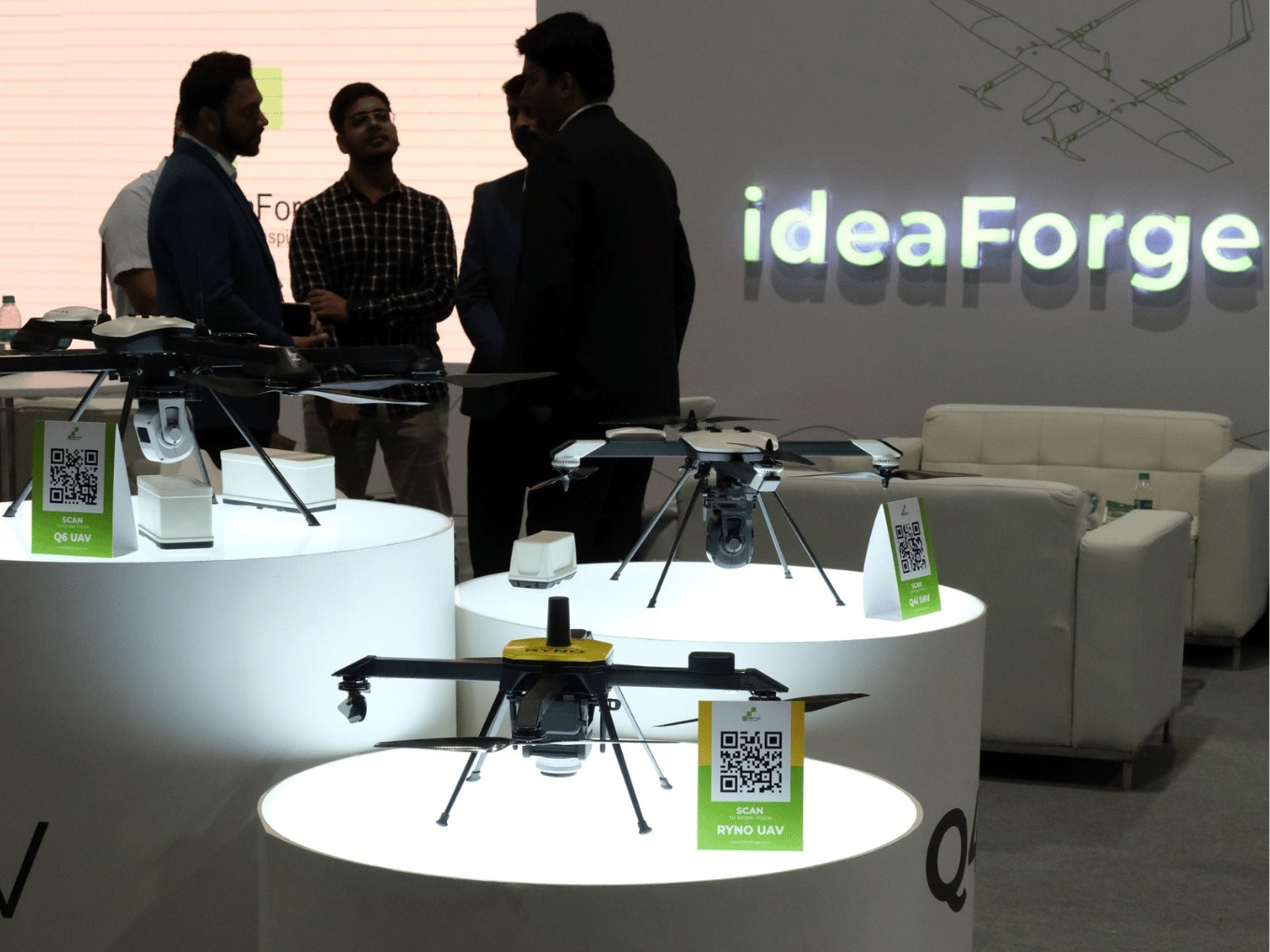
ideaForge Technology builds drones and the electronics that fly them, for defence and civil buyers. Revenue from operations in the three months to June 2026 was ₹68.59 crore. That compares with ₹12.78 crore in the same quarter a year earlier, a rise of 437 per cent. The base quarter was thin. A company with over half its staff in engineering booked less revenue than a mid-sized wedding costs.
Operating profit was ₹2.33 crore, against a negative ₹19.08 crore a year earlier. Profit after tax stayed below zero at minus ₹2.59 crore, against minus ₹23.56 crore. Earnings per share were minus ₹0.60, against minus ₹5.45 a year ago.
During the quarter the company allotted 6,289,308 equity shares under a qualified institutional placement, a share sale to large institutions. That raised ₹500 crore. It also received a Letter of Intent from the Technology Development Board for loan assistance of up to ₹151 crore for its YETI logistics platform.
Management says the deployed fleet has crossed one million customer missions. Management also says an ideaForge drone takes off somewhere in the world every two minutes, which makes the fleet a sort of airborne metronome. The order book stood at ₹256.8 crore on 30 June 2026. At the end of March it had been ₹314.2 crore. Management’s stated aim is “conversion of the opening order book into revenue” this year. Depreciation for the quarter was ₹14.21 crore, larger than operating profit.
2. Introduction
ideaForge Technology Limited was incorporated in 2007 and manufactures Unmanned Aircraft Systems. These are aircraft flown with no pilot on board, commonly called drones. By the company’s own telling, the story starts between 2004 and 2008. The founders built one of India’s first quadrotor drones at a college fest. The line would be insufferable had the work not then been incubated at SINE, IIT Bombay. By 2008 the company was supplying autopilots to government laboratories.
Between 2009 and 2013 it developed the NETRA UAV with a Government of India entity. It demonstrated the aircraft at DefExpo and made its first drone sale to a state police department. An early prototype also appeared in the Bollywood film 3 Idiots. Most engineering companies list patents; this one lists a filmography.
The 2014 to 2018 stretch brought NETRA V2, NETRA V3 and the SWITCH UAV. A Government of India contract worth ₹38.8 crore came in the same period. The years 2022 and 2023 brought a United States subsidiary and India’s largest Mini-VTOL contract, at ₹187.5 crore. The shares were listed on the NSE and the BSE in that same stretch. From 2024 to 2026 came NETRA 5, SWITCH V2 and the Q6 V2 Geo platform, alongside more than 100 global patent filings. Ministry of Defence orders followed: ₹137.4 crore for Mini UAVs and ₹107.3 crore for AFDS/Tactical and Hybrid UAVs. The ZOLT UAV was displayed at India’s 77th Republic Day Parade.
In April 2026 the company signed an agreement with Japan’s Digital Media Professionals Inc. The two plan to develop AI drones and to enter that market. In November 2025 it announced Ministry of Defence orders of ₹32 crore for Hybrid UAVs. Orders of roughly ₹75 crore for AFDS/Tactical UAVs were announced alongside them. CRISIL, a credit-rating agency, changed the corporate rating to CRISIL BBB/Negative on 6 November 2025. India Ratings, another credit-rating agency, assigned an IND BBB/Stable issuer rating on 4 June 2026.
Nineteen years separate the college fest from the Republic Day flypast. The year to March 2026 closed with revenue of ₹226 crore, up from ₹161 crore. The net loss for that year was ₹17 crore.
US
Now live
US Stocks terminal is live
13,000+ US tickers · EDGAR fundamentals · screener and filings feed — the same terminal, for American markets.
Explore →
3. Business Model: WTF Do They Even Do?
They build drones, and then build almost everything inside the drones, which is the unusual part.
Defence accounted for 69 per cent of revenue in the year to March 2026. That share was 59 per cent the year before. Civil work was the remaining 31 per cent, down from 41 per cent. The defence and dual-use platforms are NETRA 5, NETRA V4 PRO, SWITCH and SWITCH V2. They are used for border security, coastal patrol, search-and-rescue and military surveillance. Operational range runs to 20 km and endurance to 150 minutes. Civil work runs on Q4i and Q6 V2, covering surveillance, disaster management, traffic monitoring and mapping. Those aircraft reach 10 km and 60 minutes. The naming convention is a genuine achievement: a product manager somewhere argued successfully that “All Terrain Dominator” belongs on a spec sheet beside flight time in minutes.
Management’s framing of the strategy is to “own the consequential technologies and deliver a complete solution”. That stack covers radio links that resist jamming, and navigation that still works when GPS signals are faked. It also covers secure command-and-control software, computing done on the aircraft itself, and mission payloads.
Patents are spread across subsystems with the tidiness of a seating chart. Twelve cover the airframe and nine the payloads. Eight cover the ground control software and seven the motor and propeller. Six cover the software stack and four the battery. Two each cover the control system and ground communications, and one the autopilot hardware and software. Active patents totalled 112 as of 30 June 2026, of which 61 were granted.
The software layer is BlueFire Touch, the FLYGHT app and FLYGHT CLOUD. FLYGHT CLOUD stores footage, post-processes it, and now produces automated video summaries and AI-based event search. A million missions generates an unwatchable quantity of aerial video. In management’s words, the customer “is