Hubtown Ltd Q4 FY26: Audited Profits Soar 546% While Auditors Qualify Books for the 8th Time Over Unprovided Interest
1. At a Glance
Real estate turnarounds are rarely neat, and Hubtown Ltd is serving up a financial cocktail that is equal parts intoxicating and terrifying. The headline numbers for the fourth quarter ended March 31, 2026, scream structural bull run. Net profit for the quarter exploded by a staggering 546% year-on-year to ₹26.22 crore, while quarterly sales surged 65.4% to ₹160.00 crore. On a full-year basis, the group posted a consolidated net profit of ₹163.52 crore for FY26—a monumental leap from the ₹45.91 crore recorded in FY25.
But do not pop the champagne just yet. Beneath the glossy veneer of triple-digit profit growth lies a balance sheet structured like a classic financial thriller. For the eighth consecutive time, statutory auditors JBTM & Associates LLP have slapped a qualified opinion on the financial statements. The point of contention? Hubtown conveniently chose not to provide for interest expenses amounting to ₹1,751.85 lakhs (₹17.52 crore) on certain inter-corporate deposits for the year. Had the company accounted for this finance cost, its full-year profits would have shrunk from the reported ₹163.52 crore to an adjusted ₹146.00 crore.
Furthermore, the company is juggling structural realities unique to the Mumbai Metropolitan Region (MMR). On one hand, operating pre-sales look spectacular at ₹3,547 crore for the first half of the year alone, backed by an ultra-luxury inventory pipeline designed for Mumbai’s elite. On the other hand, a forensic look at the company’s real underlying cash dynamics shows an operations engine heavily dependent on persistent financial restructuring, massive related-party advances, and a looming corporate consolidation.
2. Introduction
Hubtown Ltd, originally incorporated in 1985 as Ackruti City, is a veteran player in the Indian real estate landscape. The company operates primarily across premium micro-markets in Mumbai, Thane, and Pune, with an additional footprint in major commercial hubs of Gujarat, including Ahmedabad, Surat, Vadodara, and Mehsana.
The company specializes in multi-asset class developments, spanning ultra-luxury residential towers, built-to-suit commercial spaces, IT parks, and public-private partnership (PPP) infrastructure projects, such as modern bus terminals. Historically burdened by high leverage and prolonged execution timelines, Hubtown is currently attempting a massive corporate restructuring.
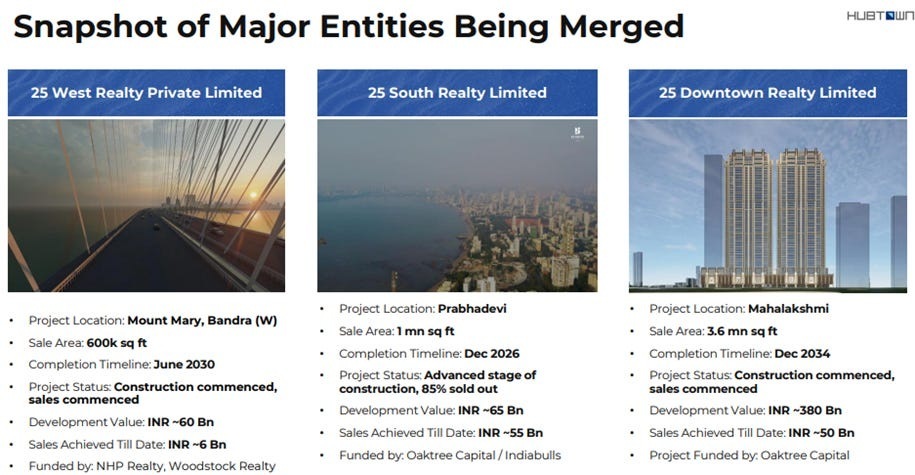
The ongoing transformation involves the wholesale amalgamation of several promoter-held private entities into the listed platform. This scheme aims to bring iconic South Mumbai development rights directly onto Hubtown’s balance sheet, effectively altering the company’s asset profile, scale, and shareholding structure.
3. Business Model – WTF Do They Even Do?
At its core, Hubtown operates as an urban land monetizer and luxury developer. It acquires high-value development rights—often through complex joint ventures, slum rehabilitation schemes, or urban renewal projects—and converts them into high-ticket real estate.
The revenue model is overwhelmingly weighted toward residential property sales, which historically account for roughly 86% of top-line inflows. Trading materials, commercial lease rentals, and investment income from joint ventures make up the residual single-digit balances.
The company’s premium strategy is anchored to its flagship “25” brand, which focuses on ultra-luxury vertical developments in South Mumbai, where individual apartment sizes stretch up to 15,000 square feet of carpet area.
Strategically, management uses a tier-based inventory release model. They sell lower floors early to cover basic construction outlays and withhold upper floors until structural completion to command premium valley and ocean views. This allows them to maximize real estate realizations in supply-constrained micro-markets.
4. Financials Overview
The table below provides a consolidated overview of Hubtown Ltd’s performance for the quarter and year ended March 31, 2026, utilizing the official numbers provided in the financials.
(Note: In accordance with standard accounting principles, the annualised EPS for Q4 is derived using the actual full-year reported consolidated EPS without further multi-quarter multiplication).
Metric
Latest Quarter (Mar 2026)
Same Quarter Last Year (Mar 2025) (YoY)
Previous Quarter (Dec 2025) (QoQ)
Full Year (FY26) Consolidated
Revenue (₹ cr)
160.00
96.75
87.59
643.51
EBITDA (₹ cr)
7.80
24.00
13.00
153.00
PAT (₹ cr)
26.22
1.89
23.42
163.52
Annualised EPS (₹)
—
—
—
10.62
Recalculated P/E
—
—
—
19.40
Commentary on Execution
While the quarterly revenue and PAT figures show exceptional year-on-year expansion, the core EBITDA margin tells a more volatile story. The operating profit for the latest quarter dropped to ₹7.80 crore, down from ₹24.00 crore in the same period last year. Management attributes this variance to their revenue recognition policy.
Hubtown follows the project completion method, recognizing revenue and associated historical costs only upon receiving the official Occupation Certificate (OC) and handing over physical possession. Consequently, current profits reflect the lower historical sales prices of units booked years ago, creating a