1. At a Glance
The story of HP Adhesives Ltd (HPAL) in FY26 is not one of steady growth or industrial dominance; it is a narrative of survival amidst chaos. For a company that was gaining investor attention with its “debt-free” status and pan-India distribution of solvent cements and sealants, the final quarter of FY26 has served a cold, hard reality check. The numbers aren’t just red; they are scorched.
The headline figure that should make any investor pause is the estimated loss of ₹24.98 Crore (₹2,498.5 Lakh) due to a massive fire at their Unit-I facility in Raigad on January 17, 2026. This isn’t just a minor operational hiccup. Unit-I was the heart of the company, contributing approximately 50% of the total revenue. When half your revenue engine catches fire, the “business as usual” tag is effectively incinerated.
But the fire wasn’t the only heat the company felt. The auditors and regulators have been busy. We are looking at a GST demand of ₹3.11 Crore, a Customs anti-dumping duty notice, and a sudden Rating Watch with Negative Implications from CARE Ratings. The net profit for the March 2026 quarter has swung into a loss of ₹2.39 Crore, compared to a profit of ₹4.12 Crore in the same quarter last year. That is a staggering 158% collapse in quarterly profit.
Investors who were blinded by the 71.4% promoter holding and the 1,250+ distributor network now face a company whose Return on Capital Employed (ROCE) has plummeted from 18% in FY23 to a measly 5.61% today. While the management has recommended a ₹0.40 dividend, one has to ask: is this a genuine reward for shareholders, or a tactical move to maintain optics while the factory floor is being rebuilt? The teaser here is simple: Can an adhesive company truly stick together when its primary manufacturing base is in ashes and the taxman is knocking at the door with multi-crore bills?
2. Introduction
HP Adhesives Limited entered the public eye with much fanfare, positioning itself as a challenger in the multi-billion dollar adhesives and sealants market. Their product list is exhaustive—solvent cements, silicone sealants, synthetic rubber adhesives, and even drainage solutions. They have the “Institutional Clientele” badge, supplying names like Pidilite, Finolex, and HIL.
However, the transition from a family-managed business to a listed entity requires more than just a wide product range. It requires operational resilience. The FY26 annual results reveal a company that is currently fragile. Total revenue for the year stood at ₹249 Crore, almost flat compared to the previous year, showing that the growth engine had started stalling even before the fire incident.
The company operates out of Khopoli, Maharashtra, with an installed capacity that they claimed was growing to 16,800 MTPA. But capacity on paper doesn’t translate to cash in the bank if the facility is non-operational. With the Rating Watch Negative (RWN) status now active, the company’s ability to raise cheap capital for reconstruction might be tested.
The Narrative here is a classic “Small-cap Struggle.” You have high promoter skin in the game (71.35%), but you also have a “Public” shareholder base that has exploded from 22,912 to over 53,000 shareholders in a few years. These retail investors are now holding a stock that has delivered a negative 30% return over the last year. We aren’t just looking at a balance sheet; we are looking at a recovery mission.
3. Business Model – WTF Do They Even Do?
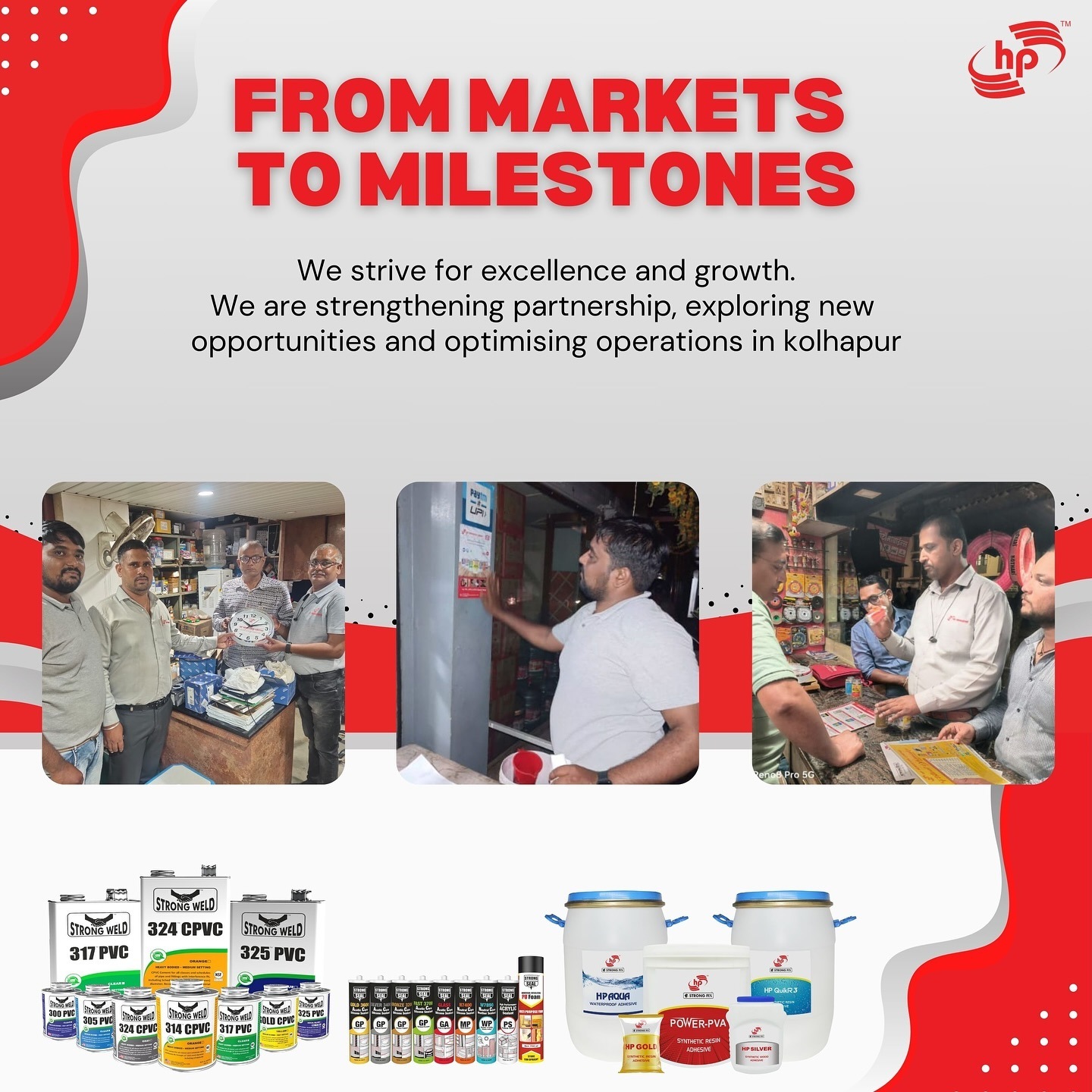
HP Adhesives essentially makes the “glue” that holds your house together. If you’ve ever seen a plumber join two PVC pipes with a pungent-smelling liquid, that’s Solvent Cement—and it accounts for a massive 59% of HPAL’s revenue. They also dabble in Silicone Sealants (the rubbery stuff around windows) and PVA glues (the white glue kids use, but for wood).
They follow a typical “Hub and Spoke” distribution model. They have 5 major depots and over 1,250 distributors. They tell the world they add 150+ distributors every year. It sounds impressive until you realize that in the specialty chemicals world, distribution is a commodity. If you don’t have the brand pull of a Pidilite, you are just fighting for shelf space by offering higher margins to the local hardware shop owner.
The “WTF” part of their business model is their recent diversification. They are now selling FRP Manhole covers and Spray Paint. While it shows “entrepreneurial spirit,” an auditor might call it “di-worse-ification.” When your core factory—the one making the 59% revenue-contributing solvent cement—is out of commission, having a great strategy for manhole covers feels like bringing a water pistol to a volcanic eruption.
They trade in ball valves and masking tapes too, which is basically a low-margin trading business (14% of revenue) to keep the distributors happy. In short, they are a manufacturing-trading hybrid that is currently missing its primary manufacturing leg.
4. Financials Overview
The financial performance for the quarter ended March 31, 2026, is a grim read. We are seeing a Quarterly Results format where the impact of the fire and regulatory fines has finally hit the fan.
Quarterly Performance Comparison (Figures in ₹ Crore)
| Metric | Latest Quarter (Mar ’26) | Prev. Quarter (Dec ’25) | Same Qtr Last Year (Mar ’25) | YoY Change |
| Revenue | 57.70 | 61.39 | 65.44 | -11.83% |
| EBITDA | -3.72 | 3.81 | 5.52 | -167.39% |
| PAT | -2.39 | 1.50 | 4.12 | -158.01% |
| EPS (₹) | -0.26 | 0.16 | 0.45 | -157.78% |
Annualised EPS Calculation:
Since the latest result is Q4, we use the full-year reported EPS as per the rules.
Reported Annual EPS for FY26: ₹0.75.
Witty Commentary:
The management used to talk about “scaling up” in old concalls. Well, they’ve scaled down the profits into negative territory quite effectively. An EBITDA margin of -6.45% this quarter is the financial equivalent of a “Keep Out” sign. They are losing money on every bottle of glue they (try to) sell right now.
Question for the reader: If a company loses its primary factory but still pays out a dividend, is it being “investor-friendly” or just “desperate”?
5. Valuation Discussion – Fair Value Range
To find the value here, we have to look past the smoke. Since the company is currently in a loss-making quarter, traditional P/E looks distorted.
Method 1: P/E Approach
The current Industry P/E is 29.5.
HPAL’s FY26 Annual EPS is ₹0.75.
Applying the industry multiple: $0.75 \times 29.5 = ₹22.12$.
However, the market is giving it a premium (Current P/E 45.3) based on “recovery hopes.”
Method 2: EV/EBITDA
Annual EBITDA for FY26 is approximately ₹13 Crore.
Current Enterprise Value (EV) is ₹335 Crore.
$EV/EBITDA = 335 / 13 = 25.7x$.
For a company with declining growth and a burnt factory, a 25x multiple is extremely rich. A fair multiple for a struggling small-cap should be closer to 12x-15x.
$13 \times 13.5 = ₹175.5$ Crore Fair EV.
Method 3: DCF (Back of the Envelope)
Given the inherent uncertainty of the insurance claim (₹24.98 Crore) and the time to rebuild, we assume a stagnant free cash flow for 2 years.
Estimated Fair Value Range: ₹18.00 – ₹24.00 per share.
Disclaimer: This fair value range is for educational purposes only and is not investment advice.
6. What’s Cooking – News, Triggers, Drama
The “news” section for HP Adhesives reads like a script for a corporate disaster movie.
- The Great Fire of Raigad: On Jan 17, 2026, Unit-I went up in flames. Management says they have “insurance coverage,” but auditors have flagged “inherent uncertainty” in measuring the ₹24.98 Crore claim. In plain English: The insurance company hasn’t written the check yet, and they might not write it for the full amount.
- The GST Raid/Audit: The GST Wing in Mumbai slapped them with a ₹3.11 Crore demand. The company “protested” most of it but already coughed up ₹32.34 Lakhs in penalties.
- Customs Drama: A show-cause notice for unpaid anti-dumping duties of ₹28.7 Lakhs. It’s a small amount, but it shows a pattern of regulatory “oversights.”
- The Rating Watch: CARE Ratings moved them to Negative Watch. This is the financial equivalent of being put on “probation” by your principal.
The drama doesn’t stop. They incorporated a new subsidiary, Unitybond Solutions, in April 2024. Why start a new subsidiary when your main one is struggling? It’s a classic “distraction” move.
7. Balance Sheet
The balance sheet is where we see the physical scars of the fire. Note that the “Other Current Financial Assets” has ballooned because they’ve booked the insurance claim they expect to get.
Consolidated Balance Sheet (Figures in ₹ Crore)
| Particulars | Mar 2026 (Latest) | Mar 2025 | Mar 2024 |
| Total Assets | 232.11 | 228.08 | 197.66 |
| Net Worth | 187.75 | 184.28 | 168.69 |
| Borrowings | 3.26 | 5.69 | 8.84 |
| Other Liabilities | 41.10 | 38.10 | 20.13 |
| Total Liabilities | 232.11 | 228.08 | 197.66 |
Sarcastic Bullet Points:
- Asset Illusion: Total assets went up, but a huge chunk of that is “Insurance Claim Receivable.” It’s like counting your lottery winnings before the draw because you “feel lucky.”
- The Debt “Pros”: They are “almost debt-free” with only ₹3.26 Crore in borrowings. Great. But when you have no factory and a negative EBITDA, even a ₹10 loan feels like a mountain.
- Inventory Vanishing Act: Inventories dropped from ₹56 Crore to ₹50 Crore. Thanks, fire! That’s one way to optimize working capital.
8. Cash Flow – Sab Number Game Hai
Cash is the only truth in a world of accounting “exceptional items.”
| Cash Flow Type (₹ Cr) | Mar 2026 | Mar 2025 | Mar 2024 |
| Operating (CFO) | 7.08 | 17.13 | 21.65 |
| Investing (CFI) | -1.55 | -16.30 | -7.53 |
| Financing (CFF) | -7.78 | 1.52 | -12.18 |
Analysis:
The Operating Cash Flow has crashed from ₹17.13 Crore to ₹7.08 Crore. They are bleeding cash internally. The only reason the net cash flow isn’t a total disaster is because they stopped investing in new equipment (CFI dropped significantly). They are in “hunker down” mode. Money is coming from internal reserves and going out to pay dividends and keep the lights on in the remaining half of the business.
9. Ratios – Sexy or Stressy?
Ratios don’t lie, even if management tries to.
| Ratio | Mar 2026 | Mar 2025 | Commentary |
| ROE (%) | 4.03 | 11.23 | Dropping faster than a lead balloon. |
| ROCE (%) | 5.61 | 14.13 | Single digits. Your FD might be safer. |
| P/E Ratio | 45.3 | 18.9 | The stock is getting more expensive as profits vanish. |
| PAT Margin | 3.01% | 7.16% | Razor-thin margins for a “specialty” company. |
| Debt to Equity | 0.02 | 0.03 | The only “sexy” thing left here. |
Witty Judgement:
HP Adhesives is currently a “Stressy” bet. With an ROCE of 5.61%, the company isn’t even earning back its cost of capital. They are effectively destroying value every day they stay in business in this state.
10. P&L Breakdown – Show Me the Money
Let’s look at the three-year trend to see the “stagnation” story.
| Year | Revenue (₹ Cr) | EBITDA (₹ Cr) | PAT (₹ Cr) |
| Mar 2026 | 249 | 13 | 7 |
| Mar 2025 | 251 | 26 | 18 |
| Mar 2024 | 236 | 31 | 21 |
Commentary:
Revenue is flat, but EBITDA has crashed from ₹31 Crore to ₹13 Crore in two years. This is a textbook case of “Margin Compression.” Raw material prices (crude derivatives) are biting, and the company has zero pricing power. They are a price-taker in a market dominated by a 1000-pound gorilla (Pidilite).
Question for the reader: Can you name another chemical company that lost 60% of its EBITDA in 24 months without a global recession?
11. Peer Comparison
How do they stack up against the big boys?
| Company | Revenue (₹ Cr) | PAT (₹ Cr) | P/E | Status |
| Pidilite Inds | 12,358 | 1,845 | 61.4 | The King. |
| Aarti Inds | 6,850 | 425 | 41.2 | Struggling but huge. |
| HP Adhesives | 249 | 7 | 45.3 | The “Burnt” Underdog. |
| Median (95 Co) | 144 | 9 | 29.5 | Industry Average. |
Sarcastic Notes:
Pidilite is playing in the Champions League while HP Adhesives is currently struggling in the local inter-school tournament. The fact that HPAL trades at a 45x P/E—higher than Aarti Industries—is a joke that only the stock market could tell.
12. Miscellaneous – Shareholding and Promoters
| Group | Shareholding (%) |
| Promoters | 71.35% |
| FIIs | 0.02% |
| DIIs | 0.00% |
| Public | 28.63% |
Promoter Roast:
The Motwani family owns a massive chunk. Anjana Motwani and Karan Motwani are at the helm. While high promoter holding is usually a good sign, the complete exit of DIIs (from 3.72% to 0.00%) is a massive red flag. Institutional investors (the smart money) have left the building, leaving the “Public” (retailers) to hold the bag.
Promoter Bio (Witty): They’ve been around since 1980, but 40 years of experience didn’t prevent a multi-crore GST demand or a fire that wiped out half the production. Experience is great, but execution is what pays the bills.
13. Corporate Governance – Angels or Devils?
The auditors, Priya Choudhary & Associates LLP, issued an “unmodified opinion,” but they were very careful to include an “Other Matter” paragraph about the fire.
The drama with the Independent Directors is also worth noting. In February 2026, right after the fire, we saw resignations and new appointments. When directors start playing musical chairs during a crisis, it’s rarely because they like the music.
Then there’s the GST Audit. A ₹3.11 Crore demand for the period 2019-2024 suggests that the internal tax compliance was “creative” at best. Angels? Maybe. But they certainly seem to have a penchant for attracting regulatory thunderbolts.
14. Industry Roast and Macro Context
The Adhesives industry is basically a battle of who can spend more on marketing. It’s a “Sticky” business, pun intended. But the macro context is brutal. Crude oil prices are volatile, and since adhesives are 100% dependent on petrochemicals, HPAL is at the mercy of global oil cartels.
The sector is currently obsessed with “Green Adhesives” and “Low VOC” products. HPAL is still trying to figure out how to stop its factory from catching fire. While Pidilite is using AI to optimize distribution, HPAL is dealing with GST show-cause notices. The gap isn’t just in revenue; it’s in the decade of technology they are lagging behind.
15. EduInvesting Verdict
HP Adhesives Ltd is currently a High-Risk, Recovery-Dependent play. On one hand, you have a debt-free company with a strong promoter stake and a wide distribution network. On the other hand, you have a “Half-Burnt” company with collapsing margins, fleeing institutional investors, and a mountain of regulatory fines.
The “Management Walk the Talk” analysis is disappointing. They spoke of growth and expansion, but the reality has been stagnation followed by a catastrophic fire. The insurance claim of ₹24.98 Crore is the “Sword of Damocles” hanging over the stock—if it gets rejected or reduced, the book value will take a massive hit.
SWOT Analysis
- Strengths: Debt-free balance sheet; High promoter holding; Established brand “Strong Weld.”
- Weaknesses: Single-location manufacturing risk (Unit-I); Collapsing ROCE; Zero pricing power against peers.
- Opportunities: Reconstruction of a more efficient factory; Expansion into “Unitybond” subsidiary.
- Threats: Insurance claim dispute; Further GST/Customs penalties; Volatile raw material prices.
Final Thought: HP Adhesives needs more than just glue to fix its current state. It needs a miracle in the insurance department and a complete overhaul of its manufacturing resilience. Until the “Negative Watch” is lifted and the new factory is pumping out solvent cement, this is a story of survival, not growth.
This fair value range and analysis is for educational purposes only and is not investment advice.