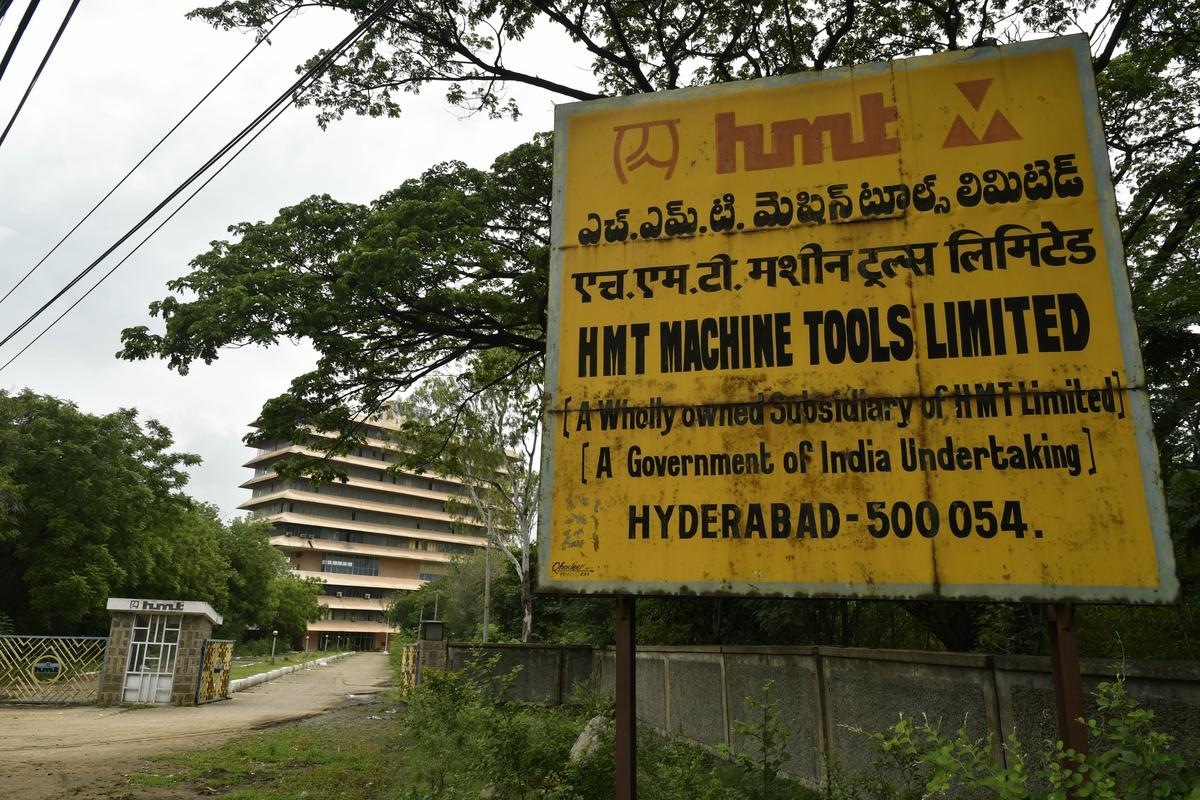
1. At a Glance – Government Zombie With a Stock Price
HMT Ltd is currently trading at ₹44, down ~30% over one year, with a market cap of ₹1,549 crore. Sales for the trailing twelve months stand at ₹111 crore, while PAT is a loss of ₹154 crore. That’s not a typo. That’s a PSU special.
Operating margins are –132%, return on assets is –24.6%, book value is –₹55 per share, and debt is sitting at ₹1,029 crore. Promoters (read: Government of India) hold 93.7%, leaving a microscopic public float of 0.7%. Liquidity? Thinner than railway tea.
Latest quarter (Q3 FY26) numbers show ₹20.8 crore revenue and ₹27.2 crore loss, with sales falling 28.6% YoY. EPS is –₹0.77 for the quarter.
So the obvious question:
Why is this thing still listed, traded, and discussed like it’s a turnaround story waiting to happen?
Welcome to HMT — where history, land, and hope do most of the heavy lifting.
2. Introduction – From Wristwatch Icon to Balance Sheet Archaeology
There was a time when HMT meant pride. If your dad had an HMT watch, it meant punctuality, discipline, and mild fear. Today, HMT means machine tools, food processing equipment, government projects, and recurring losses.
HMT is a Central PSU under the Department of Heavy Industries. Over the years, almost everything glamorous has been shut down — watches, tractors, bearings. Employees relieved. Factories mothballed. Land monetised.
What remains is a shrunk industrial shell, propped up by subsidiaries, occasional “other income”, and government patience.
And yet — the company still reports quarterly results, still has debt, still pays interest, and still bleeds cash.
So no, this is not a turnaround fairy tale.
This is a post-mortem with occasional heartbeats.
3. Business Model – WTF Do They Even Do?
HMT today operates through three surviving verticals:
1. Machine Tools – The Core That Barely Beats
~81% of revenue
This is handled via HMT Machine Tools Ltd, a wholly owned subsidiary. Products include:
- Lathes
- CNC machines
- Transfer lines
- Flexible manufacturing systems
They’ve manufactured 100,000+ machine tools historically, many still in use across India. Respectable legacy. But current demand? Meh.
Low volumes, high fixed costs, PSU procurement delays, and zero pricing power mean this segment consistently operates at a loss.
2. Food Processing Machinery – The Side Hustle
~9% of revenue
Milk pasteurisers, homogenisers, heat exchangers, pumps. Sounds exciting until you realise margins are thin and competition is brutal.
This is a survival segment, not a growth engine.
3. Projects & International Services – The Diplomatic Division
~10% of revenue
Handled by HMT International Ltd, executing turnkey projects abroad — vocational centres, IT centres, training institutes — mostly funded by the Ministry of External Affairs.
Translation:
Revenues