Hathway Bhawani Cabletel & Datacom Ltd Q3 FY26 — ₹0.58 Cr Quarterly Revenue, ₹0.03 Cr PAT, ₹0.04 EPS Reality Check at 86× P/E: Microcap Cable or Microcap Comedy?
1. At a Glance
If Indian microcaps were people at a wedding buffet, Hathway Bhawani Cabletel & Datacom Ltd would be that guest who eats quietly, avoids drama, survives till dessert, but somehow still ends up being discussed loudly. With a market capitalisation of roughly ₹11.2 crore and a current price near ₹13.8, the company operates a cable television business so small that one Mumbai housing society AGM could probably generate more heated debates than its annual revenue.
The latest quarter (Q3 FY26, Dec 2025) reported consolidated revenue of ₹0.58 crore and PAT of ₹0.03 crore. Sounds harmless? Now hold that thought while we look at valuation. The stock trades at a reported P/E of ~48.8× on trailing numbers, but once you correctly annualise the latest EPS of ₹0.04, the effective multiple balloons closer to 86×. Yes, eighty-six. For a cable TV company. In 2026.
Returns have been uninspiring: about -7.9% over three months, -18.3% over six months, and -19% over one year. ROCE stands at 3.38%, ROE at 2.25%, and price-to-book at a chunky 6.34× despite book value of just ₹2.19.
So the teaser question is simple: is this a sleepy survivor being mispriced by hope, or a stock that investors keep confusing with its much larger cousins? Let’s plug in the cable, check the signal strength, and see what’s actually playing.
2. Introduction
Hathway Bhawani Cabletel & Datacom Ltd was incorporated in 1984, which means it has lived through colour TV adoption, satellite TV disruption, DTH booms, OTT invasions, and now reels that last 12 seconds. Most companies don’t survive that long. This one did — barely, stubbornly, and quietly.
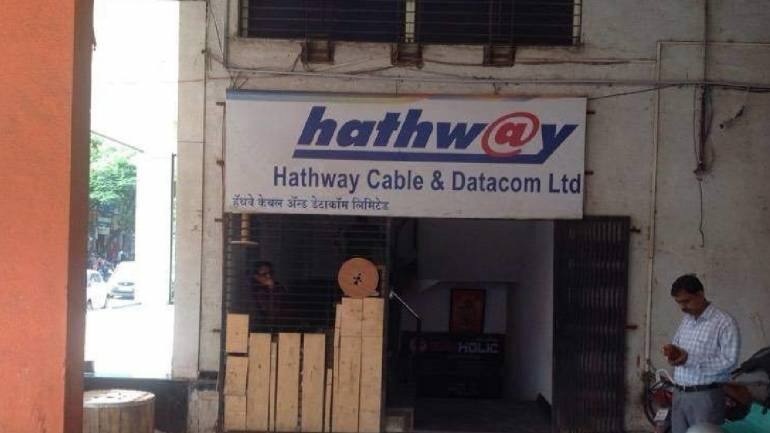
The company provides cable television network services across Maharashtra, primarily in and around Mumbai, Navi Mumbai, Karjat, and Mumbra. It also operates movie-based entertainment channels such as HB Cinema and HB Movies. If that sounds nostalgic, that’s because it is.
Over the years, revenue has steadily declined. From double-digit crore sales a decade ago, the business has shrunk to about ₹2.56 crore in FY25. Accumulated losses have eaten into reserves, leaving net worth thin but still positive. The company has survived mainly through cost control, group support, and the simple fact that some households still pay monthly cable bills.
Occasionally, a profitable quarter appears. When that happens, the stock wakes up, valuation ratios stretch, and optimism briefly returns. Then reality resumes. This pattern makes Hathway Bhawani a fascinating case study in microcap endurance — not growth, not innovation, but sheer refusal to shut shop.
So when you see a cable TV microcap trading at tech-style multiples, the obvious question arises: are investors betting on a turnaround, or just confusing survival with scalability?
3. Business Model – WTF Do They Even Do?
Let’s strip away the jargon. Hathway Bhawani runs local cable TV networks. That’s it. It installs infrastructure, distributes channels to subscribers, collects monthly fees, and pays content providers. This is a classic last-mile distribution business with razor-thin margins and zero pricing power.
Digital cable TV services are provided across select cities in Maharashtra. The company also runs movie-based channels — HB Cinema and HB Movies — which earn advertising and placement income. However, in an era dominated by OTT platforms, this segment is more about staying relevant than driving growth.
A key pillar of operations is related-party agreements. Hathway Bhawani has entered into multiple arrangements with Hathway Digital Limited (a fellow group entity) for placement, advertisement, marketing, promotional activities, subscription support, and infrastructure facilities. Assets have also been sold between group companies. Translation for lazy investors: this company does not operate in isolation; it survives inside a group ecosystem.
There is no aggressive expansion plan, no capex announcement, no diversification pitch. The business model is defensive, maintenance-oriented, and focused on continuity rather than conquest. Which is fine — but then the valuation must behave accordingly. Does it? Keep reading.
Result Type Detected: Quarterly Results EPS Annualisation Rule: Latest quarterly EPS × 4
Quarterly Performance Comparison (₹ crore)
Metric
Latest Qtr (Dec 2025)
Same Qtr Last Year (Dec 2024)
Previous Qtr (Sep 2025)
YoY %
QoQ %
Revenue
0.58
0.67
0.60
-13.4%
-1.7%
EBITDA
0.07
0.06
0.02
+16.7%
+250%
PAT
0.03
0.02
-0.02
+50.0%
Turned +
EPS (₹)
0.04
0.02
-0.02
+100%
Turned +
Now the crucial part — no shortcuts, no cherry-picking:
Latest EPS (Dec 2025): ₹0.04
Annualised EPS = 0.04 × 4 = ₹0.16
This is the only correct EPS to use for valuation discussions at this point in time.
What does the table tell us? Revenue is flat-to-declining. Profitability exists but is fragile and inconsistent. EBITDA improved sequentially because costs behaved for one quarter, not because revenue exploded. PAT turned positive mainly because the base quarter was negative.
So let me ask you directly: do you trust one green quarter after multiple red ones, or do you wait for consistency?
5. Valuation Discussion – Fair Value Range Only
Method 1: P/E-Based Valuation
Latest annualised EPS: ₹0.16
Conservative cable/media microcap multiple: 8× to 12×
Implied fair value range: ₹1.3 to ₹1.9
Even if we stretch optimism:
Aggressive multiple: 15×
Stretched fair value: ₹2.4
Compare that with CMP ~₹13.8. The gap is not small; it’s a full highway.
For a declining-revenue cable business, a reasonable EV/EBITDA would be 8×–12×, implying an EV range of ₹2.2–₹3.4 crore — far below current levels unless EBITDA magically scales.
Method 3: DCF (Sanity Check)
With:
Low single-digit margins
Flat-to-declining revenue
No visible growth trigger
A DCF does not justify current market capitalisation unless you assume multiple years of margin expansion and revenue stability — assumptions not supported by historical data.
Fair Value Range (Educational Only): ₹2 – ₹4
This fair value range is for educational purposes only and is not investment advice.