01 — At a Glance
When Abrasives Get Expensive, But Nobody Complains
- 52-Week High / Low₹1,884 / ₹1,449
- CY25 Revenue (Full Year)₹2,812 Cr
- CY25 PAT (Full Year)₹371 Cr
- Full-Year EPS (FY25)₹33.30
- Q3 EPS (Dec 2025)₹8.60
- Book Value₹206
- Price to Book7.54x
- Dividend Yield1.09%
- Debt / Equity0.04x
- OPM (Operating)18.2%
The Grindwell Story: Grindwell Norton is India’s abrasive heavyweight — manufacturing grinding wheels, cutting discs, and sandpaper like a 24/7 machine. Owned 58% by Saint-Gobain (Paris), this is the kind of business that doesn’t show up in memes but shows up in every factory floor across India. Q3 FY26 revenue ₹753 crore (+7.1% YoY), PAT ₹96 crore (+9.6% YoY). Nine straight quarters of profit growth. P/E at 44.1x is expensive. ROCE at 20.9% is mediocre for a monopoly. But consistency? That’s unquestionable.
02 — Introduction
The Abrasive Truth About Indian Manufacturing
Meet Grindwell Norton. Not a sexy name. Not a tech company. Not remotely close to a growth story by Silicon Valley standards. But walk into any automotive workshop, steel mill, or precision manufacturing facility in India, and their products are grinding metal into shape right now. While you’re reading this sentence, somewhere in Bengaluru, a Grindwell grinding wheel is being used to shape an automotive component. Two seconds later, another one is spinning in Mumbai. This is the kind of business that doesn’t headline financial newsletters but pays dividends like clockwork.
Grindwell Norton Limited is the Indian subsidiary of Compagnie de Saint-Gobain, a French multinational with €47.9 billion in annual sales globally. Saint-Gobain owns 58% of Grindwell (technically through two holding companies: Saint Gobain Abrasives Inc and SPAFI). The remaining 42% is held by Indian public and institutions. This is not a startup story. This is a 100+ year old manufacturing legacy playing out in modern India with modern supply chains and modern spreadsheets.
The company manufactures three main categories: Abrasives (40% of revenue, market leader position), Ceramics & Plastics (44%, including refractories and polymers), and Digital/IT Services (16%, INDEC offshore development centre for Saint-Gobain global operations). They run 7 plants in India: four for abrasives, two for ceramics, and scattered facilities for support operations. Employee count: 2,429 as of FY25. Revenue: ₹2,812 crore for FY25. Profit: ₹371 crore. Dividend: ₹17 per share recommended for FY25. Q3 delivered another solid quarter. And yet the stock trades at 44x earnings, which is the price you pay when a business is this boring and this reliable.
Why This Matters: Grindwell is what happens when a European conglomerate discovers that Indian manufacturing is a) durable and b) less cyclical than you’d think. They’re not trying to flip it. They’re extracting steady dividends from an asset that generates ₹458 crore in operating cash flow annually (FY25). That’s the entire business model: manufacture abrasives, pay dividends, repeat.
03 — Business Model: What Are They Actually Grinding?
Making Sharp Things Sharper, For India’s Factories
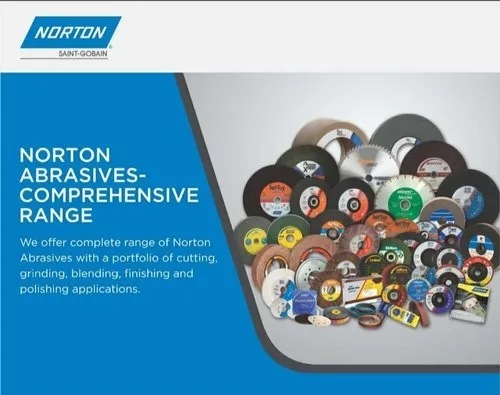
Abrasives. That’s the core. Grinding wheels, cutting discs, sandpaper, coated abrasives, non-woven abrasives (the kind used for cleaning dishes and bathroom tiles), and superabrasives (diamond-embedded wheels for precision work). They manufacture over 15,000 different SKUs annually — meaning if your workshop needs a very specific wheel for a very specific job, they’ve probably already made a variant. Market share: market leader in bonded abrasives. They sell to automotive OEMs, bearing manufacturers, steel mills, precision engineering shops, and every general engineering workshop that needs their tools.
The ceramics business is less well-known but equally durable. Performance ceramics, refractories (used in steel furnaces and glass manufacturing), advanced polymer products, and silicon carbide materials. Customers: steel industry, glass industry, aerospace components, life sciences equipment, railway applications. This is not glamorous. This is the business of making the machines that make things, and then selling parts to those machines.
The third segment is INDEC (India Development Centre) — Grindwell’s IT services arm that does software development and infrastructure management for Saint-Gobain’s global operations across 70 countries. This was ~₹460 crore of revenue in FY25, representing the digital transformation of an old manufacturing company. They run cloud infrastructure, develop enterprise software, and maintain systems for the parent company. It’s internal-facing but revenue-generating, and it’s growing fast.
Abrasives40%Revenue Mix
Ceramics44%Revenue Mix
Digital/Other16%Revenue Mix
Distribution Model: Two thousand active dealers and distributors across India. Direct sales to OEMs. Long-standing relationships with automotive (40% of India’s car manufacturers use their products), bearings, and precision engineering. The distribution network is tight, margins are sticky, and switching costs are high. A grinding wheel supplier doesn’t get replaced because of one bad quarter. The customer either dies, or you stay their supplier forever.
💬 Have you ever used or seen Grindwell Norton products in your workshop, factory, or even household? Drop a comment — abrasive enthusiasm is underrated.
04 — Financials Overview
Q3 FY26: When Consistency Pays Dividends
Result type: Quarterly Results | Q3 FY26 EPS: ₹8.60 | Annualised EPS (Q3×4): ₹34.40 | FY25 Full-Year EPS: ₹33.30
| Metric (₹ Cr) |
Q3 FY26
Dec 2025 |
Q3 FY25
Dec 2024 |
Q2 FY26
Sep 2025 |
YoY % |
QoQ % |
| Revenue | 753 | 703 | 775 | +7.1% | -2.8% |
| Operating Profit | 139 | 123 | 141 | +13.0% | -1.4% |
| OPM % | 18.2% | 17.5% | 18.2% | +70 bps | Flat |
| PAT | 96 | 88 | 107 | +9.6% | -10.3% |
| EPS (₹) | 8.60 | 7.84 | 9.65 | +9.7% | -10.9% |
The Math: Q3 delivered solid YoY growth — revenue +7.1%, PAT +9.6%. The sequential dip from Q2 is normal (Q2 was the peak of the quarter sequence). Operating profit margin expanded 70 bps YoY to 18.2%, which indicates better cost absorption and pricing power. Annualised EPS from Q3 alone (₹8.60 × 4 = ₹34.40) is already matching FY25’s full-year EPS of ₹33.30. The growth rate is modest. The quality is unquestionable.
05 — Valuation: Fair Value Range
Is 44x P/E Justified, or Just Expensive?
Join 10,000+ investors who read this every week.