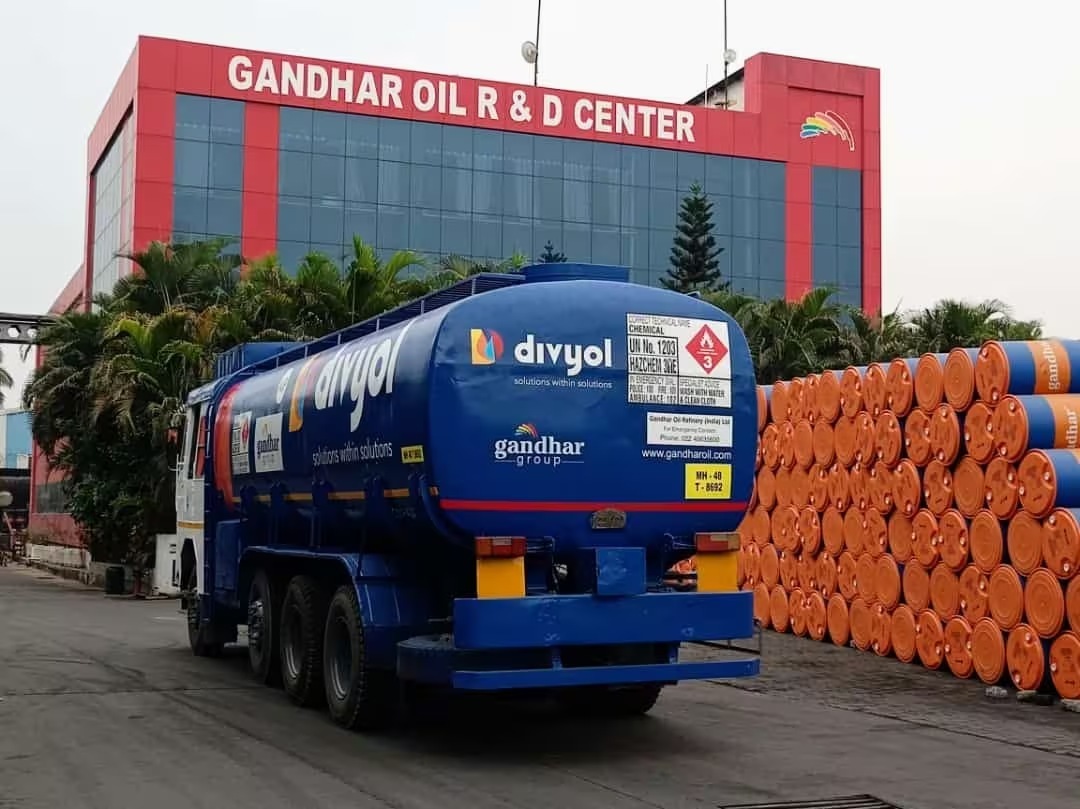
Gandhar Oil Refinery (India) Ltd Q4 FY26: A Slippery 93% Capacity Flex and the ₹17.69 Crore Customs Gift
Date of Publishing -
Spotted a factual error — a wrong number, date, or fact? Tell us and we will check the source.
Section 1 — At a Glance
The financial year concluded with an exceptional display of operational volume optimization that caught the market’s attention, even as underlying gross margins continued to struggle against global shipping headwinds. Total manufacturing volumes expanded to 5,54,212 kL for FY26, driving full-year revenue to ₹4,241.2 crore. While consolidated revenues grew by nearly 9% year-over-year, investor concern remains anchored to the company’s operating profit margins, which print at a lean 5.53% for the full year.
Geopolitical frictions centered around the Strait of Hormuz directly impacted the company’s international footprint, forcing its Sharjah-based subsidiary, Texol Lubritech, to navigate temporary port closures and structurally alter its sourcing mix. Despite these shipping constraints, domestic facilities operated at a frantic three-shift schedule to achieve an implied 125% local plant utilization rate. This tactical maneuver successfully absorbed fixed overhead costs but highlighted a stark reliance on volume expansion to offset compressing unit economics.
True operational resilience is measured not when supply chains are frictionless, but when a business can swap out its primary international import routes mid-crisis without bleeding its core operating cash flow.
With a massive volume push rescuing the top line and unexpected custom tax refunds providing a sudden cash cushion, the question shifts from whether the company can move product to whether it can ever reclaim its peak historical pricing power.
Section 2 — Introduction
Established in 1992, Gandhar Oil Refinery (India) Ltd has evolved from a localized specialty player into an international manufacturer of white oils, process insulating oils, and automotive lubricants. Operating under the corporate banner of the “Divyol” brand, the business occupies an essential niche within consumer healthcare, personal care, and industrial distribution networks.
The company’s primary corporate focus remains heavily weighted toward business-to-business long-cycle relationships. Onboarding a Tier-1 multinational client requires a prolonged string of plant audits, stability testing, and qualification processes that typically stretch between four to eight years. While this creates high customer stickiness and a defensive repeat-order profile, it simultaneously locks the company into rigid multi-year frameworks that limit swift tactical pricing adjustments when crude derivatives experience sudden inflationary spikes.
Section 3 — Business Model: WTF Do They Even Do?
Strip away the complex industrial terminology and Gandhar Oil’s core business model is effectively acting as the premium industrial kitchen that refines crude derivatives into the invisible grease keeping modern consumer cosmetics and pharmaceuticals from separating in the bottle. They take heavy base oils and transform them into ultra-pure white mineral oils, petroleum jellies, and microcrystalline waxes.
If you have ever applied a high-end face serum, swallowed a soft-gel capsule, or watched a train smoothly navigate an industrial rail line, you have interacted with their product suite. The business splits itself across three main divisions: Personal care, Healthcare, and Performance Oils (PHPO), which commands 48% of finished goods revenue; Lubricants at 27%; and Process Insulating Oils (PIO) at 10.19%. The remainder is tossed over to channel partners who resell these chemical mixtures onwards to smaller distributors.
Would you happily back a business where you must wait eight years for a consumer giant to audit your factory floor, just for the privilege of earning a 5% operating margin on their petroleum jelly?
Section 4 — Financials Overview
Figures are consolidated, in ₹ crore.
Metric
Latest Quarter (Mar 2026)
YoY Change (%)
QoQ Change (%)
Revenue
1,093.4
13.70%
-7.08%
EBITDA
63.6
89.28%
7.61%
PAT
37.0
200.81%
7.87%
EPS (₹)
4.16
249.58%
25.68%
The final quarter of the fiscal year delivered a sharp recovery in net earnings compared to the deeply depressed baseline of the prior year’s corresponding quarter. Operating profit margins for the quarter edged up to 5.81%, supported by localized domestic price pass-through actions and an average realization profile of ₹76,526 per kL across the aggregate product portfolio.
During the latest earnings call, management noted that local operations were required to sprint on an institutional three-shift architecture to fulfill demand obligations.
Earnings velocity achieved through maximizing factory runtime is a double-edged sword; it optimizes near-term fixed asset turnover but strips the balance sheet of operational buffer room when mechanical wear or supply logistics freeze.
Management said that the newly acquired 5-acre parcel of land immediately adjacent to their existing Taloja facility is being fast-tracked for capacity extensions to mitigate this exact operating bottleneck.
Section 5 — Valuation Discussion: Fair Value Range Only
To evaluate where Gandhar Oil sits relative to historical realities and market parameters, we deploy three fundamental assessment methodologies.
P/E Multiple Method: Utilizing the full-year reported FY26 EPS of ₹13.83 against the broader lubricant and specialty petroleum peer trading band (ranging from GP Petroleums at 7.4x to Savita Oil Technologies at 20.2x) yields a calculated structural valuation spectrum between ₹103 and ₹280 per share.
EV/EBITDA Method: Applying an enterprise multiple variance of 6.0x to 10.0x against the reported consolidated FY26 EBITDA of ₹234.5 crore establishes an implied enterprise valuation band that translates to an equity price range