Freshara Agro Exports: FY26 Results — The Sarasa Bet
General information and entertainment, not investment advice. The author is not a SEBI-registered adviser or research analyst. No recommendation, no promised returns. Markets carry risk including loss of capital. Figures may not be current. Consult a registered adviser before acting.
Revenue stormed past ₹314 crore in FY26, up 25% year-on-year on a standalone basis—yet the company is now straddling two continents and two business models.
The bigger move happened off-balance: Freshara acquired a 56-year-old Spanish olive company called Sarasa in late January 2026, turned it operationalized by February, and now reports consolidated numbers that fold in a Spanish turnaround story. Standalone, the India gherkin-and-pickles business is chugging. Consolidated, FY26 topped ₹353 crore revenue and ₹37.5 crore PAT—but the Spain operations ran at losses.
Working capital bloated to ₹117 days (up from ₹76 in FY25). A ₹9.1 crore order book sits against ₹314 crore annual revenue. Debt sits at ₹128 crore on a ₹355 crore balance sheet. CRISIL assigned BBB/Stable—a nod to market position and margins, but hedged against working capital hunger and seasonal lumpiness.
Management says Spain transforms to ₹200 crore revenue in FY27 on full-year consolidation, at 8–10% PAT margins. The upside thesis is real. The execution risk is sharper than it sounds.
2. Introduction
Freshara was born in 2015 as a pickup-and-process operation for gherkins in Tamil Nadu. The founders—Junaid Ahmed and K M Iqbal Ahmed—built a contract-farming network across Tamil Nadu, Karnataka, and Andhra Pradesh, and plugged the output into global customer relationships.
The company cycled through partnership, then IPO’d on the NSE Emerge platform in October 2024, raising ₹75 crore in equity. By late 2025, the balance sheet had tightened, order flow remained steady, and margins had stabilized near 15%—proof the model could scale.
Then, in December 2025, management pivoted. CRISIL filed a note that Freshara had “noted” plans to acquire a Spanish pickle-and-olive business through two wholly owned Spanish subsidiaries. The deal closed by January 20, 2026. Operations commenced. By June 2026, management was on the earnings call claiming Sarasa as the “transition to becoming an integrated international food platform.”
It is an acquisition by a ₹513 crore market-cap SME with under ₹400 crore consolidated assets—of a 56-year-old European business with 32 retail SKUs and multi-generational brand equity. On paper, it is transformational. In cash, it is constrained: the deal was funded by ₹9.5 crore in warrants, ~₹25% of acquisition cost from internal accruals, and the rest from bank working capital limits and assumed debt. Leverage ticked up from 0.74x (FY25) to… well, CRISIL lumped it all together and kept the rating flat.
The business logic is sound. The timing is aggressive.
3. Business Model: WTF Do They Even Do?
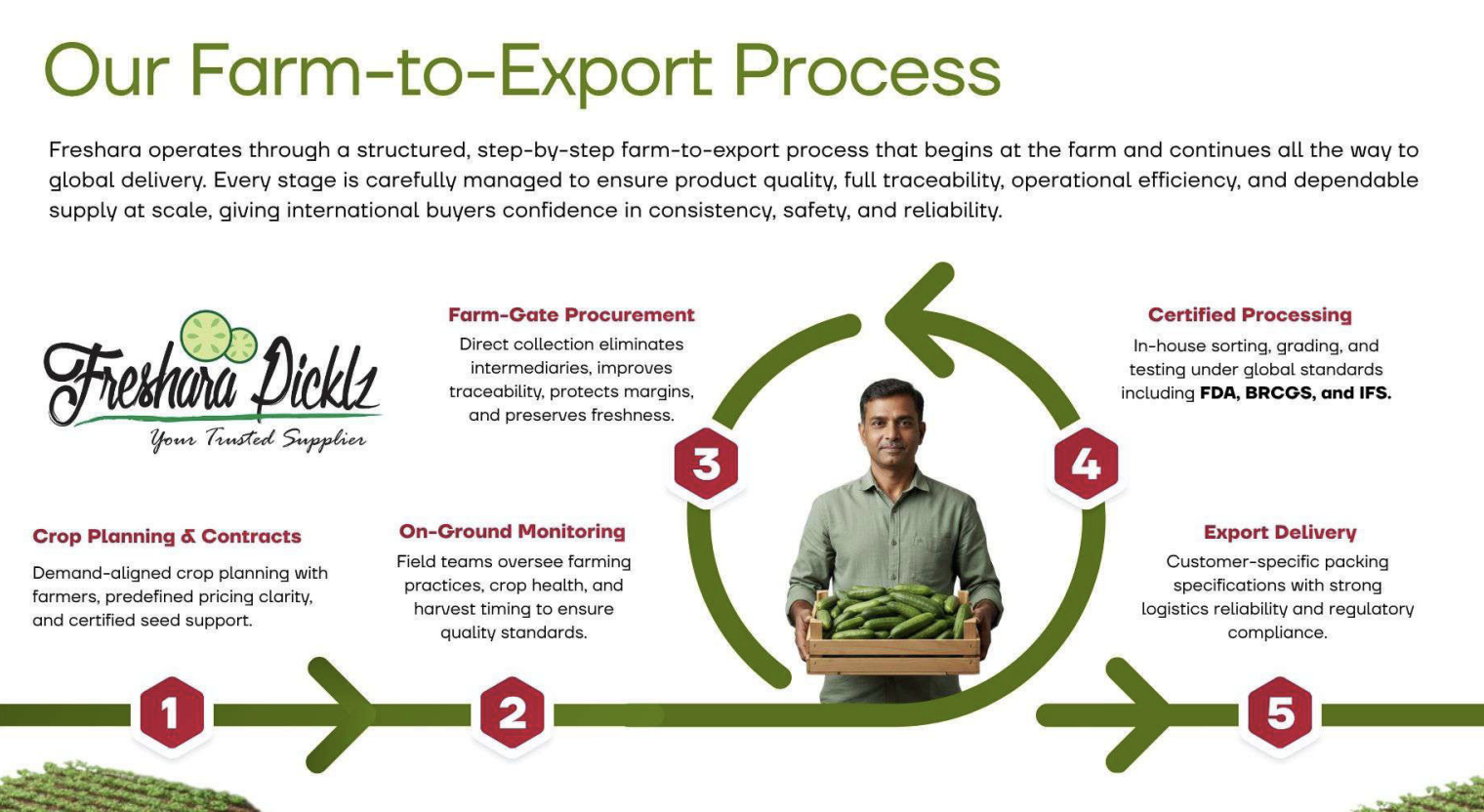
Freshara’s core is a three-step factory: procure raw gherkins and vegetables from contract farmers, process them into shelf-stable pickled products, export to global customers.
The procurement side is sticky. The company maintains cultivation notes on each farmer, provides seeds and agronomic support, and operates a buy-back agreement. Margins on procurement depend on crop timing. Timing depends on monsoons. The company sources from 5,000 contract farmers across 22 districts—a hedge against localized drought or pest, but no hedge against El Niño.
The processing side sits in two units: Unit I (50 MTPD capacity) in Tirupathur, Tamil Nadu. Unit II (100 MTPD capacity) came online in late 2025 and was running at modest utilization through FY26, with an eye to retail-pack expansion and food-service channels.
The export side is split into three channels: industrial (B2B ingredient supply to global bottlers—71% of India revenues in FY26), retail (branded jars for supermarkets—16%), and food-service (rising).
Product mix in India is gherkin-heavy (43,600 MT exported in FY26, ~₹268 crore revenue, ~80–86% of sales), with the rest scattered across baby corn, jalapeños, banderillas, and chilies. Certifications (FSSAI, FDA, Star-K Kosher, APEDA, IFS, BRCGS) lock in export compliance.
Sarasa is not gherkins—it is olives, pickled vegetables, and heritage brands sold through Spanish supermarket chains and across Europe. Sarasa operated at ~4–5% PAT margin before acquisition, ran underutilized (management claims <50% of capacity), and carried legacy cost structure. Freshara bought it out of insolvency, reset the workforce, and is now running it at 100 MTPD olive processing capacity against ~14,000 retail outlets in Spain.
The vision, per management: Indian gherkins and pickles sourced from India and packed in India, sold through Sarasa’s European distribution. Sarasa olives sold back through Freshara’s global customer base. By mid-decade, consolidated revenue above ₹1,000 crore. By FY27, Spain alone should contribute ₹200 crore.
On current capacity and consolidated scale, the thesis is cornering a slice of the European pickled-vegetable import market while keeping European supermarket shelf-space via a heritage brand. In practice, it is one Indian SME running two factories 5,000 miles apart, each with different raw material seasons, labor costs, and regulatory environments.
4. Financials Overview
Figures are consolidated. Units: ₹ crore. Latest period: FY26 (Year ended 31 March 2026).
Metric
FY24
FY25
FY26
YoY %
Revenue
71.28
250.64
313.53
+25.1
EBITDA
~12.0
~48.0
~61.0
+27
PAT
9.97
28.79
36.22
+25.8
EPS (annualized)
5.86
12.25
15.41
+25.8
Consolidated FY26 reflects ~₹353 crore revenue (India standalone ~₹325 crore + Spain ~₹28.75 crore for ~two months of business). EBITDA was ₹61 crore; PAT was ₹37.51 crore on the call (slight mismatch with reported ₹36.22, likely rounding or segment allocation).
The India business remained tight. FY26 India revenues hit ₹325 crore (a restatement of the ₹314 crore standalone figure, per the call). EBITDA margin in India held at ~18.5%. PAT margin near ~11.55%. These numbers track the pre-acquisition profile: steady gherkin exports, margin stability, and working capital churn.
Spain’s FY26 contribution is immaterial on an annual basis (two months of ops), but management’s H2 FY26 run-rate—₹36.7 crore EBITDA and ₹22.6 crore PAT in six months—suggests the combined entity is tracking toward stronger consolidated profitability once Spain is normalized.
Concall Context: Management flagged “continuous momentum in both growth and profitability” and emphasized the Sarasa acquisition as the year’s pivot point. No specific guidance was issued, but FY27 expectations point to 25% growth in India and ₹200 crore Spain revenue at 8–10% PAT margin. The India PAT margin target remains implicit: if growth is steady and the B2C channel scales via Unit II, margin pressure will be modest.
5. Market Expectations & Historical Multiples
This section describes how the market is currently pricing the company and how that compares with its own history and peer group. It is descriptive, not predictive.
Metric
Current
Historical Avg (3Y)
Peer Median
P/E
14.15
~20–25 (est)
18.82
EV/EBITDA
10.9
N/A
~18–20 (est)
P/B
2.95
~3–4 (est)
N/A
ROE
24.0%
29% (3Y)
~20% (median)
ROCE
20.9%
25% (FY25)
18.48%
The market pays 14.15 times current annualized earnings, below both the peer median of 18.82x and the company’s own 3-year average (estimated at 20–25x). Over 2024–26, the stock has moved from a post-IPO dip near ₹130 to ₹218 today—a 67% return in ~18 months.
The multiple sits compressed relative to the peer set (EID Parry at 18.88x, Manorama at 38.34x, Orkla at 29x). One explanation: Sarasa is an unknown quantity to the market. The acquisition was announced mid-December, closed early January, and FY26 results (incorporating Spain) landed in early June—a ~4-month blackout while the deal integrated. Visibility into Spain’s turnaround, margin profile, and synergy realization is thin.
Relative to Freshara’s own history, the 14x multiple is a discount. The company has grown consolidated revenues 25% YoY, driven PAT 26%, and sits on ROE of 24% and ROCE of 21%—metrics well above the peer median. Yet the multiple has compressed, not expanded. The market appears to be pricing in execution risk: Can a ₹513 crore SME operationalize a ₹7.5 crore asset purchase 5,000 miles