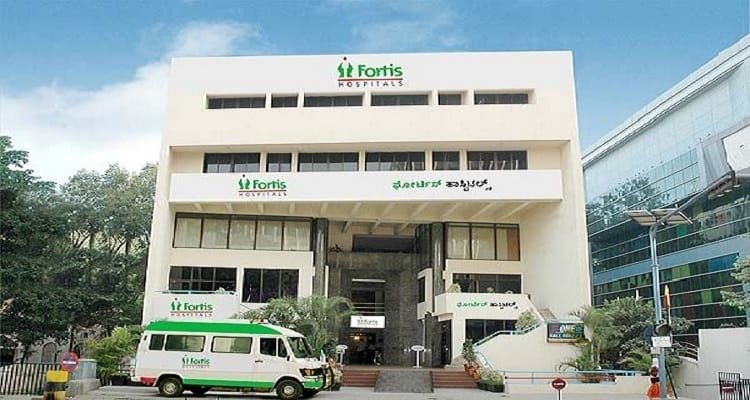
01 — At a Glance
When Hospitals Start Playing Monopoly With Real Money
- 52-Week High / Low₹1,105 / ₹521
- Q3 Revenue₹2,265 Cr
- Q3 PAT₹197 Cr*
- Q3 EPS₹2.57
- Annualised EPS (Q3×4)₹10.28
- Book Value₹125
- Price to Book7.15x
- Dividend Yield0.11%
- Debt / Equity0.34x
- Net Debt₹2,547 Cr
Quarterly Snapshot: Fortis closed Q3 FY26 with ₹2,265 crore revenue (+17.5% YoY), ₹505 crore operating EBITDA (+34.8% YoY), and 22.3% EBITDA margin expansion. The reported PAT of ₹197 crore was hit by ₹55 crore one-off Labour Code expense (partly offset by ₹9 crore impairment reversal). Strip out the noise, and pre-exceptional earnings were ₹312 crore (+21.9% YoY). The stock, trading at 66.9x P/E and 7.15x book value, has turned into a high-conviction hospital play for those patient enough to believe in 10–12% revenue CAGRs.
02 — Introduction
The Hospital Chain That Went From Scandal to Acquisition Spree
Fortis Healthcare has had a more dramatic life story than a Netflix series. Founded in 1996, it became a household name in private healthcare. Then, in 2015–2018, it imploded under the weight of massive debt and shocking founder fraud—the Singh brothers went to jail, the company was essentially seized, and shareholders got wiped. By 2018, Malaysian healthcare giant IHH Healthcare stepped in as the white knight, bought a 31% controlling stake for ₹4,000 crore, and has been quietly rebuilding ever since.
Fast forward to Q3 FY26 (December 31, 2025). Fortis isn’t just surviving—it’s thriving. Operating 33 hospitals across India with 5,700+ operational beds, a diagnostics network (Agilus) with 4,370+ customer touchpoints conducting 40+ million tests annually, and management that actually seems to know what it’s doing. The company has gone from barely profitable to posting ₹950 crore+ annual operating cash flow.
Oh, and they’re acquiring hospitals like they’re collecting Pokémon cards. In the last quarter alone, they bought People Tree Hospital in Bengaluru for ₹430 crore (with plans to add another 175 beds), completed Jalandhar acquisition, and are eyeing more. The debt levels crept up, but management keeps insisting the balance sheet has “room for more.” We’ll believe it when the credit rating agencies do.
From the Concall (Feb 2026): “The debt/EBITDA number is not that alarming… still room to take some more debt,” per management on leverage headroom post-acquisition. Confidence or recklessness? The spread between those two is what equity investors are being paid for.
03 — Business Model: Cash Extraction From Sick People (Ethically)
Hospitals + Diagnostics + M&A = The Desi Healthcare Playbook
Fortis makes money the old-fashioned way: by running hospitals and diagnostic labs. Hospitals bring in ₹1,938 crore quarterly revenue (86% of total), while Agilus Diagnostics adds ₹327 crore (14% of total). Both businesses are growing, and margins are expanding—a rare combination in Indian healthcare where occupancy and ARPOB (average revenue per operating bed) usually move inversely.
The hospital business itself is sliced roughly as follows: oncology (16.2% of revenue), cardiac sciences (16.8%), neurosciences (8.2%), orthopedics (8.3%), and the rest scattered across OPD, IPD, and miscellaneous specialties. No single specialty exceeds 20%—textbook diversification that reduces the “get hit by one regulation” risk.
Revenue mix: 62% from surgical procedures, 29.5% from digital channels (online booking, telemedicine, apps), 8.1% international patients. Payer mix: 36.3% from TPAs (insurance), 34.2% from cash patients, 8.1% international, 7.5% ECHS, 4.3% CGHS. In other words, Fortis doesn’t bet its house on any one revenue stream. Scale and diversification are the moat here—and IHH’s global backing provides access to global protocols, training, and most importantly, capital when things get scary.
Hospital Occupancy67%FY26 Q3
ARPOB₹2.56 CrPer Annum
Tests (Agilus)39.2 Mn9M FY26
Bed Capacity5,700+Operational
💬 Quick take: If occupancy is only 67%, where’s the growth coming from? Hint: (i) absolute capacity expansion, (ii) higher realization per bed, (iii) case complexity climbing. That’s the play.
04 — Financials Overview
Q3 FY26: The Quarterly Results
Result type: Quarterly Results | Q3 FY26 EPS: ₹2.57 | Annualised EPS (Q3×4): ₹10.28 | *Reported PAT includes ₹46 Cr net exceptional loss (₹55 Cr Labour Code provision less ₹9 Cr impairment reversal)
| Metric (₹ Cr) |
Q3 FY26 Dec 2025 |
Q3 FY25 Dec 2024 |
Q2 FY26 Sep 2025 |
YoY % |
QoQ % |
| Revenue | 2,265 | 1,928 | 2,331 | +17.5% | -2.8% |
| Operating EBITDA | 505 | 374 | 556 | +34.8% | -9.2% |
| EBITDA Margin % | 22.3% | 19.4% | 23.9% | +290 bps | -160 bps |
| PAT (Reported) | 197 | 254 | 329 | -22.4% | -40.1% |
| PAT (Pre-Exceptional) | 243 | 232* | 375 | +4.7% | -35.2% |
| EPS (₹) — Reported | 2.57 | 3.28 | 4.26 | -21.6% | -39.7% |
The Fine Print: Q3 reported PAT of ₹197 Cr got whacked by ₹55 crore Labour Code provision (new statutory requirement for employee benefits). Strip that out, and operational PAT was ₹243 crore. Q2 saw sequential decline in EBITDA (normal post-seasonal dip) and higher tax load. The real story: revenue +17.5% YoY, operating EBITDA +34.8% YoY, and EBITDA margins expanded 290 bps. That’s the operational heartbeat. The quarterly PAT swings are noise—what matters is the 9-month trajectory.
05 — Valuation: Fair Value Range
Is ₹893 Expensive, or Are We Pricing In “The Next Five Years”?
Join 10,000+ investors who read this every week.