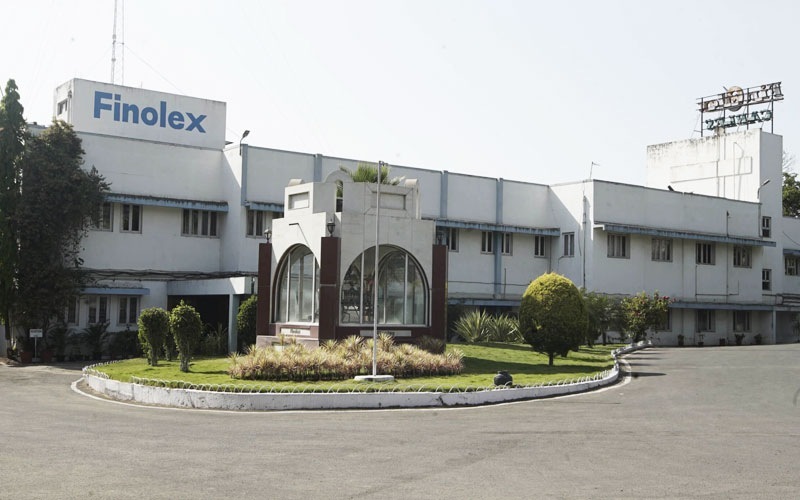
Finolex Cables FY26: 19% Sales Growth, Margins That Won’t Budge
General information and entertainment, not investment advice. The author is not a SEBI-registered adviser or research analyst. No recommendation, no promised returns. Markets carry risk including loss of capital. Figures may not be current. Consult a registered adviser before acting.
1. At a Glance
Finolex Cables closed FY26 with ₹6,321 crore in revenue—a 19% leap from FY25’s ₹5,319 crore. The headline was volume-driven muscle in electrical cables, especially auto cables (+30%) and power cables (+21%). Yet profit barely budged: PAT rose only 2% to ₹714 crore while EBITDA margin sank to 9.8%, the lowest in a decade.
The year’s story was one of quantity over quality. Copper price swings, Middle East supply shocks, and aggressive repricing by management (14 upward adjustments in FY26) kept the business running at velocity but crushed the payoff. Electrical cables—84% of revenue—is now splitting from retail-heavy (80/20 split historically) toward project-led work (two-thirds project, one-third retail), which brings scale but thinner spreads.
Communication cables stayed dead-flat in revenue (₹626 crore both years) until Q4 exploded +30% YoY when fiber prices hardened globally. The company doubled fiber capacity by July and commissioned its preform plant in March—a backward-integration bet that won’t pay till Q3. Working capital blew out: inventory climbed ₹305 crore year-on-year as the company pre-stockpiled post-geopolitical shocks.
The balance sheet is fortress-like. Zero debt, ₹168 crore cash on hand, ₹4,195 crore in investments. Yet that fortress guards nothing if ROCE stays stuck at 16% and capex burns ₹240 crore annually.
Does ₹6,321 crore revenue justify a P/E of 21.5 when the margin is contracting and the multiple is already 1.8x the peer median?
2. Introduction
Finolex Cables has been twisting copper for 70 years. Founded in 1956, it’s the second-largest organized electrical cables player in India (24.9% market share as of FY24), sitting uneasily behind market leader Polycab India. The company operates across electrical, communication, and specialty cables, with a sprawling distribution network: 5,000+ channel partners, 225,000+ retailers, and 600 distributors as of late FY25. It also dabbles in FMEG (fans, switches, LED lights), which contributed 4% of revenue in FY26.
The past 18 months have been marked by three uneasy transitions. First, copper volatility (LME prices swung wildly through FY26) forced the company to reprice products monthly and live with destocking cycles. Second, Q4 FY26 brought a “shock from the Middle East,” cited by management, that inflated raw material costs and inventory even as global fiber markets tightened due to U.S. data center demand and geopolitical supply constraints. Third, the Chhabria family dispute—a long-standing legal battle between Deepak Chhabria and Prakash Chhabria over control—added a shadow to the board.
In May 2026, Mahesh Viswanathan stepped in as CEO and Sachin Naik as CFO, marking the first external leadership appointment. The board voted a 450% dividend on FY26 earnings (₹9 per share against ₹2 face value), signaling excess capital but also a lack of organic growth optionality.
3. Business Model: WTF Do They Even Do?
Finolex is a cable company that manufactures cables. This is not a metaphor.
Electrical cables dominate: 84% of revenue, serving residential wiring, automotive underbody harnesses, industrial flexibles, solar installation, and agricultural pump wiring. The company is backward-integrated—it makes its own copper rods in-house, feeding a sprawling manufacturing footprint across Maharashtra (Pune, Pimpri), Goa, and Uttarakhand (Roorkee).
Communication cables (10% of revenue) pivot on optic fiber. Until late FY25, this segment was a zombie—fiber prices collapsed for 7–8 months as Chinese and Japanese capacity flooded the market. From October onward, prices recovered as U.S. data centers and European geopolitical rearmament sucked up supply. The company’s JV with Japan’s J-Power Systems (now called Finolex J-Power Systems, 49% stake) manufactures ultra-high-voltage power cables and turned profitable in FY26 with ₹450 crore revenue and ₹21 crore EBIT.
The FMEG and copper rod segments (5–6% combined) are margin-negative or break-even. Fans got battered by BIS norm changes and unseasonal monsoons. Lighting margins continue to erode.
The real backbone is still electrical cables in the organized retail channel and now expanding into project work (transmission lines, metro rail installations, power plants). But the company faces a structural problem: organized electrical cables are a fragmented, commodity-like market where volume matters and pricing power evaporates monthly.
4. Financials Overview
Figures are consolidated, in ₹ crore.
Metric
Q4 FY26
Q-o-Q
Y-o-Y
FY26
FY25
Y-o-Y
Revenue
1,951
+22%
+22%
6,321
5,319
+19%
EBITDA
236
+22%
+7%
868
760
+14%
PAT
161
+19%
+6%
714
700
+2%
EPS
₹10.54
—
—
₹46.67
₹45.82
+2%
Quarterly Progression: Q4 delivered the strongest quarter in company history on electrical segment volume, but EBITDA margin compressed to 12.1% (vs. 14.3% in Q3) due to late-quarter raw material cost shocks. Operating leverage showed up (revenue +22%, EBITDA +22%, PAT +19%), but the margin beat came from a low base in Q3.
Full-Year Trajectory: FY26 saw revenue accelerate from the trailing 12-month pace (TTM sales +19%) while profit growth flatlined (TTM PAT +2%). This split reveals the crux: management is chasing volume at the cost of margin. The company implemented ~14 price resets during FY26; despite that, customers at the end-consumer level pushed back. Electrical cables’ effective market price move was 24–25%, meaning raw materials absorbed most of that bounce, not profits.
Management Commentary (Concall): The company attributed margin compression to three drivers:
Copper price volatility and frequent repricing (distribution channel reluctance to stock; trade stocking at “conservative levels”).
Non-copper raw material cost hikes (aluminum, PVC, etc.) post-Middle East disruptions.
INR depreciation (small offset, but material).
Management expects “higher cost of production than before” to persist but believes pricing power will normalize. No formal guidance on FY27 was given due to “war-driven volatility.”
5. Market Expectations & Historical Multiples
This section describes how the market is currently pricing the company and how that compares with its own history and peer group. It is descriptive, not predictive.
Metric
Current
Historical 5-Yr Avg
Peer Median
P/E
21.5
20.2
26.9
EV/EBITDA
15.4
—
—
P/B
2.52
—
3.31
ROE
12.3%
13.5%
19.31%
ROCE
16.0%
18%
20.71%
The market pays 21.5x earnings here, against a peer median of 26.9x. This suggests the market is pricing in lower confidence relative to peers like Polycab (P/E 53.8), KEI Industries (54.2), and R R Kabel