Banco Products (India) Ltd FY26: Revenue 21% Up, But Margins & Multiples Sit at Odd Angles
General information and entertainment, not investment advice. The author is not a SEBI-registered adviser or research analyst. No recommendation, no promised returns. Markets carry risk including loss of capital. Figures may not be current. Consult a registered adviser before acting.
1. At a Glance
Revenue crossed ₹3,900 Cr for the first time, up 21% from ₹3,213 Cr in FY25. Net profit climbed to ₹482 Cr from ₹392 Cr—a gain of 23% year-on-year.
Operating margins remained steady at 17.5%, cushioned by a subsidiary’s insurance claim for €6.56 Mn (₹705 Lakhs) filed after a warehouse fire in NRF France. Strip that out, the core business held its line.
But at ₹662 on the reference price, the market pays 20x trailing earnings. The peer group (Bosch, Uno Minda, Schaeffler) trades at multiples between 50x and 92x. Why the gap? Ownership, scale, and a balance sheet that has grown faster than clarity.
A 400% final dividend (₹8 per share) was recommended, consistent with the promoter’s mood: “siphon cash back and then some.”
2. Introduction
Banco Products was incorporated in 1961 as an automotive components supplier. For the next 50 years it made radiators, oil coolers, and transmission systems—the invisible organs of internal combustion. Mehul K. Patel, the chairman, built it that way: single-purpose, reliable, unglamorous.
Since 2010, the company acquired a European footprint via NRF (Nederlandse Radiateuren Fabriek), a Dutch-rooted maker with warehouses across 19 European locations. That subsidiary now contributes 30% of revenue and houses the chaos of a recent fire.
In 2021, Banco launched Banco New Energy Cooling Systems as a wholly-owned vehicle for EV cooling—a hedge against the combustion engine’s slow fade. It has also picked at turbocharger patents, expanded into Romania, and doubled down on geographic reach: Turkey got an office in April; Romania, a warehouse in the same month.
The company is listed on BSE and NSE. Promoters hold 67.9% of equity, split across Mehul Patel (55.59%) and family. No pledges. FII ownership crept to 4.06%; DIIs remain negligible at 0.22%.
3. Business Model: WTF Do They Even Do?
Banco makes engine cooling modules in two forms: radiators, charge air coolers, oil coolers, AC condensers, deaeration plastic tanks, metal-layered gaskets. These sit inside cars, trucks, buses, forklifts, and industrial equipment. They are boring. They are also non-negotiable: without them, an engine boils, leaks, or seizes.
The company operates three business arms: OEM (customer base includes Ashok Leyland, Mahindra, TATA, Eicher, JCB), Aftermarket (a distribution network across India serving fleet operators and repair shops), and Exports (direct contracts with global OEMs and aftermarket channels).
Geographically, India contributes 70% of revenue; international, 30%.
The product portfolio is both a strength and a ceiling. Radiators for passenger cars have commoditized; margin pressure from Chinese competitors is real. EV cooling is higher-margin but smaller. Turbochargers are a bet, not yet a business. The company makes many things competently but owns none uniquely.
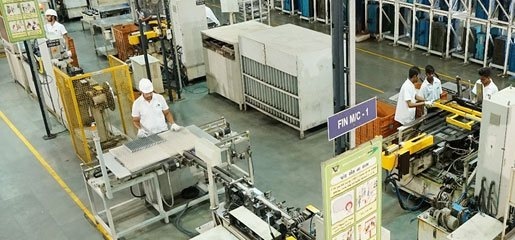
Five manufacturing plants can produce 3.33 million radiators annually. NRF operates 19 warehouses across Europe and handles 8,000 SKUs (now 13,000 after recent catalogues). The company spent ₹6 Cr on R&D in FY24 and likely similar in FY25—just shy of 0.2% of revenue. For a thermal-systems maker hedging into EVs and turbos, that’s lean.
4. Financials Overview
Figures are consolidated, in ₹ crore. Results are annual (full-year FY26).
Metric
FY26
FY25
YoY Change
Revenue
3,896
3,213
+21.3%
EBITDA
816
705
+15.7%
PAT
482
392
+22.9%
EPS (₹)
33.68
27.39
+23.0%
Revenue expanded briskly, lifted by OEM order intake and aftermarket resilience. EBITDA swung up but left OPM flat at 17.5% (FY25: 19.4%). The margin dip was deliberate: the fire claim (€6.56 Mn, accrued as ₹2,150 Lakhs as an exceptional item in FY26) pulled reported profit. Adjust for that, and core margins were healthier.
PAT rose 23%, in line with sales. EPS stood at ₹33.68 (consolidated) after issuing a bonus (1:1) in FY25, which halved the share count and doubled the par value. The company also declared ₹16,113 Lakhs of dividend from its subsidiary NRF—a one-time hit to reported profit but a cash distribution that inflated the tax bill.
Interest costs rose to ₹23 Cr from ₹26 Cr, a marginal relief from deleveraging. Tax rate stayed at 25%.
5. Market Expectations & Historical Multiples
This section describes how the market is currently pricing the company and how that compares with its own history and peer group. It is descriptive, not predictive.
Metric
Current
5-Yr Average
Peer Median
P/E
20.3x
14.5x
27.5x
EV/EBITDA
12.8x
—
—
ROE
31.2%
27.0%
13.5%
ROCE
30.9%
—
15.9%
The market currently pays 20x earnings, a premium to its own five-year average (14.5x) but a discount to the peer set (27.5x median). Bosch trades at 48x; Schaeffler at 50x; Uno Minda at 52x. Banco sits apart.
The gap reflects capital intensity and growth: Bosch is cash-generative, stable; Uno Minda and Schaeffler are riding EV exposure and margin expansion. Banco’s growth is solid but front-loaded into a near-term OEM cycle. The fire has also obscured the trajectory: how much upside or downside does the NRF warehouse disruption imply?
At 20x, the market appears to price Banco as a mature regional player with emerging EV optionality, neither a cyclical commodity play nor a structured-growth story. ROE and ROCE, both above 30%, suggest capital is working hard—a rarity in auto components.