Spotted a factual error — a wrong number, date, or fact? Tell us and we will check the source.
Europe’s quest for financial sovereignty
Spooked by US adventurism, Russian aggression and Chinese protectionism, the EU is rushing to assert its financial sovereignty through a range of initiatives. Will they work? Alex Katsomitros reports
July 28, 2026
When the Italian bank UniCredit started building a significant stake in the German lender Commerzbank in 2024 as part of a takeover strategy, the German government strongly opposed the move, calling it ‘hostile,’ partly due to Commerzbank’s importance to German industry. Commerzbank rejected the offer, although officials at the European Central Bank (ECB) warned that such resistance undermined the single European banking market. The episode, however, served as a stark reminder of a contradiction in the EU’s financial architecture: although member states support deeper integration, they are often reluctant to surrender control. Yet further consolidation may still lie ahead, as calls for EU autonomy in finance continue to grow.
Pushing for autonomy
Ever since the EU single market emerged in the 1990s, experts have argued that the EU will never become a true superpower unless its financial services sector becomes both genuinely European and globally competitive. Yet it has been a recent confluence of internal and external pressures that has added urgency to these demands. Brexit marked a setback for the EU by depriving it of the City of London, its single globally significant financial centre; since then, the bloc has relied on a patchwork of hubs – including Frankfurt, Dublin, Paris, Milan and Amsterdam – none of which match the scale of New York or Hong Kong. Then came Russia’s invasion of Ukraine, which prompted financial sanctions against Russia, including the exclusion of Russian banks from the Brussels-based SWIFT system and the freezing of Russian assets in Europe, all stressing the EU’s alignment with US financial architecture.
Even more significant was Trump’s victory in the 2024 presidential election, which reminded Europeans that nationalism is a feature rather than a bug of 21st-century America. Since Trump returned to the presidency, US economic policy has been staunchly anti-European, with higher tariffs on EU products making the need for European sovereignty more pressing. A speech by Vice President JD Vance in Munich last year unsettled European policymakers, as did renewed pressure on Denmark over Greenland, including suggestions the territory could come under US control.
Fears that the invisible thread holding together the transatlantic alliance has frayed are now spilling over into the financial sector. European policymakers are openly questioning whether the Federal Reserve, under a nationalist US administration, would still fulfil its role as the global lender of last resort, as it did during the Great Recession.
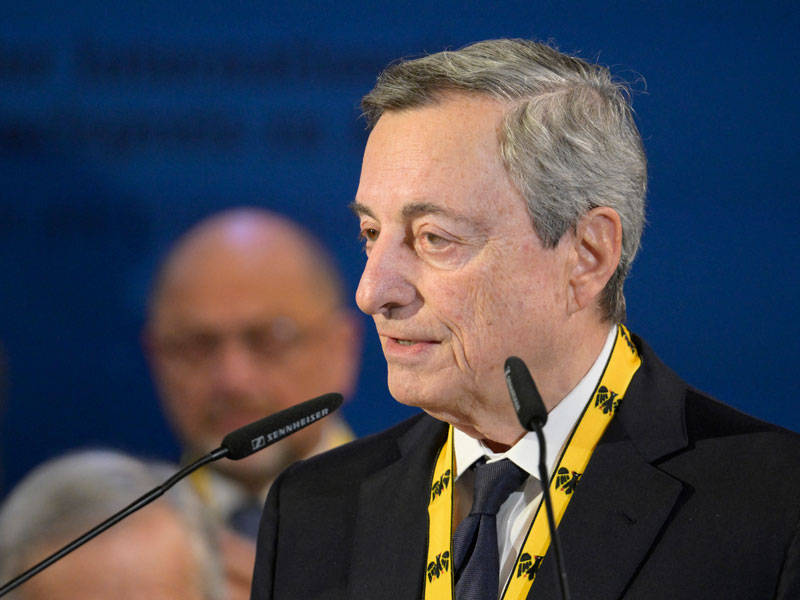
Former President of the European Central Bank Mario Draghi
A report led by Mario Draghi has injected fresh urgency into calls for European financial sovereignty, arguing that the EU risks falling behind competitors unless it accelerates financial integration. The former ECB president frames the challenge as a strategic imperative in an era of geopolitical fragmentation. A separate EU-commissioned report led by Enrico Letta reinforces the message from a single market perspective. Letta argues that Europe must complete its internal market to unlock scale. His proposals emphasise removing barriers to cross-border investment, harmonising rules and strengthening common institutions to mobilise private capital. Both reports highlight structural weaknesses – fragmented capital markets, limited risk-sharing and insufficient depth in financial services – and warn that without reform Europe will struggle to fund priorities such as the green transition, digital innovation and, crucially in a fraying geopolitical environment, defence. True to form, European policymakers have taken their time to absorb the lessons. “The Draghi report has been widely discussed by political leaders,” says Holger Schmieding, chief economist at Berenberg Bank, the world’s oldest merchant bank. “In that sense, it has shaped the debate. But so far, few of the steps Draghi has recommended have been taken.” Yet, taken together, the two reports have helped crystallise a consensus that financial integration is essential if Europe is to secure its strategic autonomy.
A question of capital
At the epicentre of the debate lies the consolidation of EU capital markets, a project the bloc has been pursuing for over a decade. One of the weaknesses in Europe’s economic model identified by the Draghi report is the underuse of the bloc’s accumulated capital. Compared with the US, Europe has struggled to channel savings into investment for companies, particularly in the technology sector. Approximately €14trn of retail capital in Europe is estimated to be sitting idle in deposits.
Another concern is that Europe’s investment landscape is gradually being dominated by US firms. American investment banks already play a leading role in Europe’s capital markets, accounting for roughly 40 percent of investment banking fees and an even larger share in key areas such as M&A and equity underwriting. Three US asset managers – BlackRock, Vanguard and State Street – have been steadily expanding their presence in Europe while often maintaining a home bias toward US investments. The sector remains underdeveloped in Europe, as governments discourage cross-border activity to retain domestic savings and sustain demand for public debt.
In a bid to deepen Europe’s capital markets, the European Commission has relaunched its plans for a capital markets union under the broader banner of a ‘Savings and Investment Union.’ Measures under consideration include tax incentives to encourage retail investment in European assets, changes in capital requirements for banks and insurers to support lending, and reforms to private pension and savings frameworks aimed at channelling household savings into capital markets.
Another goal is to build a unified regulatory regime for equities, bonds and other investment vehicles that could improve investor confidence and reduce regulatory arbitrage. By harmonising regulations and removing barriers to cross-border investments, the scheme aims at diversifying funding sources for businesses beyond the banking sector.
The reforms aim to indirectly tackle a long-standing problem in the European economy: overbanking – too many banks competing for a relatively fixed pool of capital. The large number of banks across Europe has limited economies of scale and weakened competition, while encouraging firms to rely more heavily on bank lending than on bonds or equity financing. This, in turn, has slowed the development of deeper capital markets. Sceptics warn that even if implemented, the plans do not go far in addressing structural problems. “The proposals so far will further harmonise capital markets but not complete it {the union},” says Carsten Brzeski, global head of macro research at ING Research, part of the Dutch bank ING, adding: “Another hampering issue will be tax issues and how to deal with different taxation of capital gains and asset wealth.”
What is fuelling optimism, though, is a gradual change in the political mood. The bloc’s largest economies have backed the Commission’s proposal to expand the supervisory role of the European Securities and Markets Authority (ESMA) in Paris, giving it direct oversight of major cross-border market infrastructures, including central counterparties, securities depositories, selected trading venues and crypto-asset service providers.
Currently supervision remains largely national, even for institutions whose activities span multiple jurisdictions, as member states resist EU-level oversight. “National regulators have and will continue to have for a long time a key role as components of the euro area-wide supervisory system,” argues the economist Ignazio Angeloni, senior policy fellow at the Leibniz Institute for Financial Research SAFE and former member of the ECB’s supervisory board. A mixed model, such as the one created for banking supervision within the ECB during the eurozone debt crisis, would be the best option, he suggests. “The structure of the Single Supervisory Mechanism (SSM), where the supervisory board, effectively its decision-making arm, includes national banking supervisors as voting members, has proved viable and can be extended to market supervision.”
Long-awaited banking union is closer
Reforming Europe’s financial architecture requires reviving the politically sensitive project of a fully fledged banking union. However, removing the national barriers that fragment European banking has long proved difficult. The plan was announced with great fanfare in 2012 during the Eurozone debt crisis, but the job remains unfinished. Eurozone banking remains a loosely connected