Emkay Tools Ltd (FY26): Tap Master Meets Valuation Vertigo
General information and entertainment, not investment advice. The author is not a SEBI-registered adviser or research analyst. No recommendation, no promised returns. Markets carry risk including loss of capital. Figures may not be current. Consult a registered adviser before acting.
1. At a Glance
Threading taps aren’t sexy. But a margin profile pushing 57% while the market remains quiet is. Emkay Tools closed FY26 with revenue of ₹144 Cr—up 24% from ₹117 Cr a year earlier—and net profit of ₹59 Cr, a 32% climb. The stock trades at 17.4× trailing earnings, a figure that sits alongside competitors paying 30× and above.
What gets interesting is the raw return on capital. The company generated 71% ROCE last year and 52% ROE, paired against debt sitting at zero. Yet the balance sheet holds ₹77 Cr in investments and just ₹4.5 Cr in cash—an unusual posture that raises a direct question: does a business that strong need to park capital elsewhere?
The operational story: thread cutting taps for industrial use, niche enough to protect margins, distributed enough (95% same-day dispatch) to keep customers tied in. Exports account for 8% of revenue; the domestic moat looks durable.
The tension: A company with textbook capital returns trades at a multiple that looks restrained by peer standards—yet the absolute valuation against cash flows, working capital intensity, and market cap suggests the profit pool may already be in the price.
2. Introduction
Emkay Tools was incorporated in 2023 and listed on NSE Emerge in July 2025. This is a young company on paper, old in practice: it has been manufacturing high-speed steel (HSS) taps for over two decades before incorporation, run by the Kanoria family, now assembled as one of India’s largest captive tap manufacturers.
The company operates four facilities with a combined monthly capacity of approximately 200,000 taps. Nine product lines span spiral-point, spiral-flute, fluteless, pipe, and specialty taps serving automotive, aerospace, agriculture, electrical, and engine manufacturers.
Recent moves: The board approved FY26 audited results on 29 May 2026 with an unmodified audit opinion. A final dividend of ₹2.50 per share was announced, though the company has historically paid no dividends—this marks the first payout. Promoters, led by Ajayprakash Murlidhar Kanoria and his family entities, hold 75% of equity. The public float sits at 25%, with no institutional ownership at year-end.
3. Business Model: WTF Do They Even Do?
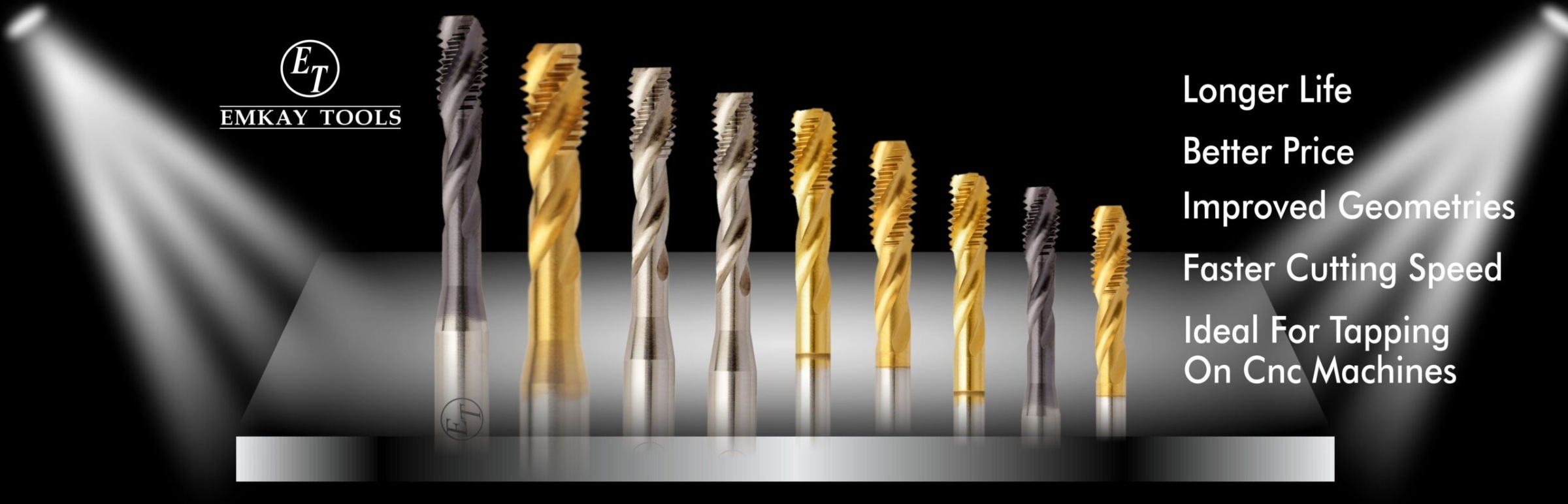
Thread cutting taps are precision tools used to cut threads inside materials. Every automotive engine block, aircraft bracket, and electrical connector that needs an internal thread requires a tap. Industrial demand is continuous, unglitzy, and inelastic—if a factory shuts down, taps stop moving; if demand rises, it rises fast.
Emkay’s moat sits in speed and specialization. They maintain stock of ~10,000 SKUs and dispatch 95% of orders within 24 hours, a service window that keeps customers loyal to a supplier rather than hunting for cheaper alternatives across borders. The sales pitch is simple: “Custom taps for your exact material spec, made to order, here tomorrow.”
Revenue mix is 99% taps and tools, 1% trading and scrap. Exports (8% of sales) are concentrated in the US (4.5% of sales), pointing to a company still anchored in domestic OEM relationships. The largest customer base clusters around automotive—a sector that values predictability and near-zero defect rates.
Pricing power: At 57% operating margins (FY26), Emkay sits in the 99th percentile globally for precision tool makers. Peers typically run 12–15% OPM. This gap reflects both product mix—specialty taps for high-precision industries command premium pricing—and operational efficiency. The company charges per tap, not per hour; higher volumes of smaller, bespoke runs push SG&A down as a percentage of sales.
The fragility: concentrated in a handful of large automotive suppliers, vulnerability to EV transition timelines, and reliance on quarterly new-model launches and capex cycles. A pause in auto capex ripples fast through a precision tool supplier.
4. Financials Overview
Figures are consolidated, in ₹ crore.
Metric
FY26
FY25
YoY Change
Revenue
144.37
116.55
+23.9%
Operating Profit
80.11
61.78
+29.6%
Pat
58.72
44.49
+31.9%
EPS (₹)
55.03
41.69
+31.9%
Reading the headline numbers:
Revenue grew 24%, but the real story sits below the line. Operating profit—that is, earnings before interest, depreciation, and tax—expanded from ₹62 Cr to ₹80 Cr. This 29% jump outpaced sales growth, meaning the business got leaner, not just bigger. OPM moved from 53% to 56%, a 3-point expansion that compounds over the year.
Net profit, at ₹59 Cr, reflects a tax rate of 26%, unchanged from prior year. Interest expense dropped from ₹0.15 Cr to ₹0.01 Cr—nearly all debt was paid down (₹0.77 Cr outstanding in FY25, nil in FY26). Depreciation rose from ₹1.95 Cr to ₹2.85 Cr, a sign of recent capex hitting the books.
Annualised EPS for valuation: The FY26 full-year EPS is ₹55.03. Using this figure against the reference price of ₹880 (as per the Excel data), the P/E works to 16.0×. Against the current market price of ₹955 (per the document), P/E is 17.4×.
5. Market Expectations & Historical Multiples
This section describes how the market is currently pricing the company and how that compares with its own history and peer group. It is descriptive, not predictive.