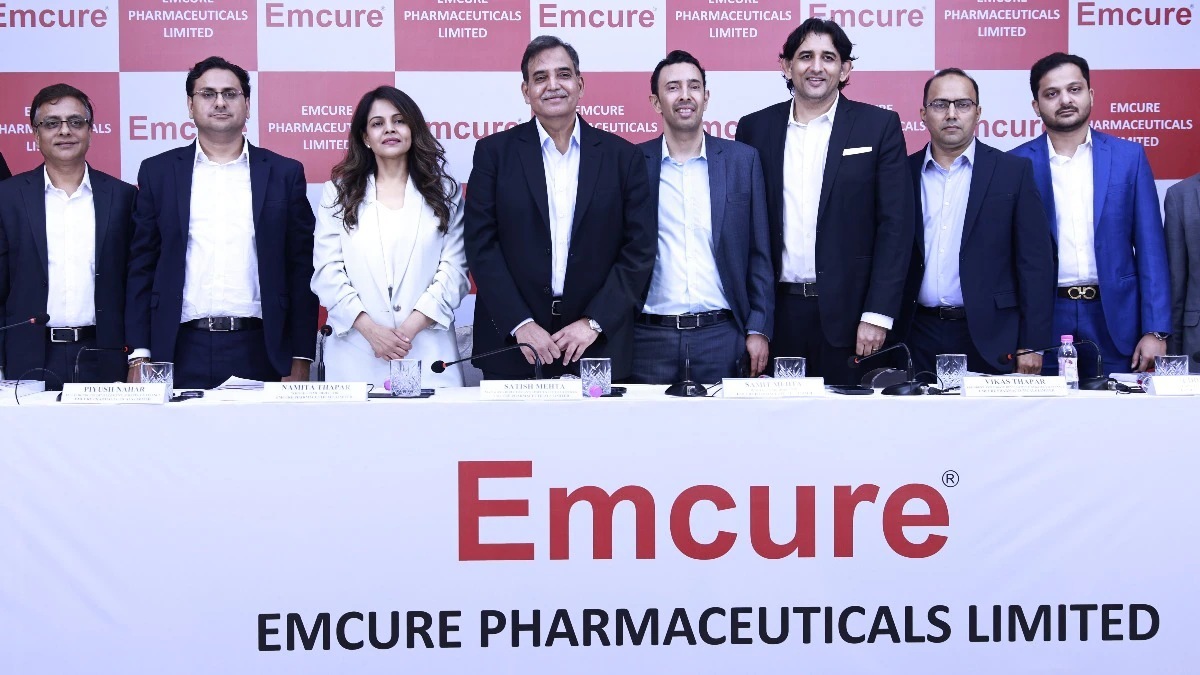
The pharmaceutical landscape is littered with companies that promise “specialty” but deliver nothing but generic price erosion. Emcure Pharmaceuticals just dropped a set of numbers that suggest they are successfully navigating the transition from a branded generic player to a complex specialty powerhouse. For the financial year ended March 31, 2026, the company didn’t just meet expectations—it sprinted past them.
The headline figure is a massive ₹9,204 Crore in annual revenue, marking a 16.6% growth. But the real story is hidden in the margins. Despite the heavy lifting required to integrate the Sanofi OAD portfolio and the strategic buyout of the Zuventus minority stake, Emcure managed to expand its EBITDA margins to hit 19.4%. In an industry where input costs and regulatory hurdles are constant headwinds, seeing bottom-line growth outpace the top-line is a significant indicator of operational efficiency.
However, it wasn’t all smooth sailing. A fire incident at the Hinjawadi plant in February 2026 and a GST search operation in late 2025 created temporary noise. While management claims “no material impact,” the stock market rarely likes the smell of smoke—literally or figuratively. The surge in Net Debt to ₹1,558 Crore is the price they paid for total control over Zuventus. The question now is: can they deleverage fast enough while funding a global biosimilar and liposomal pipeline?
1. At a Glance
The year FY26 was the “Year of the Big Swing” for Emcure. They crossed the US$1 Billion revenue milestone, a psychological and financial barrier that separates the mid-caps from the global heavyweights. The company is currently firing on two very different cylinders.
In India, they are aggressively pivoting toward Chronic therapies. We are talking about Cardiology, CNS, and Oncology—the high-margin business where patient loyalty is high. Their partnership with Novo Nordisk to launch Poviztra (Semaglutide) is a notable move. They are now among the few marketing the innovator drug in the weight-loss category in India. While the rest of the domestic pack is waiting for patent expiries to launch generics, Emcure is already in the room with the innovator.
Internationally, the growth was even more explosive at 22.2%. The European market grew by 25.5%, driven by the ramp-up of Amphotericin B, a complex liposomal injectable. This isn’t your run-of-the-mill paracetamol; it’s high-barrier manufacturing where few can compete. They’ve secured approvals across 23 countries for this product alone.
But let’s look at the friction points. The Gross Margin saw a slight dip in Q4 compared to the yearly average, primarily because the Sanofi in-licensed portfolio carries a different margin profile. Furthermore, the Zuventus reorganization caused a softer 5.2% growth in the domestic segment for Q4. Management is essentially rebuilding the engine while the car is doing 100 mph. They’ve also got a ₹350 Crore earnout due for the Mantra acquisition in Canada, which will keep debt levels in focus.
With a P/E of 33.4, it’s trading at a premium to some of its larger peers. The market is clearly pricing in the “Specialty Alpha.” If the execution on the biosimilar pipeline or the global rollout of Lenacapavir (HIV) falters, that premium could come under pressure.
2. Introduction
Emcure Pharmaceuticals has been a fixture in the industry since 1981. However, the Emcure of 2026 looks fundamentally different from its earlier iterations. They have transitioned from being a pure-play formulation company to a diversified giant with 13 manufacturing facilities and 5 R&D centers.
The company’s DNA is now split between three distinct segments:
- Domestic Formulations: Where they hold leadership in Gynaecology and are rapidly climbing the ranks in Cardiology (now 4th largest in India post-Sanofi deal).
- International Markets: Covering Europe, Canada, and Emerging Markets, which now contribute