General information and education, not investment advice. The author is not a SEBI-registered adviser or research analyst. No recommendation, no promised returns. Markets carry risk including loss of capital. Figures may not be current. Always consult a SEBI-registered adviser.
1. At a Glance
Dynamatic Technologies makes aircraft structures, hydraulic gear pumps and iron castings. Consolidated revenue for the three months to June 2026 came to ₹425 crore. That is 14.5% above the ₹371 crore of the same quarter a year earlier. Operating profit, the profit left before interest, tax and depreciation, reached ₹55 crore. The year-earlier figure was ₹38 crore, so the gain is 45.9%. Net profit came to ₹20.79 crore, against ₹10.77 crore a year earlier. The increase is 93.0%. The board declared an interim dividend of ₹3 per share.
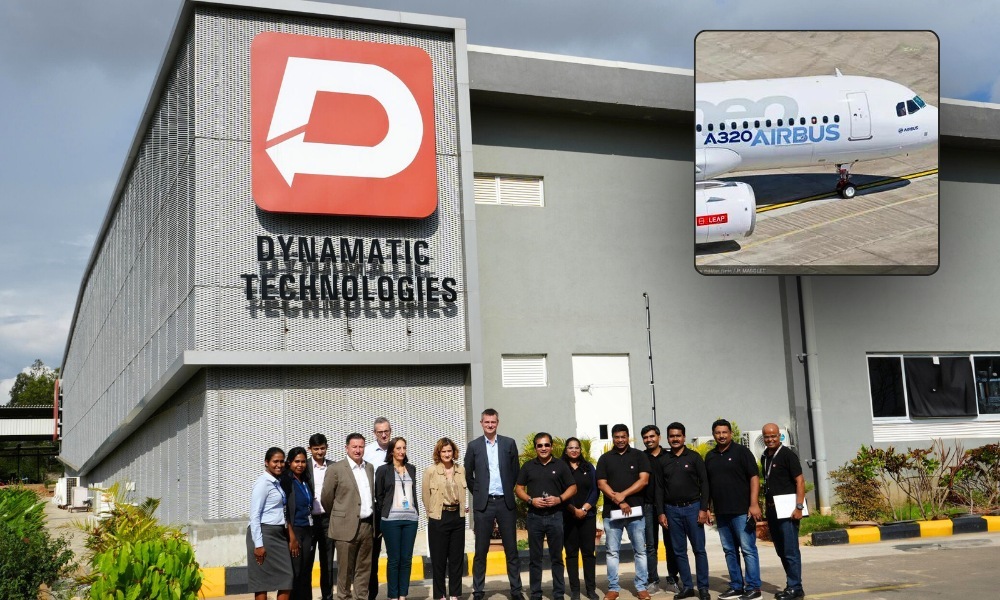
The venue is worth sitting with. Most Indian boards approve results in a conference room, with filter coffee and a slow projector. This one met inside a ferrous casting plant at Schwarzenberg, in Germany. It began at three in the afternoon, German time, and ran for two and a half hours. The auditor, Deloitte, signed the review report with “Place: Erla, Germany” on it. Deloitte flew to a foundry.
Aerospace supplied ₹202 crore of the quarter’s revenue, which is 48% of the total. Hydraulics brought in ₹116 crore and metallurgy ₹106 crore. All three segments grew, aerospace by 17.0% and metallurgy by 15.7%. Hydraulics grew 9.4%. Operating profit in hydraulics moved from ₹3.6 crore to ₹14.5 crore, on a small base.
Against the quarter immediately before it, revenue was 1.9% lower. Management states that a foreign exchange impact of ₹39.3 crore sits inside the growth. Adjusted for that, management puts revenue growth at 3.9% rather than 14.5%.
The twelve months to March 2026 carried revenue of ₹1,621 crore and net profit of ₹32 crore.
2. Introduction
Dynamatic Technologies was incorporated in 1973, older than most of the aircraft programmes it now supplies. Its fifty-first annual general meeting is scheduled for 15 September 2026. Keeping a hydraulics business in the family for fifty-one such meetings is a long innings. The equity history in the company’s own presentation reads like a slow-motion scrapbook. It listed in 1974 with equity capital of ₹0.29 crore. Rights issues followed in 1987, 1992 and 1994, and a bonus issue came in 1995. An amalgamation and a placement of shares with large institutions came in 2008. Warrants and another such placement followed in 2014. A preferential allotment in 2023 took year-end equity capital to ₹6.79 crore. Nine corporate actions across five decades works out at roughly one every six years, which is a restrained pace for a smaller listed company.
The company describes itself as one of the world’s largest makers of hydraulic gear pumps and automotive turbochargers. It serves customers across six continents from plants in India, the United Kingdom and Germany. Screener’s key points record an 80% share of the Indian tractor market among the firms that build the tractors, and about 38% globally. The company’s own presentation for the three months to June 2026 states roughly 70% of the organised Indian tractor market.
The recent story, as the filings tell it, is aerospace eating the mix. Screener’s extracted data puts aerospace at 18% of total revenue in the year to March 2016. The same data puts it at 47.8% in the year to March 2026. In the year to March 2024 the company moved its aerospace facility to a site near Bangalore International Airport.
The announcements have arrived at a fair clip since. April 2025 brought the inauguration of the assembly line for the D328eco rear fuselage, the back section of the aircraft body. In September 2025 the Airbus board visited to see a first article inspection of an A220 aft door, done with help from artificial intelligence, with eight doors ahead of schedule. In November 2025 the L&T-BEL consortium onboarded Dynamatic as exclusive partner for the AMCA fifth-generation fighter programme. December 2025 brought an award to make and assemble the complete rear fuselage of Dassault’s Falcon 6X. A January 2026 press release stated readiness to deliver a first complete ship-set of eight Airbus A220 doors, a ship-set being the full set for one aircraft, with over 99% indigenous content.
Running underneath all of that is a less glamorous project: moving hydraulics production out of Swindon and into Bangalore.
US
Now live
US Stocks terminal is live
13,000+ US tickers · EDGAR fundamentals · screener and filings feed — the same terminal, for American markets.
Explore →
3. Business Model: WTF Do They Even Do?
Three businesses share a factory-floor philosophy and almost nothing else.
Aerospace supplied 48% of revenue in the three months to June 2026. The segment makes wings, rear fuselages, ailerons and wing flaps. It also builds major airframe structures, ramp structure assemblies and aft pylon assemblies. Customers include Airbus, Boeing, Bell and Deutsche Aircraft. Prestwick Aerosystems, HAL and Dassault Aviation also buy from the segment. A single component here takes longer to certify than many companies take to reach a listing. In aerostructures, eight doors delivered ahead of schedule is itself a press release.
Hydraulics contributed 27%. It makes hydraulic valves, gear pumps and fan drive systems. It also makes combined displacement pump packages and fixed displacement pumps. A gear pump is a device whose entire job is to move oil in a straight line with dignity. The company has spent over five decades becoming one of the world’s largest makers of them. Customers include Cummins, Eicher, Escorts and John Deere. JCB, Mahindra & Mahindra, New Holland and Same Deutz-Fahr are also on the list, as are Terex and MacDon. The company states that it holds the design rights for every product made in this segment.
Metallurgy contributed 25%, through casting and forging. Products include case fronts, intake manifolds, exhaust manifolds and turbocharger components. Customers include Audi, BMW, Daimler and IHI, alongside MAN, BorgWarner and AGCO. The German subsidiary Eisenwerk Erla