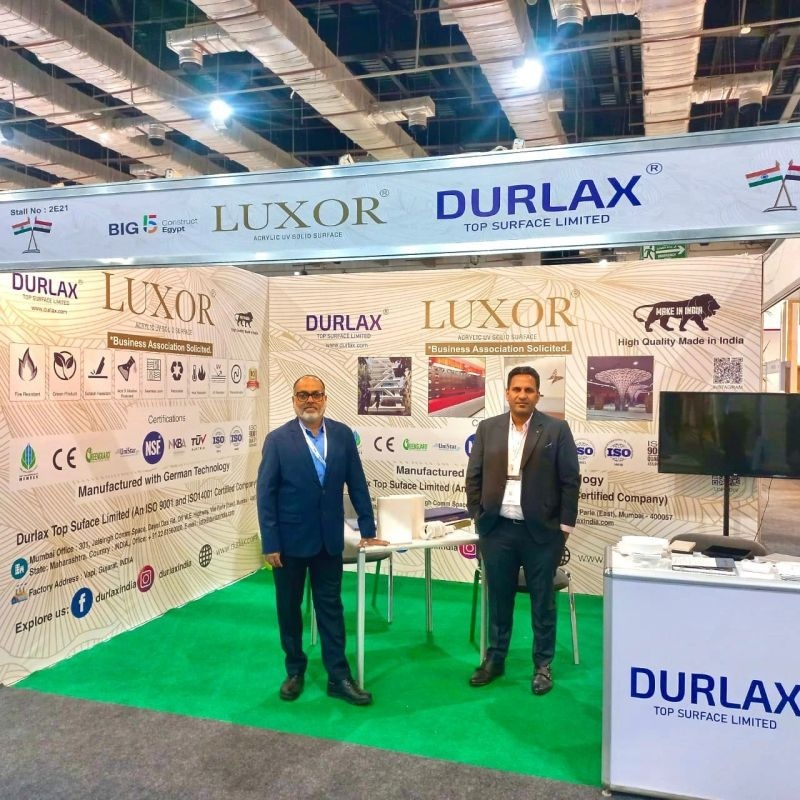
Durlax Top Surface FY26: The ₹49-Crore Sheet Drama That Floated the Balance Sheet
Section 1 — At a Glance
A dramatic cash transformation redefined the financial landscape for Durlax Top Surface in FY26. The manufacturer of solid surface materials went from scraping the bottom of its bank accounts to holding an unprecedented pile of liquid assets. Headline growth paints a picture of a micro-cap sprinting for scale, with top-line expanding sharply and net profitability accelerating to record heights.
Yet, beneath the glossy surface of expanding margins and surging revenues lies a corporate architecture radically altered by a massive equity expansion. The capital required to sustain this aggressive volume growth did not emerge from standard operational generation. Instead, it arrived courtesy of a heavily utilized structural funding event that hit the ledger just before the close of the financial year.
For public market observers, the core dilemma is balancing this newly acquired balance sheet cushion against structural inefficiencies. Working capital cycles continue to trap substantial funds, trade receivables are climbing faster than actual deliveries, and operational cash flows remain deeply negative. The business is scaling up its production footprint significantly, but historical capacity utilization trends indicate that selling these additional volumes will require navigating an incredibly fragmented domestic market.
Corporate actions have added layers of complexity, with key managerial transitions and promoter structural changes occurring simultaneously with the funding round. A business can easily camouflage structural constraints with fresh capital, but true economic value is determined when that capital is converted into cash returns rather than uncollected ledger balances. The immediate horizon will test whether this liquid fortress can successfully generate high-yielding capital efficiency.
Section 2 — Introduction
Durlax Top Surface has spent the better part of the last decade operating out of its manufacturing base in Vapi, Gujarat, churning out solid surface sheets that eventually become seamless countertops, office vanities, and hospital reception desks. In the world of premium interior surfaces, it is an environment where you are either a high-margin brand or a commoditized volume pusher.
For years, Durlax functioned as a quiet, tightly controlled regional player. However, FY26 marked the period where management decided to abandon the comfort of a lean capital structure. They stepped onto the public stage with an aggressive push for national scale, a major equity dilution via a rights issue, and an investment thesis that promises high-growth luxury finishes while keeping its working capital heavily dependent on external funding injections.
Section 3 — Business Model: WTF Do They Even Do?
Durlax basically manufactures artificial stone sheets so that commercial complexes, hotels, and luxury homeowners can feel fancy. They execute this through two primary brands: LUXOR, which handles the premium acrylic UV solid surface sheets, and ASPIRON, which peddles modified solid sheets. They boast about things like “seamless designs” and “antibacterial properties,” which translates to selling expensive plastic-resin blocks that look like marble but do not stain when someone spills coffee.
The geographical realities of this operation, however, reveal a deep reliance on local turf. Despite claiming a national footprint, Maharashtra accounts for a massive 72% of their revenue. Their distribution framework mirrors this concentration, with Maharashtra swallowing up 58.67% of their distributor network. International presence is mostly a conversational talking point, sitting at a minor 4.5% of sales across a few Middle Eastern and South Asian spots.
Worse still, they suffer from heavy customer dependency, with their top 10 buyers hoarding 78% of total sales. If three of these key interior infrastructure distributors decide to look elsewhere, a massive chunk of Durlax’s demand vanishes overnight.
Section 4 — Financials Overview
Figures are standalone, in ₹ crore.
Half-Yearly Performance Table
Metric
Latest Half (Mar 2026)
YoY (Mar 2025)
Previous Half (Sep 2025)
Revenue
116.37
115.54
68.18
EBITDA / Operating Profit
15.35
11.54
7.14
PAT
9.60
4.12
3.04
EPS (₹)
3.32
1.42
1.10
The second half of FY26 was an absolute absolute sprint for