Duncan Engineering Ltd Mar 2026: Working Capital Explodes to 170 Days as Cash Flow Turns Negative
Section 1 — At a Glance
Duncan Engineering Ltd logged a revenue from operations of ₹80.67 crore for the fiscal year ended March 31, 2026, marking a top-line contraction of 4.77% compared to ₹84.71 crore in the previous fiscal. Net profit for the full year decelerated by 6.72% to ₹4.86 crore down from ₹5.21 crore in FY25, highlighting a multi-year earnings erosion where three-year compounded profit growth sits at negative 21%. While the company’s operating profit margins expanded slightly from 8.61% to 9.14% on the back of lower raw material procurement costs, severe working capital stress has begun to completely choke liquidity.
Investor attention is sharply trained on the massive divergence between paper accounting profits and actual cash realization, with cash from operating activities sinking into negative territory at -₹0.62 crore for FY26. The primary culprit behind this cash destruction is an unmitigated build-up of receivables, which nearly doubled in a single year to ₹11.42 crore. Consequently, the firm’s working capital cycle exploded from 21.54 days to an alarming 170.31 days, locking up vital liquidity in the balance sheet. A business that consumes cash while reporting stable profits is structurally borrowing against its own future survival. This operational cash drain forced the company to draw down its cash balances and increase short-term borrowings, even as it paradoxically maintained a high dividend payout ratio.
Section 2 — Introduction
Duncan Engineering Ltd (DEL) finds itself at a historical crossroads in May 2026. Long positioned as a trusted niche specialist in industrial pneumatics, the microcap auto-component manufacturer is fighting structural demand shifts and hyper-competition. Controlled by Oriental Carbon & Chemicals Ltd (OCCL) with a 50.01% stake, DEL is facing an impending shift in its ownership hierarchy via an ongoing corporate demerger at the parent level. The manufacturing assets of OCCL are being spun off, leaving DEL under a newly minted investment holding shell.
This article examines why a legacy industrial brand with virtually zero long-term debt and high promoter backing is witnessing an erosion of its fundamental return profile. With the recent re-appointment of Managing Director Akshat Goenka and operational expansion via new international joint ventures, we look past the audited ledger to see whether the stock’s 21% three-month correction signals a buying zone or a structural trap.
Section 3 — Business Model: WTF Do They Even Do?
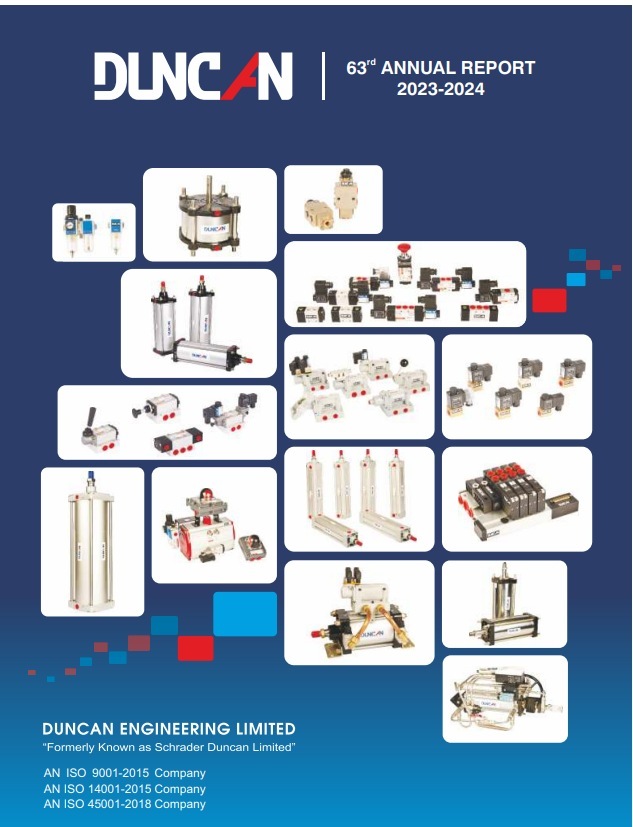
Duncan Engineering fundamentally moves heavy things using air and channels gases through high-pressure rubber and steel. They operate across two distinct, highly unglamorous industrial verticals. The first is Fluid Power & Automation, under which they design and forge air cylinders, pneumatic valves, and complex positioners used in factory automation systems, steel mills, and cement plants. If a heavy robotic arm shifts precise positions in a Pune assembly line, a DEL valve is likely regulating the air pressure.
The second vertical is Off-The-Highway (OTH) tyre valves and garage accessories. They are the guys making specialized, high-pressure tubeless valves and large-bore valve extensions for heavy earthmovers, dump trucks, and agricultural tractors. It is an intensely localized, domestic-heavy model with 98% of total revenue derived within India, exposing the company directly to the cyclical capex swings of the domestic manufacturing sector.

One Response
hehehe