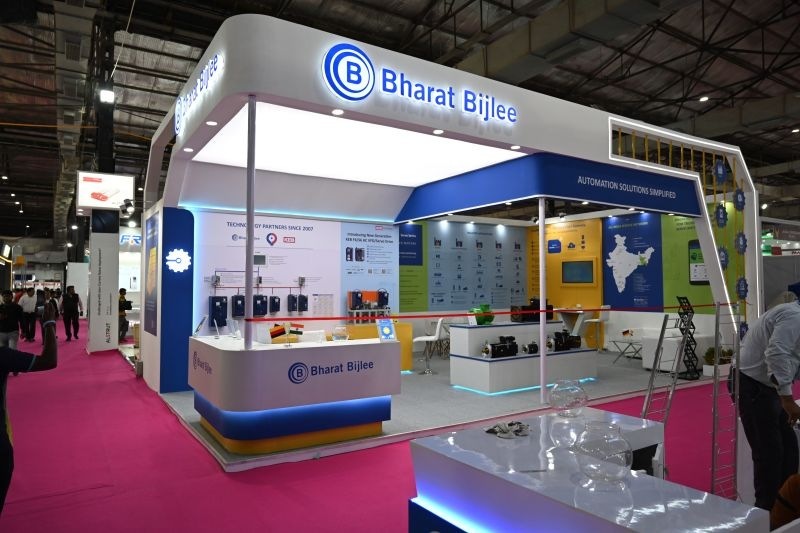
At a Glance
Bharat Bijlee is currently a fascinating study in industrial scaling. The top line is screaming growth, while the bottom line is fighting a silent war against rising input costs and competitive intensity. With a total revenue of ₹ 2,274.80 Crore for FY26, the company has officially entered a higher orbit of operations, yet the market remains wary. Why? Because the net profit has dipped from ₹ 133.65 Crore to ₹ 120.09 Crore over the same period.
The story here is one of a “Transformer Titan” meeting a “Margin Monster.” On one hand, the company is riding the massive wave of India’s infrastructure push—renewables, data centers, and massive electrical substations. On the other hand, the motors business is a street fight. Intense competition in the industrial systems segment has turned volume growth into a double-edged sword; you sell more, but you keep less.
Investors are currently staring at a Price-to-Earnings (P/E) ratio of 23.3, which looks reasonable compared to the industry average of 28.7, but the “red flag” lies in the return profile. A Return on Equity (ROE) of 6.05% is hardly the stuff of legends for an engineering giant with nearly eight decades of history. The company has literally billions of rupees locked in equity investments—marketable securities worth over ₹ 1,304 Crore—yet its core operations are struggling to extract premium margins.
The intrigue builds as we look at the debt. The company slashed its debt significantly in the previous years, only to see borrowings jump back to ₹ 307 Crore by March 2026. This isn’t necessarily a sign of weakness—it’s likely the fuel for their massive capacity expansion to 35,000 MVA at Airoli—but it does change the risk profile. Is Bharat Bijlee a dormant giant finally waking up, or an old-school player getting outmuscled by leaner, meaner peers?
Introduction
Bharat Bijlee Limited (BBL) isn’t your typical “flash in the pan” industrial stock. Established in 1946, it has seen the birth of modern India and the evolution of its power grid. For decades, it has operated from its massive 1,70,300 sq.m. campus at Airoli, Navi Mumbai, serving as a pillar for state electricity boards and private giants alike.
The company operates primarily through two lungs: Power Systems and Industrial Systems. For the longest time, these two segments shared the load equally. However, in the last 24 months, the Power Systems segment has taken the lead, now contributing nearly 61% of the total revenue. This shift is intentional and strategic.
Despite the pedigree, BBL finds itself at a crossroads in 2026. It is no longer enough to just “be” Bharat Bijlee. The market is demanding efficiency. While the sales have grown at a CAGR of 15% over the last five years, the profitability hasn’t followed a linear path. The recent warning letter from the National Stock Exchange (NSE) regarding audit committee non-compliance also adds a layer of administrative “drama” that seasoned analysts hate to see.
We are looking at a company that is technically proficient—holding patents for high-efficiency IE4 and IE5 motors—but financially constrained by the very markets it serves. The next few sections will deconstruct whether the massive ₹ 235 Crore capex is a masterstroke or a desperate move to stay relevant.
Business Model – WTF Do They Even Do?
If you’ve ever seen a massive metal box humming in a fenced-off area near a highway, that’s a transformer. BBL makes the “heavy-duty” version of those. They specialize in the 220 KV class, which is the backbone of regional power distribution.
Their business is split into two distinct worlds:
- The Power Transformers (The Heavy Lifters): This is where the big money and the big orders reside. They don’t just sell a box; they provide turnkey solutions. They design, commission, and maintain substations. This is a high-stakes game where one bad contract can bleed you dry, but a good one builds a reputation for decades.
- The Industrial Systems (The Street Fighters): This segment makes electric motors and elevator systems. If you’ve been in a lift recently, there’s a decent chance a BBL gearless motor was doing the