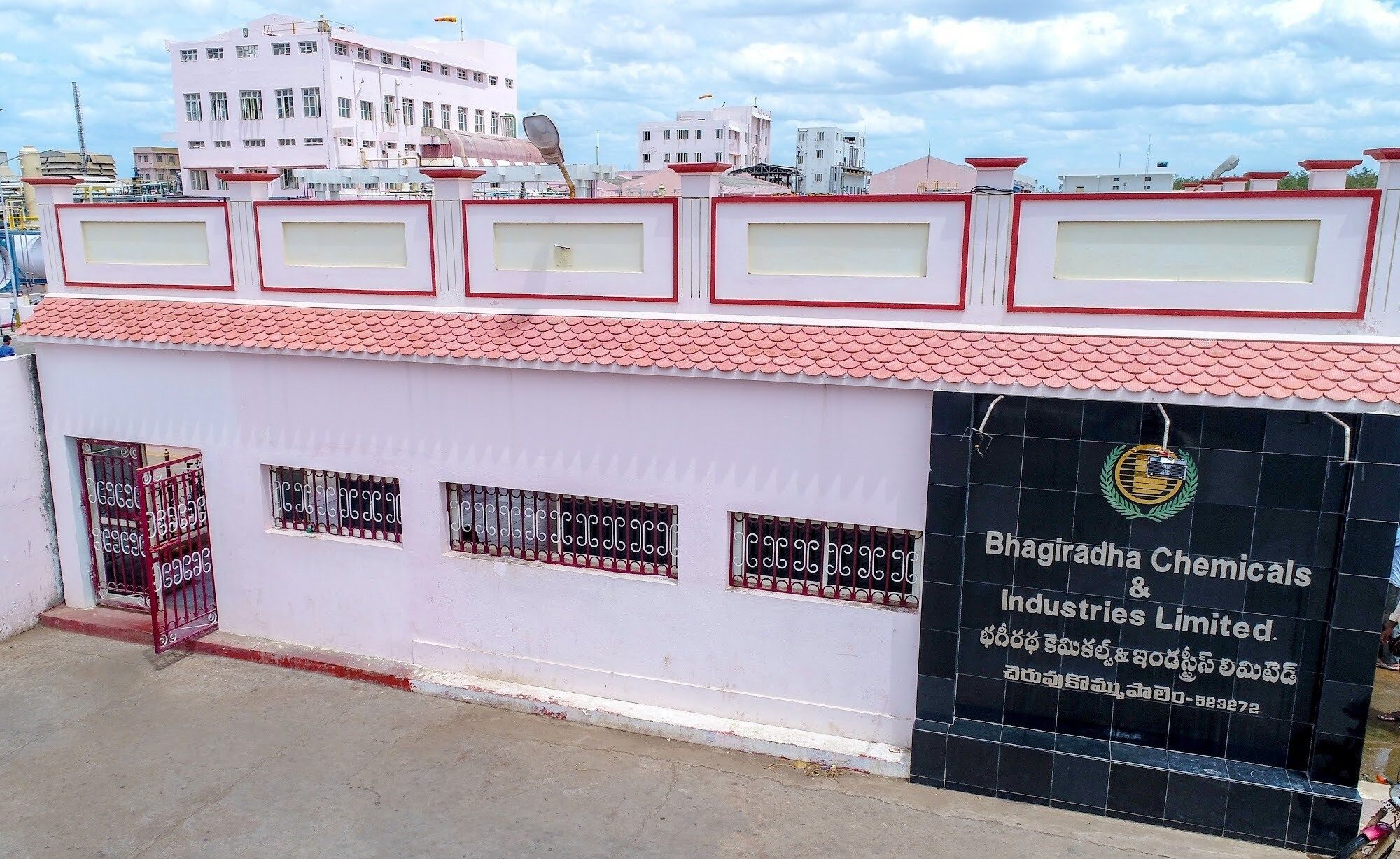
Bhagiradha Chemicals & Industries Ltd FY26: The ₹850 Crore Capex Gambit Meets the Agrochemical Margin Grind
Section 1 — At a Glance
Bhagiradha Chemicals & Industries Ltd (BCIL) wrapped up the fiscal year ending March 31, 2026, with a consolidated revenue from operations of ₹535.94 crore, representing a 21.7% expansion over the previous year’s ₹440.47 crore. The growth engine was fueled evenly by volumetric recovery and improved asset utilization. Operating profit (EBITDA) surged 54.7% to arrive at ₹57.10 crore. Meanwhile, Net Profit after Tax (PAT) posted a more modest 31.1% gain to touch ₹18.17 crore, dragged down by a sharp uptick in fixed overheads.
Investor focus is intensely locked onto the transformational ₹850+ crore expansion program being executed through its wholly-owned subsidiary, Bheema Fine Chemicals Pvt. Ltd., in Karnataka. While the commercialization of Phase 1B (4,500 MTPA) in late 2025 unlocks an exponential jump in technical manufacturing capacity, it has triggered structural headwinds.
The primary anxiety stems from a balance sheet under pressure: consolidated borrowings escalated from ₹88.92 crore to ₹234.64 crore within twelve months, driving a significant surge in annual financing costs. Furthermore, project execution was marred by a ₹70 crore cost overrun and a two-to-three-quarter delay in regulatory approvals for Phase 1.
When structural capital expenditure precedes market stabilization, a business must endure an intermediate phase of compressed returns before operating leverage kicks in. The near-term challenge remains managing a highly intensive and elongated working capital cycle. This structural pain must be tolerated while waiting for technical grade product volumes to absorb the newly capitalized asset base.
Section 2 — Introduction
Bhagiradha Chemicals & Industries Ltd has historically operated as an agrochemical active ingredient (AI) and intermediate specialist. Established in 1993 by a former scientist from the Indian Institute of Chemical Technology, the company carved out a niche in basic chemical synthesis and contract manufacturing.
The publication of these financial results comes at a critical juncture. The company has officially transitioned from a steady-state asset (BCIL 1.0) into a highly leveraged growth vehicle (BCIL 2.0).
With the recent retirement of long-standing CFO B. Krishna Mohan Rao and the subsequent appointment of industry veteran Ranjit Kumar Kilaru on March 1, 2026, management is clearly restructuring its leadership to oversee its large capital allocation project. This article analyzes whether the operational realities of the business can successfully support this high-stakes capacity expansion.
Section 3 — Business Model: WTF Do They Even Do?
To put it simply: BCIL manufactures the raw technical poisons that global and domestic brands package into crop protection products. Their portfolio spans 32 active ingredients, concentrated around heavy-duty insecticides like Chlorpyrifos and Fipronil, alongside select fungicides and herbicides.
The historical model relied on an existing 3,250 MTPA facility in Andhra Pradesh, which operates at an optimal 92% capacity utilization. The business model is deeply collaborative yet concentrated: they maintain multi-year supply arrangements with over 100 domestic formulators and 25 multinational corporations. However, a lazy investor must realize that the top three products account for a massive 73.6% of overall sales, leaving the company highly exposed to product-specific regulatory bans.
Section 4 — Financials Overview
Figures are consolidated, in ₹ crore.
The quarterly and annual performance profiles reveal an operational recovery occurring alongside escalating balance sheet friction.