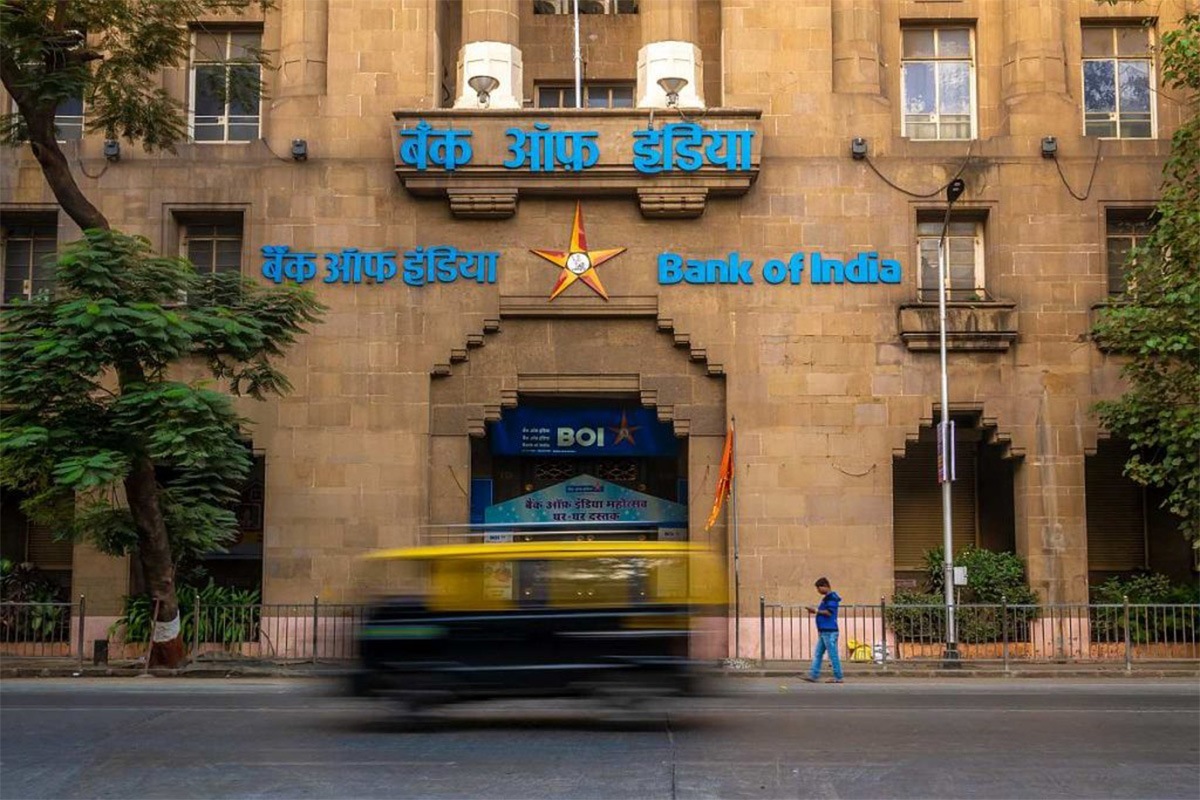
Bank of India Q4 FY26: 12.4% ROE at a 6x P/E, or Why the Market Still Doesn’t Trust PSU Banks
Date of Publishing -
Spotted a factual error — a wrong number, date, or fact? Tell us and we will check the source.
1 — At a Glance
Bank of India (BOI) closed FY26 with a net profit of ₹10,306 Cr, translating to an annualised EPS of ₹22.64. For Q4 FY26 alone, the bank posted a bottom line of ₹3,087 Cr, a 18.7% jump over the same quarter last year. Asset quality, the historical boogeyman of public sector banks, continued its multi-year clean-up: Gross Non-Performing Assets (GNPA) plummeted to 1.98%, while Net NPAs tightened to 0.56%, backed by a Provision Coverage Ratio (PCR) of 93.57%.
Despite these headline numbers, the market values this ₹11.7 lakh crore balance sheet at a mere ₹63,696 Cr, giving it a Price-to-Earnings (P/E) multiple of roughly 6.18x. The market forgives a bad history only when the future looks undeniably cheaper than the present.
Management’s focus has decidedly shifted from survival to scale, guiding for a 15-16% global advances growth in FY27. Yet, structural pressures are visible. Global Net Interest Margins (NIM) compressed to 2.52% in FY26, dragged down by a lower-yielding international book. The overarching narrative is a tug-of-war between accelerating credit demand and a structurally tightening deposit environment. The numbers are clean, the provisioning is heavy, and the capital buffers (CRAR at 18.01%) are robust. The question is whether the franchise can sustainably fund its ambitions.
2 — Introduction
As the sixth-largest nationalised bank in India, Bank of India is a sprawling piece of state machinery. With total business crossing ₹16.98 lakh crore in FY26, it is systemically important and backed by the Government of India, which holds a 73.38% stake. The bank operates 5,447 domestic branches, 22 overseas outposts, and serves as a primary lending engine for corporate India, MSMEs, and agriculture. The recent narrative has been one of quiet rehabilitation, moving past legacy corporate write-offs toward a retail-heavy, compliance-focused posture.
3 — Business Model: WTF Do They Even Do?
They take money from cautious savers at 4% and lend it to ambitious borrowers at 9%, pocketing the spread. It is the world’s oldest business model, currently executed across 37,928 customer touchpoints.
The portfolio is split into Retail Banking (39%), Wholesale Banking (34%), and Treasury (26%). Domestically, they are pivoting hard toward RAM (Retail, Agriculture, and MSME), which now makes up nearly 59% of their advances. Internationally, they operate across 15 countries, contributing about 17% to the total business mix. In a bid to stay relevant, they recently launched rooftop solar panel financing for housing societies. Apparently, when you have a ₹11.7 lakh crore balance sheet to deploy, you eventually start funding the sun.
4 — Financials Overview
Figures are consolidated, in ₹ crore.
Metric
Q4 FY26 (Mar ’26)
YoY (Mar ’25)
QoQ (Dec ’25)
Revenue
19,573.37
18,478.96
19,051.83
Operating Profit
13,584.43
12,429.29
13,850.38
PAT
3,087.76
2,601.98
2,812.29
EPS (₹)
6.78
5.72
6.18
Earnings quality in banking isn’t about how much you made, it’s about how little you had to set aside for past mistakes.
Management’s commentary on the Q4 FY26 concall was a mix of quiet swagger and macro anxiety. The CEO noted that they have established 82 Resource Managers solely dedicated to hunting for CASA (Current Account Savings Account) deposits. When you name your deposit-gathering initiative “Project UDAAN”, you are clearly feeling the heat of mutual funds stealing your lunch.
They also addressed the elephant in the room: NIM compression. Management pointed out that 14% of their book is international, yielding a tragic 1.10% to 1.30%. They guide global NIMs to claw back toward 2.70% by March 2027. We will be watching.
5 — Valuation Discussion: Fair Value Range Only
Valuing a public sector bank is less about projected growth and more