Bambino Agro Industries Ltd Q4 FY26: Profit Margins Squeeze to 0.52 EPS As Internal Litigations and Rising Input Costs Challenge the Packaged Food Pioneer
1. At a Glance
Bambino Agro Industries Ltd, a veteran household name that pioneered the vermicelli and pasta segment in India since 1982, presents a striking paradox that demands close scrutiny. On one side, the brand commands staggering market recognition with a massive footprint spanning across India and 26 export destinations, including the USA, Canada, and the UAE. On the other side, the corporate structure is trapped in severe internal friction and tightening margin traps.
The financial performance for the final quarter of FY26 reveals deep structural wounds. While top-line collections grew to ₹98.61 crore, the net profit available to equity shareholders collapsed to a meager ₹0.41 crore. This leaves the company with a quarterly Basic EPS of just ₹0.52.
Investors tracking the business are witnessing a severe disconnect between product popularity and bottom-line delivery. Total operating revenue for the full year of FY26 hit ₹393.68 crore, showing a modest growth of 7.10% over the previous fiscal year’s ₹367.59 crore. However, total expenses surged at an unmanageable pace, climbing from ₹354.32 crore in FY25 to ₹379.47 crore in FY26.
The biggest red flags are hidden in the structural and operational bottlenecks. The corporate structure is strained by severe legal battles. Substantial shareholders and promoters have dragged disputes into the National Company Law Tribunal (NCLT) and the Telangana High Court, causing disruptions that include the regulatory freezing of 15,91,973 equity shares held by the promoters.
Operationally, the business is extremely capital-intensive, running on a highly elevated working capital cycle with an average bank limit utilization of roughly 96% throughout the year. Cash generation remains weak, and the debt protection metrics are showing visible signs of pressure.
The company’s Debt Service Coverage Ratio (DSCR) fell below unity to 0.97x in FY25, highlighting that its core cash accruals are barely enough to service structural obligations without relying on ad-hoc banking limits. This combination of sluggish profit growth, freezing promoter shares, intense regional competition, and rising input costs forms an intricate financial puzzle that requires an objective breakdown.
2. Introduction
Bambino Agro Industries Ltd (BAIL), originally incorporated as Jaya Food Industries Ltd in 1983 by the late Mr. M Kishan Rao, operates out of its registered headquarters in Secunderabad, Telangana. Over nearly four decades, the company transformed itself from a local food processor into an institutional brand. Its manufacturing footprint is driven by automated plants located in Begumpur Khatola village (Gurugram) and Gohana (Sonepat), commanding an aggregate installed capacity of 1,41,310 Metric Tonnes Per Annum (MTPA).
The operational history of the company shows a distinct shift. In FY23, the plant recorded a total production volume of approximately 43,652 MTPA and managed a sales volume of 45,219 MTPA. By examining historical extraction metrics, we notice that the actual production volumes have faced high volatility, compressing significantly from the historical peak of 4,22,236 MT in FY20 down to under 44,000 MT in recent years, revealing massive underutilization of its aggregate assets.
The board of directors is chaired by Mrs. Myadam Shirisha Raghuveer, who acts as the Chairperson and Managing Director. The management has recently shuffled its core executive layer, appointing Mrs. Namratha Vippala as the Chief Executive Officer (CEO) and Executive Director for a five-year tenure. Additionally, the company recently approved the structural re-appointment of Mr. Kothapalli Srinivasa Rao as the Executive Director of Sales & Administration to navigate its complex distribution logistics.
Despite these structural leadership anchors, the operational machinery is heavily weighed down by systemic risks. The cost of raw materials—primarily durum wheat and semolina—is highly volatile and subject to agricultural supply shocks. Operating in a deeply fragmented space, Bambino faces intense pricing pressure from unorganized local units and deep-pocketed FMCG giants. This leaves the firm with minimal pricing flexibility to pass on input inflation without risking its market share.
3. Business Model – WTF Do They Even Do?
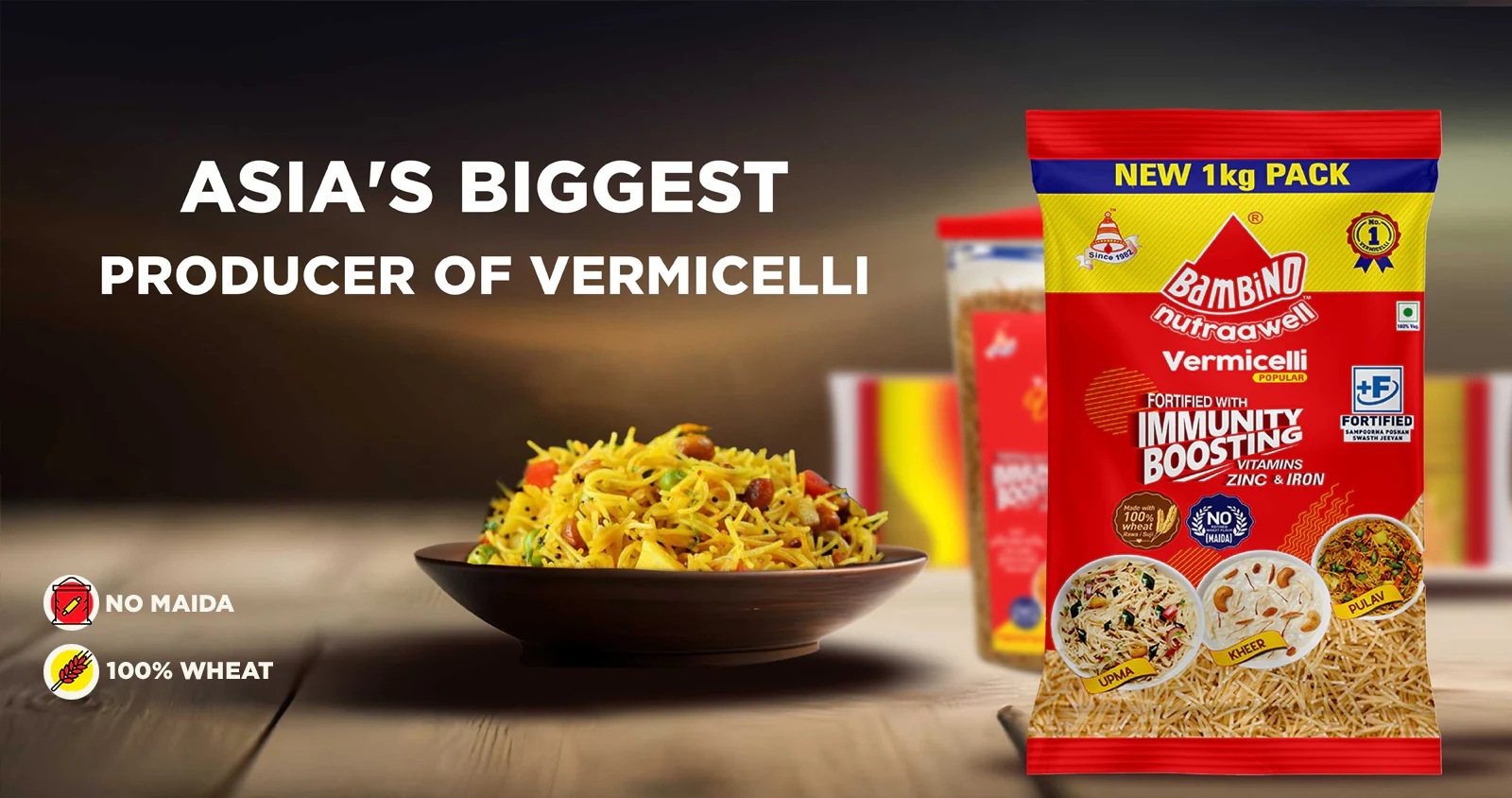
At its core, Bambino’s business model is incredibly simple: they process wheat into high-carb convenience foods. The product mix covers more than 74 items divided across convenience foods, ready-to-eat packages, and blended spices. Their main revenue drivers are traditional vermicelli (sewai), short-cut pasta, macaroni, spaghetti, instant pasta, and instant soups. The company also sells breakfast mixes, sweets, namkeens, soya chunks, and hing.
The revenue architecture is heavily dependent on a single product track. The sale of processed food products accounts for a staggering 99% of total operating collections, leaving alternative channels or other income to account for less than 1%.
To move these massive volumes of low-margin products, the company relies on a widespread distribution network. It works through a hierarchical chain of super stockists, clearing and forwarding (C&F) agents, and independent retail distributors. While the brand enjoys strong visibility in northern, eastern, central, and northeastern India, this massive footprint requires maintaining high inventory buffers across the supply chain.
For a smart but lazy investor, the business looks like a massive kitchen that buys plain wheat flour, shapes it through automated extruders into various formats of pasta and vermicelli, packages it in brightly colored plastics, and ships it across global geographies.
The catch is that this model offers almost no defensive moat. A consumer rarely exhibits unbreakable brand loyalty toward plain vermicelli when cheaper regional alternatives emerge on supermarket shelves. To counter this stagnation, the management is trying to pivot toward premium segments by planning a new millet-based product line, attempting to catch the health-conscious consumer wave. However, until these premium variants scale up, the core business remains an asset-heavy, low-margin bulk processing operation.
4. Financials Overview
The financial updates for the final quarter and the full year ended March 31, 2026, present a sober picture of expanding revenue alongside deteriorating profit margins.
To evaluate the operational performance accurately, we look at the official financial disclosures for the final quarter (Q4 FY26), the immediate preceding quarter (Q3 FY26), and the corresponding prior year quarter (Q4 FY25).
Quarterly Financial Comparison Table
(Figures in ₹ Lakhs, except EPS)
Financial Metric
Latest Quarter (Q4 FY26) Audited
Previous Quarter (Q3 FY26) Unaudited
Same Quarter Last Year (Q4 FY25) Audited
Revenue from Operations
9,861.24
9,335.85
9,234.32
EBITDA
572.96
494.34
525.95
PAT
41.33
116.10
103.93
Basic EPS (₹)
0.52
1.45
1.30
Full-Year Financial Performance
Looking at the full-year performance, total revenue from operations for FY26 reached ₹39,367.92 lakhs (₹393.68 crore), compared to ₹36,758.75 lakhs (₹367.59 crore) in FY25. Total EBITDA for the full year stood at ₹3,047.25 lakhs, up from ₹2,729.18 lakhs in FY25.
The net profit after tax for the full twelve months of FY26 was recorded at ₹999.82 lakhs (₹10.00 crore), registering a minor recovery against the ₹921.45 lakhs posted in FY25.
Financial Wisdom: The Volume vs. Margin Traps
Financial Wisdom: In corporate analysis, tracking top-line revenue growth without checking margin expansion is a dangerous trap. A company can easily push higher volumes into its distribution pipeline by spending heavily on promotions or taking on high material costs. However, if the operating profit margins do not expand alongside revenue, the business is simply working harder to make its lenders richer while leaving nothing for equity shareholders.
The core issue during Q4 FY26 lies in the massive jump in overall tax expenses and procurement volatility. Profit before tax for Q4 FY26 stood at ₹142.22 lakhs, which was ahead of Q4 FY25’s ₹131.20 lakhs. However, a sharp spike in current and deferred tax adjustments knocked net profit down to