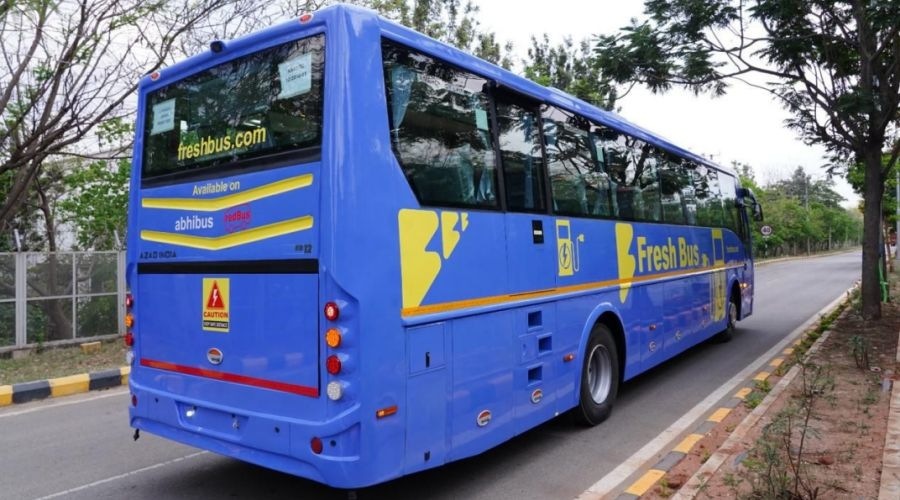
Azad India Mobility: FY2026 Results — From Steel to Buses, From Loss to ₹2.37 Cr Profit
General information and entertainment, not investment advice. The author is not a SEBI-registered adviser or research analyst. No recommendation, no promised returns. Markets carry risk including loss of capital. Figures may not be current. Consult a registered adviser before acting.
A former steel-bar maker bet its entire future on electric buses. Forty-two months ago, it was dead.
Then came the turn. FY2026 saw revenues explode to ₹64.94 crore from ₹9.03 crore a year earlier—a 619% sprint that reads like fiction until you see the order book: ₹3,500+ crore of secured EV bus sales over 24 months.
The company swung to a ₹2.37 crore profit from breakeven territory. Net cash stands at ₹15.74 crore against a ₹151.24 crore balance sheet. Yet the P/E touches 229x.
The question isn’t whether the buses work. It’s whether the multiple survives the market’s current infatuation.
2. Introduction
Azad India began in 1960 manufacturing steel bars. For sixty years it was nobody’s story—a small-cap afterthought.
In April 2024, the company filed a change of business objective. Steel was out. Electric buses, cars, rickshaws, scooters, and battery-powered vehicles were in.
The script was a capital raise and a 71%-stake acquisition in NAE Mobility Private Limited, a subsidiary already building EV buses. By March 2025, Azad owned 100% of NAE.
Promoter holding collapsed from 35.56% to 15.53% in the space of twelve months—a dilution engineered by preferential share issues at ₹98 and ₹16 per share to FIIs who now own 48.90% of the equity.
A CEO transition happened on 29 May 2026: Sabina Khurana, an international corporate leader with 30 years in transformations, replaced the internal management structure. The independent director Ramesh Chandra Pareek resigned the same day, citing personal commitments.
3. Business Model: WTF Do They Even Do?
Azad builds luxury electric buses. That’s it. The 71-acre manufacturing facility in Bengaluru (leased for ₹25.50 lakh monthly from October 2025) rolls out the first commercial batch: 12 buses in May 2025.
The order book screams legitimacy. ₹3,500+ crore of orders over 24 months means the company isn’t chasing hype—it’s executing against signed POs.
Buses are high-ticket, low-volume. A luxury EV bus at perhaps ₹1+ crore per unit clears 3,000–3,500 buses over two years at those prices. Margins are fat if execution holds.
Distribution is direct to state transport corporations and private fleet operators. No middleman chaos, no retail scaling risk.
The subsidiary NAE Mobility is consolidated into the results, so you’re seeing the combined factory output, not a holding-company fiction.
4. Financials Overview
Figures are consolidated, in ₹ crore.
Metric
FY2026
FY2025
Change (₹ Cr)
Revenue
64.94
9.03
+55.91
EBITDA
2.30
-0.96
+3.26
PAT
2.37
0.03
+2.34
EPS (Full Year)
0.44
0.01
+0.43
The swing is real, not accounting magic. FY2025 was a transitional year: the company had just acquired NAE, cash was burning on capex and pre-revenue operations, and the factory wasn’t running yet.
FY2026 marks the pivot: the facility came live, orders converted to revenue, and the operating loss flipped to a thin ₹2.11 crore operating profit (3.25% margin).
Other income of ₹1.24 crore—largely interest on fixed deposits and cash balances—padded the bottom line. Strip that and operating profit was the real hero.
Q4 FY2026 (Jan–Mar 2026) alone delivered ₹8.76 crore revenue and ₹1.41 crore PAT. The operating margin in Q4 jumped to 21.8%, signaling that at volume and full utilization, the factory can hit double-digit PAT margins.
5. Market Expectations & Historical Multiples
This section describes how the market is currently pricing the company and how that compares with its own history and peer group. It is descriptive, not predictive.