Search for Stocks /

Arkade Developers FY26: ₹182 Crore Write-Off Walks Into a Bar, Leaves With a ₹3,500 Crore Project

Spotted a factual error — a wrong number, date, or fact? Tell us and we will check the source.

June 2026 | Consolidated Results Analysis


At a Glance

Arkade Developers reported consolidated revenue of ₹828 crore in FY26, up 19.2% year-over-year. Pre-sales surged 17% to ₹901 crore, while area sold climbed 27% to 3.15 lakh sq ft. But here’s the plot twist: net profit collapsed to ₹5 crore after an ₹182.17 crore exceptional write-off from the Filmistan acquisition—a one-off accounting impact that management is framing as “cost this year, margin boost next year.” The company also just locked in a ₹1,100 crore Kandivali East redevelopment, signed an MOU for a ₹1,000 crore Bhandup project, and has a ₹12,000 crore pipeline stretched over five to six years. Operating performance is firing. The balance sheet is clean. The question is whether an 11.4x P/E on a luxury builder with 20% ROE is a discount or a trap.

Insight: In real estate, the difference between reported profit and operating profit is often the difference between a story and reality. Arkade’s PAT is distorted by a one-time event; its EBITDA margin of 23.2% and operating momentum tell the true story.


What’s Arkade, Actually?

Arkade is a Mumbai-centric luxury residential developer with a 40-year legacy. They operate in two modes: greenfield new projects (buying land, building from scratch) and redevelopment (taking old Mumbai buildings and making them into premium towers). Think of it as buying 1990s office space and turning it into ₹10 crore+ homes. They’ve completed 32 projects across ~5.5 million sq ft, and they’re sitting on a pipeline of 12+ upcoming projects spanning Goregaon, Thane, Bhandup, and Eastern suburbs. Revenue mix leans luxury; average selling price is around ₹20–21 lakhs per sq ft. The brand is Amit Mangilal Jain (promoter, 66.7% holding) with brothers and family members filling out the cap table. This is a family shop with execution pedigree.


The Numbers: Revenue, EBITDA, PAT

MetricFY26FY25YoY Growth
Revenue from Operations₹816 Cr₹683 Cr+19.5%
EBITDA₹189 Cr₹206 Cr-8.2%
EBITDA Margin23.2%30.2%-7 bps
PAT (after exceptional item)₹5 Cr₹157 Cr-96.8%
PAT Margin0.6%22.6%N/A

The headline is clear: revenue grew 19.5%, but net profit fell off a cliff. Why? The Filmistan write-off. Back in January 2025, Arkade paid ₹165 crore for the land and acquired tenancy/operating rights valued at ₹182.6 crore. When consolidating the subsidiary, those tenancy rights were written off, creating a one-time exceptional charge of ₹182.17 crore.

Management’s take: “This cost sits in FY26. Next year, the Filmistan project has zero project cost attached to it, which means margins on that project will be cathedral-ceiling high.” The CFO also noted this wipes out ₹182 crore of anticipated project cost, lowering the effective cost structure of the eventual Filmistan development. Mathematically, it’s clean. Emotionally? A ₹5 crore PAT after ₹828 crore revenue is the kind of result that makes equity analysts pause mid-sentence.

Insight: An exceptional write-off that improves future project economics is not a red flag—it’s a reset. But it tests credibility. Arkade’s management has a track record of execution (most projects delivered ahead of RERA timelines), so the promise carries weight. Still, the market is pricing caution.


What’s Cooking: The Filmistan Opportunity and Beyond

Filmistan (Goregaon West)

₹3,500 crore GDV. 4.2 acres. A historic film studio with “unique heritage and strategic importance,” per management. The plan: an “uber-luxury residential project”—which is code for “pricing that starts at ₹5+ crore per unit and goes up.” Expected cumulative bottom-line contribution over the next 3–5 years: ₹1,000–1,200 crore. Launch is targeted for “financial year-end” (by March 2026, though that ship may have sailed; realism suggests FY27 launch). This is the flagship deal. It will define Arkade’s next chapter in premium residential.

Kandivali East (Ashok Nagar Cluster)

Just signed MOU on May 27, 2026. 9 societies in Kandivali East. 3.25 lakh sq ft RERA carpet area. ₹1,100 crore GDV. Redevelopment play—lower execution risk than greenfield, faster collections. This adds breathing room to the pipeline and diversifies geography slightly eastward.

Bhandup (Woollen Mills MOU)

3.5 acres. ₹1,000 crore GDV. MOU signed; acquisition cost ~₹148 crore. Another greenfield play, another premium trophy asset.

Thane Entry

₹1,900 crore GDV. 6.5 acres in Kasarvadavali. First move outside Mumbai proper. Management highlighted this as a key growth driver for FY27–FY28, riding the Mumbai Trans-Harbour Link and metro expansion tailwinds.

Question: Would you allocate ₹1–2 crore of your investable surplus to a builder betting ₹3,500+ crore on a single luxury project, even with a clean balance sheet?


Balance Sheet: Debt Discipline and Cash

ItemFY24FY25FY26
Total Assets₹575 Cr₹1,251 Cr₹1,127 Cr
Equity (Reserves + Capital)₹324 Cr₹884 Cr₹882 Cr
Total Borrowings₹71 Cr₹113 Cr₹99 Cr
Cash & EquivalentsN/A₹217 Cr₹115 Cr
Net Debt / (Cash)PositiveNegative ₹269 Cr*Negative (est.)
Debt / Equity0.22x0.13x0.11x

Credit rating report FY25 figure. FY26 adjusted for lower cash after capex and land purchases.

Here’s the ballsy move: Arkade is de-leveraging while expanding. Total borrowings fell from ₹113 cr (FY25) to ₹99 cr (FY26), even as the company spent ₹186 crore on land acquisitions (Filmistan, Bhandup, Thane, et al) and ₹109 crore on land premiums/approvals/TDR in FY26 alone. How? IPO proceeds of ₹407 crore in FY25 funded the land spree. The company raised equity in September 2024, deployed it into pipeline assets, and is now living off internal accruals and customer advances. Debt/Equity of 0.11x is fortress-like for a real estate developer. Interest coverage is north of 200x.

Insight: A builder that chooses not to borrow when leverage is cheap is either disciplined or paranoid about the cycle. Arkade is the former, or at least its promoters are betting they are. Watch the capex in FY27–FY28; that’s when the discipline gets tested.

Cash Flow: Collections Beat Revenue

FY26₹ Cr
Collections (Customer Advances)₹728
Construction Cost Outflow-₹324
Other Expenses & Taxes-₹72
Operating Cash Flow₹332
Land Acquisitions & Approvals-₹295
Capex (CWIP, PPE)-₹186
Net Cash Outflow-₹149

Collections of ₹728 crore funded ₹324 crore of construction, ₹295 crore of land buys, and ₹186 crore of capex. The remaining delta came from debt reduction and IPO proceeds depletion. This is the real estate playbook: pre-sales = cash first, revenue recognition = accounting later. Arkade is riding that wave hard. The company collected ₹728 crore against ₹816 crore revenue—an 89% conversion, which management flagged as their target. Healthy.


Operating Metrics: The Momentum Story

MetricFY26FY25Growth
Pre-Sales Value₹901 Cr₹773 Cr+16.6%
Area Sold (Carpet)3.15 lakh sq ft2.49 lakh sq ft+26.6%
Collections₹728 Cr₹716 Cr+1.7%
Avg Selling Price (per Sq. Ft.)~₹20–21 L~₹20–21 LFlat

Pre-sales grew 16.6%, area sold grew 26.6%. This means higher volume, not price inflation—good sign in a market obsessed with affordability. Collections grew only 1.7% YoY, which is the soft spot. Management attributed it to timing; some projects are in mid-execution stages, so cash advances haven’t fully flowed. The company ended FY25 with 249k sq ft area sold; by FY26, that jumped to 315k sq ft. Q4 FY26 alone saw ₹303 crore pre-sales (+40% YoY) and 1.1 lakh sq ft sold (+57.5% YoY). The final quarter was scorching.


Valuation: Is 11.4x P/E Cheap or Tethered to Hope?

Current Metrics:

  • CMP: ₹113 | Market Cap: ₹2,098 crore
  • Reported EPS (FY26): ₹0.29 | Annualised P/E: 11.4x
  • ROE: 20.8% | ROCE: 19.3%

An 11.4x P/E on a 20.8% ROE builder is a statistical bargain. Peers like DLF trade at 33.8x, Lodha at 26x, Prestige at 49.8x. Arkade’s discount reflects three things: (1) scale (Market cap ₹2,098 cr vs DLF’s ₹1.43 lakh cr), (2) concentration risk (all projects in MMR), and (3) the Filmistan opacity—investors aren’t sure if the ₹1,000–1,200 crore “contribution” is conservative or blue-sky thinking.

Fair Value Estimate (Three Methods)

Method 1: P/E on Normalized PAT

Strip out the exceptional item. FY26 “normalized” PAT = ₹5 Cr + ₹182.17 Cr exceptional write-off – tax benefit (~₹46 cr) = ~₹141 crore. EPS on normalized PAT = ₹141 Cr / 18.6 Cr shares = ₹7.58. Peer median P/E is 27x. At 25–30x, fair value = ₹189–227 crore. Per share: ₹10.16–12.20.

Method 2: EV/EBITDA

FY26 EBITDA: ₹189 Cr. Peer EBITDA multiples: 10–12x for builders of Arkade’s size. At 10–12x, FV EBITDA = ₹1,890–2,268 crore. Less net debt (~₹0 after accounting for cash/borrowings), Fair Value = ₹1,890–2,268 crore. Per share: ₹101–122.

Method 3: Pipeline PV (Simplified)

Arkade has ₹12,000 crore pipeline over 5–6 years (ongoing + upcoming). At management’s guided 27–28% EBITDA margin, that’s ₹3,240–3,360 crore cumulative EBITDA. Assuming 25% net margin (after taxes, land costs), ₹2,430–2,520 crore net profit over 5–6 years, or ~₹405–420 crore annualized. Discounted at 12% (required return for micro-cap builders): PV ≈ ₹2,700–2,800 crore. Per share: ₹145–150.

Fair Value Range: ₹100–150 per share (current ₹113, so ~1–33% upside depending on execution visibility and risk comfort). The variance reflects uncertainty around Filmistan launch timing, collection ramp, and broader real estate cycle.

This fair value range is for educational purposes only and is not investment advice.


Ratios: Sexy or Stressy?

ROE (20.8%): Sexy. This is empire-building returns. DLF’s ROE is 9.6%; Arkade’s is >2x higher. Why? Asset-light model (they develop on-land, not buy land speculatively). High leverage (relatively) on a smaller equity base. Execution efficiency. The caveat: smaller scale means more volatility. One bad project can crater ROE. DLF’s 9.6% is boring but bulletproof.

ROCE (19.3%): Sexy-adjacent. Above cost of capital (10%+), but below the 25%+ expected of a high-quality compounder. Real estate ROCE is lumpy (project-by-project); this is a reasonable multi-year average.

Debt/Equity (0.11x): Pristine. Most builders in this range leverage 0.4–0.6x; Arkade is half that. This is either prudence or leaving money on the table. Probably both.

Current Ratio (7.13x): Stressy in reverse—this is overkill liquidity. A 2–3x ratio is normal; 7x means cash sitting idle. Though for a pre-IPO builder, it’s a moat against refinancing risk.

Dividend Yield (0.89%): Stressy. Zero dividend payout. Company is plowing everything into pipeline. Expect no income; expect re-investment.


P&L Breakdown: Three-Year Story

ItemFY24FY25FY263-Yr CAGR
Revenue₹635 Cr₹683 Cr₹816 Cr13.3%
EBITDA Margin26.5%30.2%23.2%-6%
PAT (before except.)₹123 Cr₹157 Cr₹141 Cr (est.)7.2%

Revenue CAGR of 13.3% is steady. EBITDA margin compression (from 30.2% to 23.2%) is the red flag—indicates either rising construction costs, mix shift to lower-margin projects, or one-time operating charges. The company guided to EBITDA margin stabilization at 27–28% going forward, which would require operational tightening or higher-margin project mix. PAT growth (7.2% CAGR) trails revenue growth, implying leverage used up or margin pressure. Watch FY27 closely: if EBITDA margin snaps back to 27%+ and collections accelerate, the story restores. If margins stay 23–24%, the narrative shifts from “value compounder” to “cyclical builder hitting margin peaks.”


Peer Comparison: Arkade vs the Big Cats (and Kittens)

CompanyCMPP/EMCap (Cr)ROE (%)ROCE (%)
DLF₹57833.8x₹1,43,0119.6%6.3%
Lodha Developers₹89426.1x₹89,34615.8%16.6%
Oberoi Realty₹1,63323.5x₹59,41815.0%17.8%
Arkade (Focus)₹11311.4x₹2,09820.8%19.3%
Anant Raj₹57037.0x₹20,51111.1%12.1%
Sector Median₹15027.1x₹7547.4%7.8%

Arkade’s 11.4x P/E vs sector median 27.1x is a 60% discount. Its 20.8% ROE vs median 7.4% is a massive quality premium. This is not a coincidence; it’s a micro-cap liquidity discount. Arkade’s market cap of ₹2,098 crore is 1.5% of DLF’s. Institutional investors avoid single-digit market-cap realty because exit velocity is awful and news flow compounds risk. Arkade trades like a small-cap sneeze—one bad quarter, and liquidity vanishes.

Question: Does a 20.8% ROE builder deserve a 43% discount to peer median P/E, or is the discount a sign the market knows something about Arkade’s execution risk?


Shareholding: Jain Family Fortress

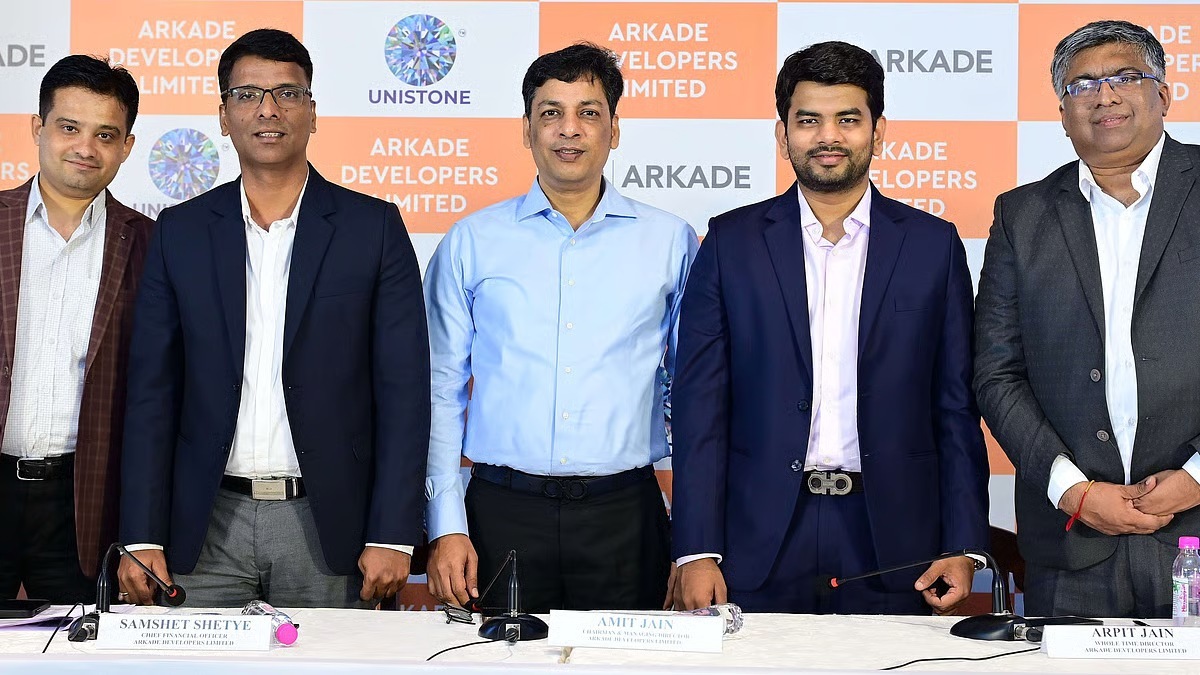
Amit Mangilal Jain (promoter) owns 66.7%. Brother Arpit Jain and sister Anuja Jain own 1.43% and 1.52% respectively. Other family members make up the remainder of the 71.19% promoter holding. FIIs hold 0.23%, DIIs 0.09%, Public 28.48%. This is a tightly-held family business with minimal institutional free float. Zero pledges. No red flags on shareholding. The concentration means founder alignment (good for execution discipline) and liquidity risk (bad for equity investors wanting to exit fast).


Corporate Governance: Clean Bill, But Young Auditor

Arkade listed in September 2024 (just 8 months old as a public company). Three director exits in the past two years (resignations for personal reasons, per announcements). IPO was via a DRHP; no red flags in the ICRA/India Ratings credit report. Rating: IND BBB+/Stable (assigned Feb 2026). The rating commentary flagged “concentrated geographical presence” and “execution risk for new projects” as constraints, but praised “healthy operational performance,” “adequate liquidity,” and “debt aversion.” No related-party concerns. No audit qualifications mentioned in annual secretarial compliance (May 2026). The company is clean, but it’s also a junior public company—governance track record is two months old.


Industry Roast: When Luxury Builders Battle the Monsoon (and Interest Rates)

The Mumbai real estate market is in a luxury-led bull run. Luxury segment (above ₹2 crore) now accounts for 44% of area sales in MMR (up from 31% in FY21)—a dramatic shift. Affordable housing is collapsing; ₹2–5 crore is where the action is. Absorption is tight; years-to-sell is 1.2–1.4 years (i.e., strong demand). Infrastructure tailwinds (Mumbai Trans-Harbour Link, metro expansion) are pulling demand into Thane and Eastern suburbs—exactly where Arkade is expanding.

But macro headwinds loom. Interest rates remain sticky (repo at 6.5%, still elevated). Home loan rates in the 8.5–9.5% range are deterring first-time buyers and speculators. Political uncertainty (state elections, GST on ongoing projects, rent control fears) keeps deep-pocketed investors cautious. Regulatory delays (approvals, RERA compliance, society redevelopment governance) can push project timelines by 6–18 months. Arkade’s track record is “delivery before RERA deadlines,” which is rare and credible. Still, one monsoon season, one structural delay, one promoter health issue, and the narrative flips.

The sector is not cheap; it’s just less expensive than FY24–FY25. P/E compression is real, but so is revenue growth. Arkade’s 11.4x P/E is the lowest in the peer set—a reflection of execution unproven on the public market and capital markets’ distrust of micro-caps.


SWOT Summary

Strengths

  • 20.8% ROE, 19.3% ROCE (well above cost of capital)
  • Debt/Equity 0.11x, zero pledges, pristine balance sheet
  • Pre-sales growing 17% YoY; area sold +27% YoY (volume, not price)
  • ₹12,000 Cr pipeline over 5–6 years
  • Track record of early project deliveries

Weaknesses

  • EBITDA margin compressed 7 bps (30.2% → 23.2%)
  • Collections growth only 1.7% YoY (lagging pre-sales)
  • Reported PAT artificially low (₹5 Cr) due to Filmistan write-off
  • Market cap ₹2,098 Cr (liquidity risk)
  • Junior public listing (8 months old)

Opportunities

  • Filmistan (₹3,500 Cr GDV) flagship project debut
  • Thane expansion riding infra tailwinds
  • Redevelopment pipeline in Eastern/Western suburbs
  • Luxury segment momentum (44% mix, and rising)
  • Pre-IPO capital structure allows rapid capex deployment

Threats

  • Concentration risk (all projects in MMR)
  • Filmistan execution risk (first uber-luxury, unproven)
  • Interest rate stickiness (8.5%+ home loans dampen demand)
  • Real estate cyclicality (one down-cycle and ROE compresses sharply)
  • Execution risk on 12 upcoming projects simultaneously

Verdict: Execution Will Determine if ₹113 Is a Gift or a Trap

Arkade Developers is a tightly-run micro-cap builder with credible operational chops, a clean balance sheet, and a pipeline that could justify a higher valuation—if execution delivers. The Filmistan write-off is a one-off accounting reset that management is positioning as a future margin unlock. That may be true, or it may be corporate optimism masquerading as accounting discipline. The jury is out.

The case for the stock: 20.8% ROE at 11.4x P/E is statistically cheap. An 11x P/E on a 20% ROE compounder, in any other sector, would trigger a bidding war. Arkade’s discount is pure micro-cap illiquidity and execution skepticism. If the company closes Filmistan by FY27-end, launches Thane, and maintains 27–28% EBITDA margins, per-share earnings will likely exceed ₹10–15 by FY28. At that run-rate, 11.4x P/E becomes 8–10x forward P/E—a screaming buy.

The case against: Scale is tiny. Liquidity is scarce. Concentration risk is real (one bad launch derails growth). Filmistan is a bet-the-farm project; if it stumbles (delays, cost overruns, demand shock), the narrative breaks. And the company is only 8 months into public life; governance pedigree is untested.

The fair value range of ₹100–150 reflects these tensions. The current price of ₹113 sits in the middle—neither cheap nor expensive, but fairly priced for a micro-cap builder with proven fundamentals and execution on trial.

Final Insight: The best micro-cap compounders are the ones that don’t stay micro-caps for long. Arkade has the fundamentals (ROE, pipeline, execution record) to scale into a mid-cap by FY28–FY29. Whether ₹113 today is a pre-scale entry point or a value trap hinges on 24 months of Filmistan and Thane performance. Investors with a 3-year horizon and stomach for 30% drawdowns might find value here. Those seeking certainty should wait for a larger peer trading at a smaller discount.


Fair Value Disclaimer: This fair value range is for educational purposes only and is not investment advice. Fair value is a mathematical construct based on assumptions (margin guidance, pipeline timing, WACC estimates) that may not materialize. Past performance is not indicative of future results. Micro-cap equities carry liquidity risk and volatility. Investors should conduct their own due diligence and consult a licensed financial advisor before making investment decisions.


Analysis as of June 6, 2026 | All figures consolidated, in ₹ crore unless stated
