Ambuja Cements FY26: The Price Tag and the Problem
General information and entertainment, not investment advice. The author is not a SEBI-registered adviser or research analyst. No recommendation, no promised returns. Markets carry risk including loss of capital. Figures may not be current. Consult a registered adviser before acting.
1. At a Glance
Ambuja Cements closed FY26 with ₹40,656 Crore in sales—a 15% climb on the year—but buried inside is a tax anomaly that should set off your reading glasses: a ₹2,338 Crore tax refund in a year where profit before tax fell 46% versus FY25. The result: net profit of ₹4,728 Crore, up 10% on the year, which is the kind of relief that makes you squint and ask where the growth really came from.
The market pays 22.5x earnings here, a notch above the peer median of 19x. The three-year ROE lingers at 8%, while the nearest peer swings above 10%. At ₹429, the stock is down 21% over the past year.
The balance sheet has zero debt and ₹59,347 Crore in net worth—a fortress. But the fortress is underutilised: acquired assets (Sanghi, Penna, Orient) are running at 46–57% utilisation, dragging group margins below what the legacy plants deliver.
Consolidated capacity hit 109 MTPA in FY26 and is set for 119 MTPA by end-FY27. The company is in a capex and integration fever, and management’s tone in May shifted from growth targets to cost discipline and acquired-asset turnaround. Read on to decode what “reset” means.
2. Introduction
Ambuja Cements, part of the Adani Group, is the second-largest cement company in India when combined with its subsidiaries ACC, Sanghi, Penna, and Orient. The company operates 24 integrated cement units, 22 grinding units, and 116 ready-mix concrete plants across 31 states, holding ~14–15% of India’s cement market.
The past year was a year of consolidation and acquisition, not organic growth alone.
In April 2025, Ambuja completed the acquisition of a 72.66% stake in Orient Cement for ₹5,910 Crore in cash, adding 8.5 MTPA of capacity. In March 2026, the Penna Cement and Sanghi Industries mergers became effective, further expanding the footprint. These transactions reshaped the consolidated entity, introducing new factories with different utilisation rates, geographies, and cost structures.
During May 2026, in a concall, management acknowledged that “performance has not been great” and the group “not been able to deliver what we have promised to shareholders.” The phrase “reset” was deployed—not a reversal of ambition, but a pivot from growth-at-scale toward cost discipline and asset turnaround. The 155 MTPA target by 2028 has been unspoken; the new language is return-on-invested-capital at 18%+ and utilisation recovery before fresh capacity.
3. Business Model: WTF Do They Even Do?
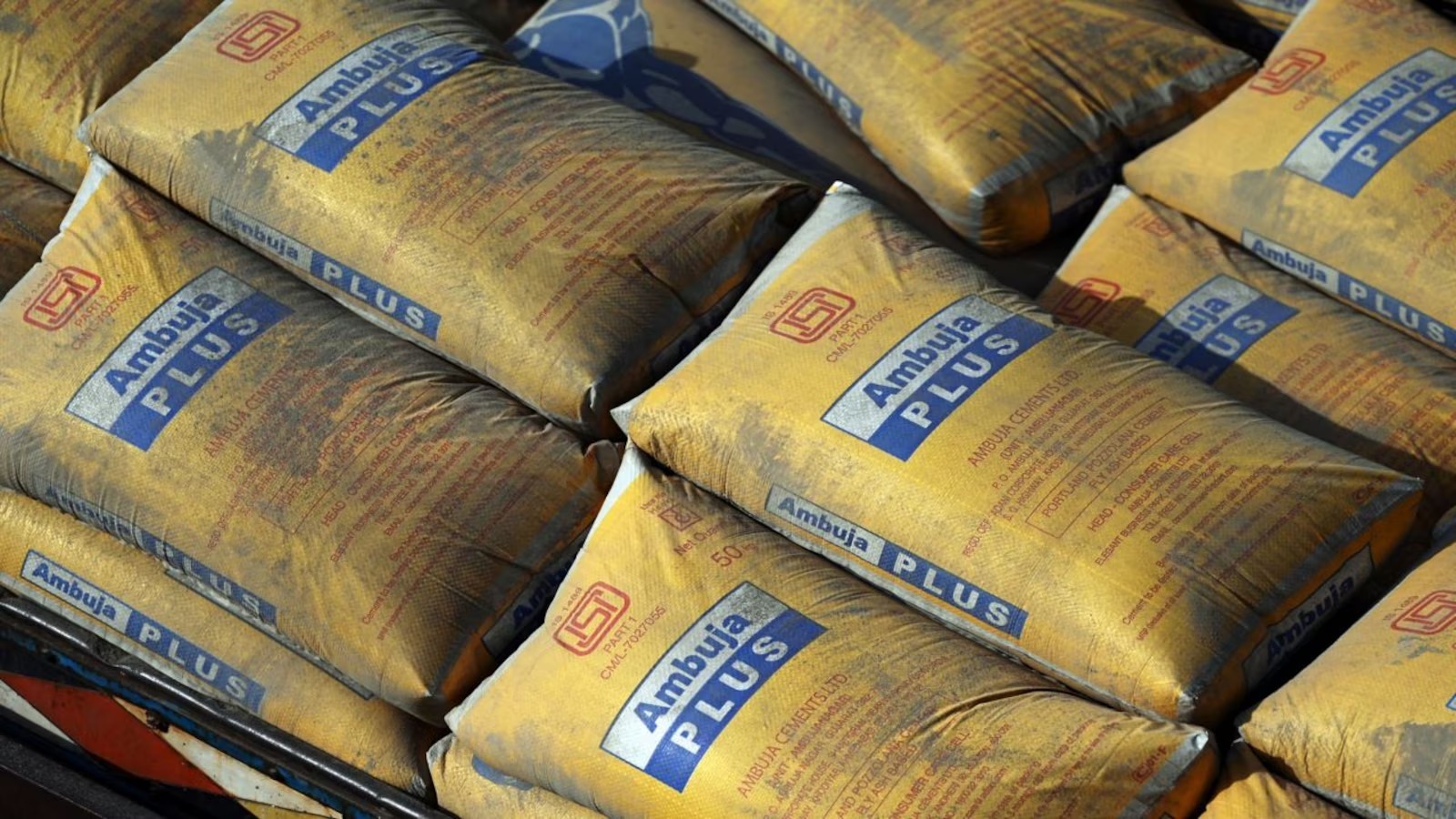
Ambuja Cements manufactures and sells Portland cement and blended cement, ready-mix concrete, and allied building materials. The product line spans base-range (Ambuja Cement), premium (Ambuja Kawach, Ambuja Plus), and super-premium (Ambuja Compocem) tiers. ACC, the group’s second brand and oldest cement company in India, serves the same market with overlapping product ladders—Gold, Suraksha Power, HPC, Shaktimaan—creating both channel choice and internal competition.
Blended cement comprises 77% of the product mix, a deliberate shift to lower clinker factors (67%) and higher fly ash content. This math works because blended cement is less capital-intensive to grind and cheaper to produce, assuming you have the right sourcing. The company operates 116 ready-mix concrete plants, a capital-light addon that captures construction-site premiums. Geography spans the subcontinent: 665+ districts, 120,000+ channel partners, 11 captive ships for coastal logistics.
The business is commodity cement. Margins depend on input costs (coal, power, limestone), freight, capacity utilisation, and demand. The company has diversified into green power—32% of energy from wind and solar by Q4 FY26—to hedge fuel inflation. It’s a volume game wrapped in a cost game, with a regulatory backdrop (GST, freight laws, environmental norms) and an acutely cyclical demand cycle tied to infrastructure, real estate, and monsoon.
4. Financials Overview
Figures are consolidated, in ₹ crore.
Metric
Q4 FY26
Q4 FY26 YoY
Q3 FY26
FY26
FY26 YoY
FY25
Sales
10,915
+9.4%
9,174
40,656
+15.0%
35,336
EBITDA
~1,465
—
~1,761
~6,577
—
~5,971
PAT
1,830
+74.3%
1,766
4,728
+10.0%
4,303
EPS
7.37
—
7.11
19.03
—
17.31
From the May 2026 concall:
Management reported consolidated FY26 volumes of 73.7 MT (+16% YoY), with EBITDA of ₹6,539 Crore (₹887/ton, +12% YoY) and normalised PAT of ₹2,647 Crore. The reported PAT of ₹4,728 Crore benefited from a ₹2,338 Crore tax reversal in Q4—an accounting reclassification or claim not detailed in the press release.
Q4 sales accelerated to ₹10,915 Crore (+9.4% QoQ, +9.4% YoY), with PAT jumping to ₹1,830 Crore despite an EBITDA margin compression. The spread between EBITDA and PAT suggests higher depreciation (from acquisitions and capex) and the tax benefit skewing the bottom line.
The company guided FY27 industry demand growth at 5–5.5%, with in-house volumes at ~80 MT (+8% YoY), driven by grinding unit commissioning (10 MT ongoing) and utilisation recovery at acquired assets. For FY27, management committed to a ₹250/ton cost reduction and has flagged that cost is “peak” at ₹4,500/ton in FY26, normalising to ₹4,250/ton in FY27.
5. Market Expectations & Historical Multiples
This section describes how the market is currently pricing the company and how that compares with its own history and peer group. It is descriptive, not predictive.
Metric
Current
Historical Avg (5Y)
Peer Median
P/E
22.5x
26.8x
19.0x
EV/EBITDA
14.3x
12.5x
13.2x
ROE
8.0%
9.0%
8.5%
ROCE
5.6%
11.0%
10.5%
The market currently pays 22.5x earnings here versus a peer median of 19x. The multiple has contracted from its 5-year average of 26.8x, reflecting disappointment in returns and utilisation. EV/EBITDA at 14.3x sits above its historical norm (12.5x) and the peer set (13.2x), suggesting the market is neither deeply discounting the balance sheet nor pricing in a near-term ROCE recovery.
ROE at 8% lags peers materially. This reflects both lower profit margins (acquisitions at lower capacity utilisation drag group-level returns) and the ₹59,347 Crore equity base, which has inflated post-acquisition. ROCE at 5.6% is the most candid number: the invested capital—fixed assets, working capital, and integration capex—is earning a sub-cost-of-capital return. The company’s own history shows ROCE at 11–12% in better years, and peers at 10%+.
The market appears to be pricing in two competing narratives: (a) the balance sheet and market position deserve a decent multiple, and (b) returns are