General information and education, not investment advice. The author is not a SEBI-registered adviser or research analyst. No recommendation, no promised returns. Markets carry risk including loss of capital. Figures may not be current. Always consult a SEBI-registered adviser.
1. At a Glance
Ambika Cotton Mills spins fine cotton yarn at its mills in Tamil Nadu and sells most of it abroad.
Revenue from operations in the three months to June 2026 was ₹257.92 crore. The same quarter a year earlier brought ₹191.98 crore, an increase of 34.3 per cent. That is the largest quarterly top line in the company’s recorded run of quarters. Operating profit was ₹39.41 crore and net profit ₹25.70 crore. Earnings per share came to ₹44.89.
The rest of the quarter was paperwork. The board approved a modernisation of Unit IV costing ₹135 crore, funded from internal accruals. The work lifts that unit’s spindle count from 43,000 to 45,000. Spindles are the machines that twist fibre into yarn. The board also reappointed P.V. Chandran as Managing Director for five years from 1 April 2027. It recommended K. Murali Mohan as an Independent Director. It proposed reappointing Vijayalakshmi Narendra as Independent Woman Director for a term running to 11 August 2031.
A note in the filing discloses that 6,480 spindles shipped from Germany are delayed in transit. The company attributes the delay to the West Asia crisis and expects the machines in the first week of September 2026. Machinery, like everyone else, has been rerouted.
Borrowings on the March 2026 balance sheet stood at nil. Crisil, a credit-rating agency, upgraded the short-term rating to A1+ on 28 July 2026. It reaffirmed the long-term rating at A+/Stable on the same date. Other expenditure for the quarter includes a foreign currency fluctuation loss of ₹41.09 lakh, disclosed to the second decimal.
2. Introduction
Ambika Cotton Mills was incorporated in 1988 as a private limited company and reconstituted as a public one in 1994. It has spent nearly four decades doing one thing: spinning cotton yarn in finer counts. Most of that yarn is exported. Production runs from five manufacturing facilities in Dindigul, Tamil Nadu. The company reports a single segment, textiles. The June 2026 filing records no subsidiary, associate or joint venture. The org chart here is a rectangle.
The trajectory has been anything but a straight line. Sales were ₹528 crore in the year to March 2017. By the year to March 2022 they had climbed to ₹920.52 crore. That year brought operating profit of ₹271 crore and net profit of ₹179.89 crore. The two years after it brought ₹847.50 crore and then ₹823.46 crore. The year to March 2025 fell further, to ₹702.07 crore. The year to March 2026 recovered to ₹780.95 crore. Compounded sales growth works out at 4 per cent over five years, and minus 3 per cent over three.
Recent activity has clustered around spindles and courtrooms. In February 2026 the company commissioned 6,048 spindles and announced another 6,480. That programme costs ₹57 crore and is funded from internal accruals. Audited results in May 2026 carried a modernisation plan of ₹75 crore and a final dividend of ₹37 a share.
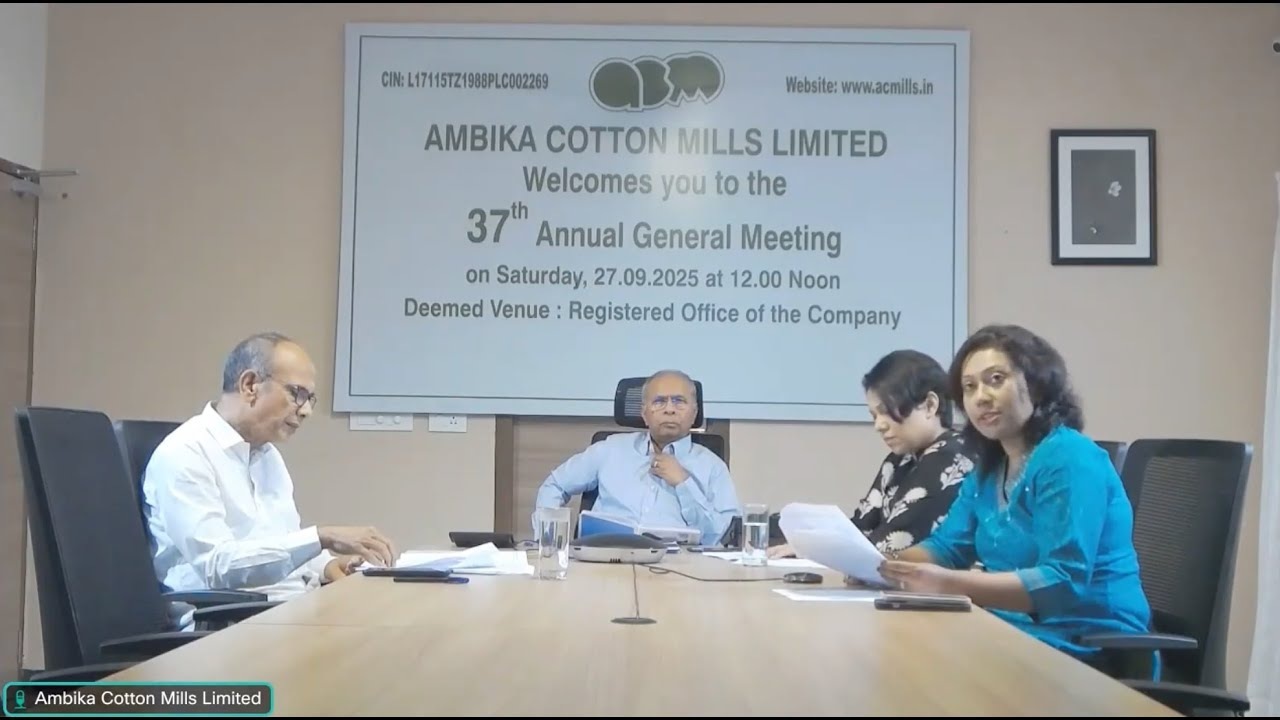
The legal file is busier. An income-tax assessment order dated 29 March 2026 raises a demand of ₹45,24,490 and disallows ₹1,75,93,707. The company says it will appeal. A March 2026 order demands ₹1,80,07,822 in deemed charges plus interest, following a ruling of the Madras High Court. An appellate order reinstated a goods and services tax demand of ₹4.10 crore in October 2025. The Registrar of Companies, which polices company filings, fined the company ₹1,02,000 for a two-day delay in filing a form. Three senior managers were fined ₹78,000 between them over the same delay. The exchanges levied fines totalling ₹13,55,820 under a corporate governance rule. Those were paid, and the company plans an appeal to the Securities Appellate Tribunal, the court that hears market disputes. The annual general meeting of 27 September 2025 passed all eight resolutions, including approval for voluntary delisting from BSE.
US
Now live
US Stocks terminal is live
13,000+ US tickers · EDGAR fundamentals · screener and filings feed — the same terminal, for American markets.
Explore →
3. Business Model: WTF Do They Even Do?
The business is cotton, twisted very, very finely.
Ambika manufactures and exports premium Compact and Elitwist cotton yarn for hosiery and weaving. It spins mainly in the 60s to 100s count range, which is the fine end of the trade. Yarn that fine is destined for shirting rather than for hard-wearing cloth. The compact yarn blends imported and indigenous cotton, with raw cotton bought from the USA, Egypt and Australia. Three products come out the other end: cotton yarn, knitted fabrics and waste cotton. The last is the rare business line where the name is also the product description.
Capacity is 108,288 spindles across five units. The company can also convert 40,000 kg of yarn a day into fabric. It holds twelve international certifications, among them OEKO-TEX, GOTS, SUPIMA and Cotton USA. That is a filing cabinet given over to proving the cotton is fine, ethical and traceable.
Power is where the model gets characterful. Windmills in the Tirunelveli, Dharapuram and Theni districts total 27.4 megawatts. Rooftop solar at the plants adds 8.33 megawatts. Together they cover 82 to 84 per