General information and education, not investment advice. The author is not a SEBI-registered adviser or research analyst. No recommendation, no promised returns. Markets carry risk including loss of capital. Figures may not be current. Always consult a SEBI-registered adviser.
1. At a Glance
Consolidated sales for the three months to June 2026 were ₹432.16 crore. A year earlier the figure was ₹338.20 crore, a rise of 27.8%. Operating profit went from ₹20.31 crore to ₹49.13 crore. Net profit was ₹18.62 crore, against a loss of ₹7.16 crore in June 2025. That line has spent the past three years behaving like a mood ring.
Management reported consolidated total income of ₹441.9 crore. EBITDA, meaning profit before interest, tax, depreciation and amortisation, was ₹58.9 crore, up 103.4%. The EBITDA margin was 13.3%, against 8.35% a year earlier. Film volumes rose 2.7% to 22,120 tonnes. Film revenue rose 37.7% to ₹399.5 crore. The volumes barely moved and the revenue got on a plane. Management attributed the divergence to better realisations, margins and product mix.
Elsewhere in the quarter, 67,08,851 shares were allotted on the conversion of warrants, which let holders subscribe to shares later. Equity capital went to ₹52.15 crore. The board proposed a final dividend of ₹0.25 for the year to March 2026. The record date is 17 September 2026. Promoters had also proposed an inter-se transfer, which is a move of shares between promoters themselves, of 37,97,468 shares. That block is 3.64% of the company, and the transfer was cancelled on 20 August 2026. The earnings call transcript went up four days later.
2. Introduction
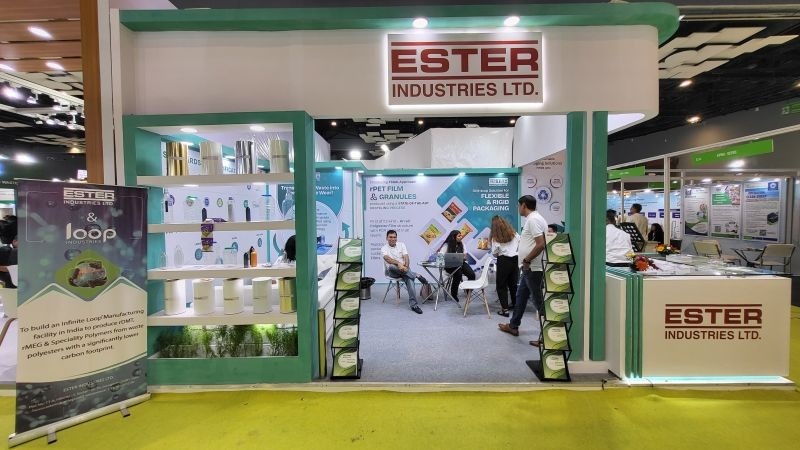
Ester Industries was incorporated in 1985 and manufactures polyester film and engineering plastics. The company describes itself as an ISO-certified manufacturer of polyester film, speciality polymers and rPET, which is polyester recycled from used bottles. Its milestone chart is a forty-year scroll of the least glamorous verbs in industry: enhanced, modernised, de-bottlenecked. Commercial production began in 1988, and the shares were first sold to the public in the same year. Film Line-2 followed in 2001. Speciality polymers and Film Line 3 arrived around 2011 and 2012. Somewhere in there the chips plant was modernised to use PTA in place of DMT. Both are raw materials for polyester, and swapping one for the other changes a whole cost structure while reading like a typo.
The last five years were busier. Ester Filmtech, a wholly owned subsidiary, commissioned 48,000 tonnes a year of capacity in Telangana in January 2023. Commercial operations ran from the three months to March 2023, with debt taken in a 70:30 ratio, per CRISIL, a credit-rating agency. Then came a two-stage offline coater and an extruder for post-consumer recycled material at Sitarganj. A second pair followed at the Telangana plant. There is also a 50:50 joint venture with NASDAQ-listed Loop Industries, to chemically recycle polyester textile waste.
The board also changed shape. Per the filing of 26 March 2026, Arvind Singhania was redesignated non-executive chairman, subject to members’ approval. Vaibhav Jha was appointed chief executive with effect from 27 March 2026. A postal ballot run from 20 February to 21 March 2026 reappointed the managing director and the whole-time director. The same ballot approved material related-party transactions, which are dealings with parties connected to the company.
CRISIL revised its outlook to stable from negative in July 2025 and reaffirmed the long-term rating at Crisil A-. The agency cited improved operating performance, steady demand, and a correction in the demand-supply imbalance that had been squeezing flexible packaging. The short-term rating stayed at Crisil A2+.
US
Now live
US Stocks terminal is live
13,000+ US tickers · EDGAR fundamentals · screener and filings feed — the same terminal, for American markets.
Explore →
3. Business Model: WTF Do They Even Do?
The company makes very thin plastic, in enormous quantity.
The core product is BOPET film, or biaxially oriented polyethylene terephthalate, which is polyester stretched in two directions. It is sold in over 300 varieties: plain films, metallised films, holographic films and coloured films among them. Coated, barrier and window metallised grades are sold too. These end up in food packaging, beverage packaging, and home and personal care. Industrial packaging, identification and security are the other end uses. Installed capacity is 108,000 tonnes a year of polyester films and 67,000 tonnes of polyester chips, which are the pellets film is made from. Capacity for rPET is 28,000 tonnes a year. The plants are at Sitarganj, Khatima and Hyderabad, with the corporate headquarters filed away in Gurgaon.
The second segment is speciality polymers, at 30,000 tonnes a year. Here the company makes customised grades of polyester and allied co-polymers. It describes itself as a global leader in sustainable polybutylene terephthalate. Ester lists more than 20 granted patents and a pipeline of over 30 speciality products. The company characterises the segment as largely protected by patents, hard for rivals to enter, export-oriented and high-margin. The slide saying so reads like a dating profile written by a chemical engineer.
The strategic thread through both is value-added and speciality products,