General information and education, not investment advice. The author is not a SEBI-registered adviser or research analyst. No recommendation, no promised returns. Markets carry risk including loss of capital. Figures may not be current. Always consult a SEBI-registered adviser.
1. At a Glance
Pradeep Metals makes forged and machined steel components at Rabale, in Navi Mumbai. The parts go to oil and gas, petrochemical and general engineering customers in India and abroad.
Revenue for the three months to June 2026 was ₹93.71 crore, against ₹77.53 crore a year earlier. That is a rise of 20.9%. Net profit came in at ₹8.35 crore, against ₹5.57 crore in the same quarter. Operating profit was ₹13.76 crore, an operating margin of 14.68%. Operating margin is what the core business keeps before interest and tax.
That is the arithmetic. The company has spent four decades heating steel until it agrees to become a flange. The next act is a plant at Butibori, Nagpur, making 155 mm artillery shells. The estimated cost is ₹250 crore. An advance of ₹28.59 crore had been paid out by 30 June 2026. Revenue for the whole of FY26 was ₹338.03 crore.
The existing business carried on doing existing-business things. Capital spending in FY26 was ₹15.31 crore. Research and development spending was ₹34.54 lakh, up from ₹21.82 lakh. That work has produced two granted Indian patents, one of them co-owned with a Japanese university.
Crisil, a credit-rating agency, reaffirmed the ratings at BBB/Stable and A3+ on 29 June 2026. It also enhanced the rated bank facilities from ₹102 crore to ₹282 crore. Inside that jump sits a ₹180 crore rupee term loan maturing in 2036, from Union Bank of India.
The June quarter segment disclosure now carries a third line item, “Ammunition manufacturing unit”. Its segment assets were ₹48.82 crore, on nil revenue.
2. Introduction
Incorporated in 1982, Pradeep Metals manufactures and sells forged and machined components. The plant is at Rabale, Navi Mumbai, an address that has been on the letterhead long enough to read like a family surname.
The move abroad happened the sensible way. During 2013-14 the company set up a wholly owned subsidiary, PML Inc. USA, to find customers and push exports into America. That subsidiary in turn holds a step-down subsidiary, Dimensional Machine Works LLC, which manufactures precision machined components. Crisil, a credit-rating agency, combines all three as the PML group.
The last eighteen months have carried more paperwork than the eighteen years before them. In March 2025 the board approved a Scheme of Amalgamation of Nami Capital Private Limited into the company. No cash changes hands, and equity is issued to NCPL shareholders on an approved exchange ratio. The company states the aim as simplifying the group structure. NCPL holds 59.03% of Pradeep Metals, a layer of holding company sitting between the promoters and the shares. BSE conveyed no adverse observation in July 2025. The National Company Law Tribunal, which signs off on mergers, passed the First Motion Order on 8 April 2026. Shareholders met by video conference on 12 June 2026 and approved the scheme. The Second Motion Petition is now filed. The scheme becomes effective once the tribunal’s order arrives and is filed with the Registrar of Companies, a sentence that has been true in various tenses since March 2025.
The defence project moved on a parallel track and slightly faster. On 30 January 2026 the board approved a greenfield project costing ₹250 crore, meaning a plant built from scratch on empty land. On 30 April 2026 the company published a clarification on a Dainik Bhaskar news item, calling it speculative and pointing back to the January approval. Land at Butibori was identified on 27 April 2026. A lease assignment deed for 33,040 square metres was executed on 16 June 2026. The 43rd annual general meeting on 7 August 2026 noted the investment. It reappointed Dr Kewal Krishan Nohria, and reappointed Pradeep Goyal as Chairman and Managing Director for three years.
US
Now live
US Stocks terminal is live
13,000+ US tickers · EDGAR fundamentals · screener and filings feed — the same terminal, for American markets.
Explore →
3. Business Model: WTF Do They Even Do?
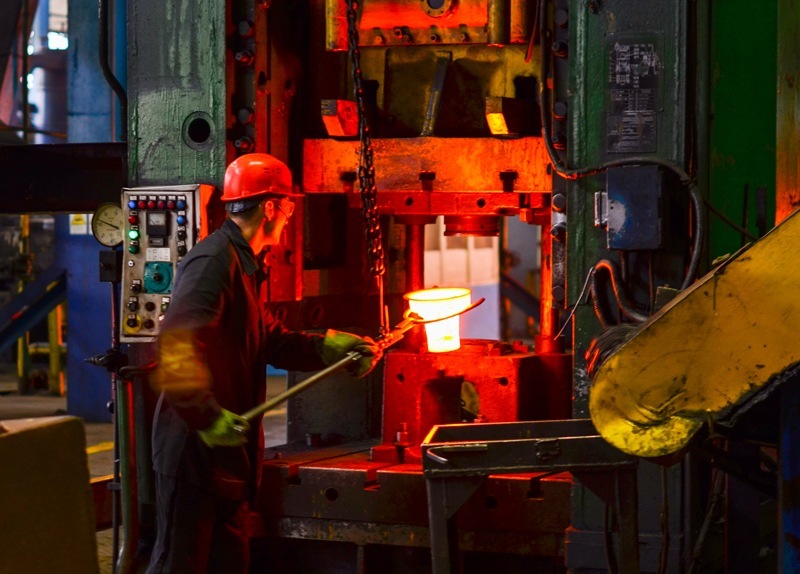
The company takes steel, gets it very hot, and hits it in a closed die until it becomes a specific shape. A closed die is a two-part mould that gives the hot metal its form.
More formally, the output is closed-die forgings in stainless steel, alloy steel and carbon steel. These are supplied as finished and semi-finished machined components to oil and gas, petrochemical and general engineering buyers. The in-house list runs from raw material cutting through forging, die tooling and heat treatment. Machining, sub-processing, coating and surface finishing also happen on site. The metal enters as a bar and leaves as a product, without being couriered to a specialist across town.
The hardware behind that is 13,000 tonnes of installed forging capacity and more than 80 CNC machines. There is also multi-axis machining, in-house die manufacturing and 4 tonnes of heat treatment capacity. During FY26 the facility ran at 65% capacity utilisation and achieved 88% on-time delivery. It developed more than 300 new products, and export sales grew 48%.
That is three hundred new products in one year, at a company that makes things called NRV cones and wedge shoes. General engineering and instrumentation made up about 34% of FY26 revenue, and flanges about 33%. Valves came to about 30%, with defence at about