General information and education, not investment advice. The author is not a SEBI-registered adviser or research analyst. No recommendation, no promised returns. Markets carry risk including loss of capital. Figures may not be current. Always consult a SEBI-registered adviser.
1 — At a Glance
Tenneco Clean Air India makes exhaust systems and shock absorbers for vehicles.
Revenue from operations for the three months to June 2026 was ₹1,545 crore, up 20.2%. The comparable figure a year earlier was ₹1,286 crore. Operating profit rose 7.9% to ₹247 crore from ₹229 crore. Net profit slipped 1.7% to ₹165 crore from ₹168 crore. Three numbers, three directions, one quarter.
Management says the year-ago quarter carried a one-time gain from selling the Motocare business, plus other one-off income. Excluding that, management says profit growth would have been similar to operating profit growth. The chief financial officer also named commodity cost escalation tied to the geopolitical situation. The same executive pointed to the cost of moving from a private company to a listed one. The company completed its market listing in November 2025, so this is the first June quarter carrying that cost.
Value-added revenue, the company’s own measure of sales, grew 18.4% to ₹1,381.6 crore. Volumes in the markets it serves grew 16.2%. Commercial vehicle clean air share by value reached 58% in the year to March 2026. Passenger vehicle shocks and struts reached 55%, and off-highway clean air held at 68%. A spark plug order arrived from what management called one of India’s largest passenger vehicle makers. Management described it as entry into a product area the company had not sold into before.
Operating margin was 16% of revenue in the June quarter, against 18% a year earlier. The market pays ₹35 for every ₹1 of yearly profit, against ₹29.70 across the industry. On 12 August, the promoters sold 6.05 crore shares.
2 — Introduction
Tenneco Clean Air India Limited was incorporated in 2018. It is a subsidiary of Tenneco Inc., the American group that designs and makes clean air and powertrain parts for vehicles. The parent is a Tier-1 supplier, meaning it sells directly to vehicle makers rather than through another supplier. It also serves the aftermarket, the trade in replacement parts once a vehicle is on the road. The Indian arm arrived with a customer list rather than the job of building one.
The shares listed on the BSE and the NSE on 19 November 2025. The offer covered 9,06,80,100 equity shares of ₹10 face value, and was subscribed 61.8 times. It was entirely an offer for sale by existing shareholders. The ₹3,600 crore raised went to those shareholders rather than into the company.
The filing record since has run at a steady clip. In February 2026 the board approved a factory at Kharkhoda, with ₹71 crore of capital spending. It adds roughly 130,000 cold-end and 256,000 hot-end units. In May 2026 a subsidiary approved a new factory in western India, adding 2.1 million units. That carries ₹69 crore of investment by the year to March 2028. The earnings call for the three months to December 2025 disclosed programme wins of ₹220 crore and ₹115 crore. The annual results release in May 2026 reported an operating margin of 18.8% for the year to March 2026.
The statutory auditors are Deloitte Haskins & Sells LLP. The consolidated June 2026 results went through a limited review, a lighter check than a full audit. The auditor’s report states that nothing came to its attention causing it to believe the statement contained a material misstatement. The standalone results carried an unmodified conclusion.
The group consolidates four subsidiaries. Two of them are Tenneco Automotive India Private Limited and Federal-Mogul Ignition Products India Limited. The others are Federal-Mogul Sealings India Limited and Federal-Mogul Bearings India Limited. For accounting purposes the group treats itself as a single segment under Ind AS 108, the standard covering segment reporting. The financials therefore show no separate reportable segments, though the business describes itself in two halves.
US
Now live
US Stocks terminal is live
13,000+ US tickers · EDGAR fundamentals · screener and filings feed — the same terminal, for American markets.
Explore →
3 — Business Model: WTF Do They Even Do?
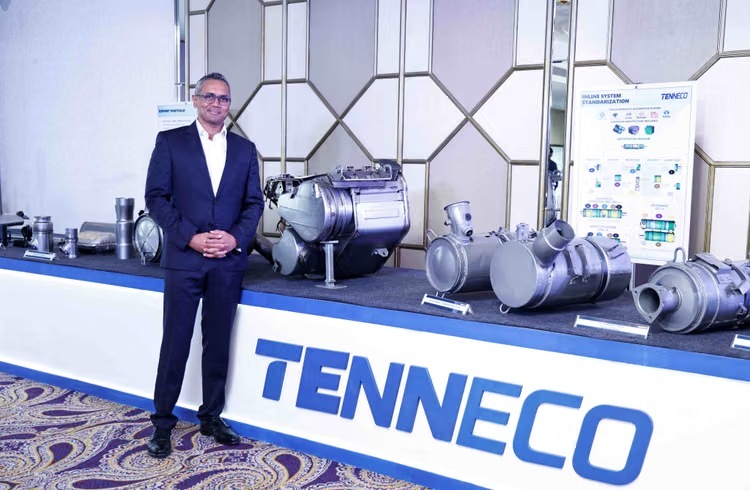
Two halves, then. Clean Air & Powertrain Solutions makes the parts that sit between an engine and the atmosphere. That covers exhaust after-treatment systems, catalytic converters, mufflers and exhaust pipes. The converters run to DOC, DPF, SDPF and SCR, the alphabet of not choking. The same division sells engine bearings using IROX technology, and sealing systems covering cold and hot gaskets and heat shields. Ignition products sit here too: spark plugs and coils under the Champion brand.
Advanced Ride Technologies is the other half. It makes passive and semi-active shock absorbers and struts, electronic and semi-active dampers, and suspension modules. This is the business of turning Indian road surfaces into a rumour the passenger merely hears about.
Value-added revenue splits 52.5% to Clean Air & Powertrain and 47.5% to Advanced Ride. Passenger vehicles account for 63.5% of that revenue and commercial vehicles 21.5%. Industrial and other uses take 7%, and the aftermarket 5.5%. Another 2.5% comes from other end markets.
Domestic sales were 93% of value-added revenue in the year to March 2025, with exports at 6.5%. Those exports reach 18 to 22 countries across the Americas, Europe, Asia-Pacific and Africa. Named markets include the United States, Germany, the United Kingdom and Brazil. Mexico, Japan, Thailand and Vietnam also take shipments.
Twelve plants run across seven states and one union territory. Seven make clean air and powertrain products and five