R M Drip & Sprinklers FY26: Revenue Exploded, But the Cash Ran
General information and entertainment, not investment advice. The author is not a SEBI-registered adviser or research analyst. No recommendation, no promised returns. Markets carry risk including loss of capital. Figures may not be current. Consult a registered adviser before acting.
1. At a Glance
Revenue more than tripled in five years. The headline number: ₹197 Cr in FY26, up 51% year-on-year from ₹130 Cr.
But here’s the tension: cash from operations turned negative. The company burned ₹11.4 Cr in FY26—worse than the ₹22.4 Cr drain in FY25. Growing fast looks great on a pitch deck. Growing while bleeding cash raises a question.
The margins stayed solid—operating margin held at 26.5% in FY26 against 27% in FY25. Profit after tax was ₹35.2 Cr. The market is pricing this at ₹19.3 per share, which values the entire business at ₹826 Cr.
A 5:7 bonus was issued in April 2026. The company acquired a pipe-making subsidiary (Brahmanand Pipes) in January for expansion. Debt climbed—borrowings jumped to ₹52.8 Cr from ₹25.5 Cr a year earlier.
All this growth and all this cash burn: what’s the real story?
2. Introduction
R M Drip & Sprinklers Systems began in 1996 as a partnership shop making micro-irrigation gear. The business manufactures drip systems, sprinklers, pipes, filters, and fertigation equipment.
In January 2026, the company acquired Brahmanand Pipes—a move to backward-integrate and add capacity. Construction of the new plant was set to start in Q1 FY27, with commercial production expected by Q2 FY27. This 50,000 sq. ft. phase-one facility would add ₹12,000 MT of annual capacity on top of the existing 22,000 MT.
The board approved a 3% dividend payout for FY26 (₹0.75 Cr spent on dividends in FY26). That’s 2% of net profit—cautious shareholder returns from a growth-focused company.
In April 2026, the board allotted bonus shares in a 5:7 ratio, diluting existing shareholders but keeping capital light and dealer-friendly. The company also installed a 2.2 MW solar plant, expected to save ₹3 Cr annually from Q1 FY27 onwards.
3. Business Model: WTF Do They Even Do?
The company sells irrigation systems—drip and sprinkler equipment, mainly. It also manufactures HDPE and PVC pipes, filters, fertigation gear, and mulch films.
Revenue split in 9M FY26 shows the diversification: micro irrigation accounted for 54.5% of sales, pressure pipes (institutional) 14.5%, single-use drip & sprinklers 9.5%, polymer compounds 10.5%, and agriculture pipes 11%. A year earlier, micro irrigation was 75% of the mix. The company is genuinely broadening out.
The dealer network has exploded. As of 9M FY26, the company had 1,000+ dealers spread across 12 states (Maharashtra, MP, Gujarat, Karnataka, UP, Bihar, Jharkhand, and others). In FY24, it had 300 dealers in 5 states. This ~67% jump in dealer count in less than two years is real distribution leverage.
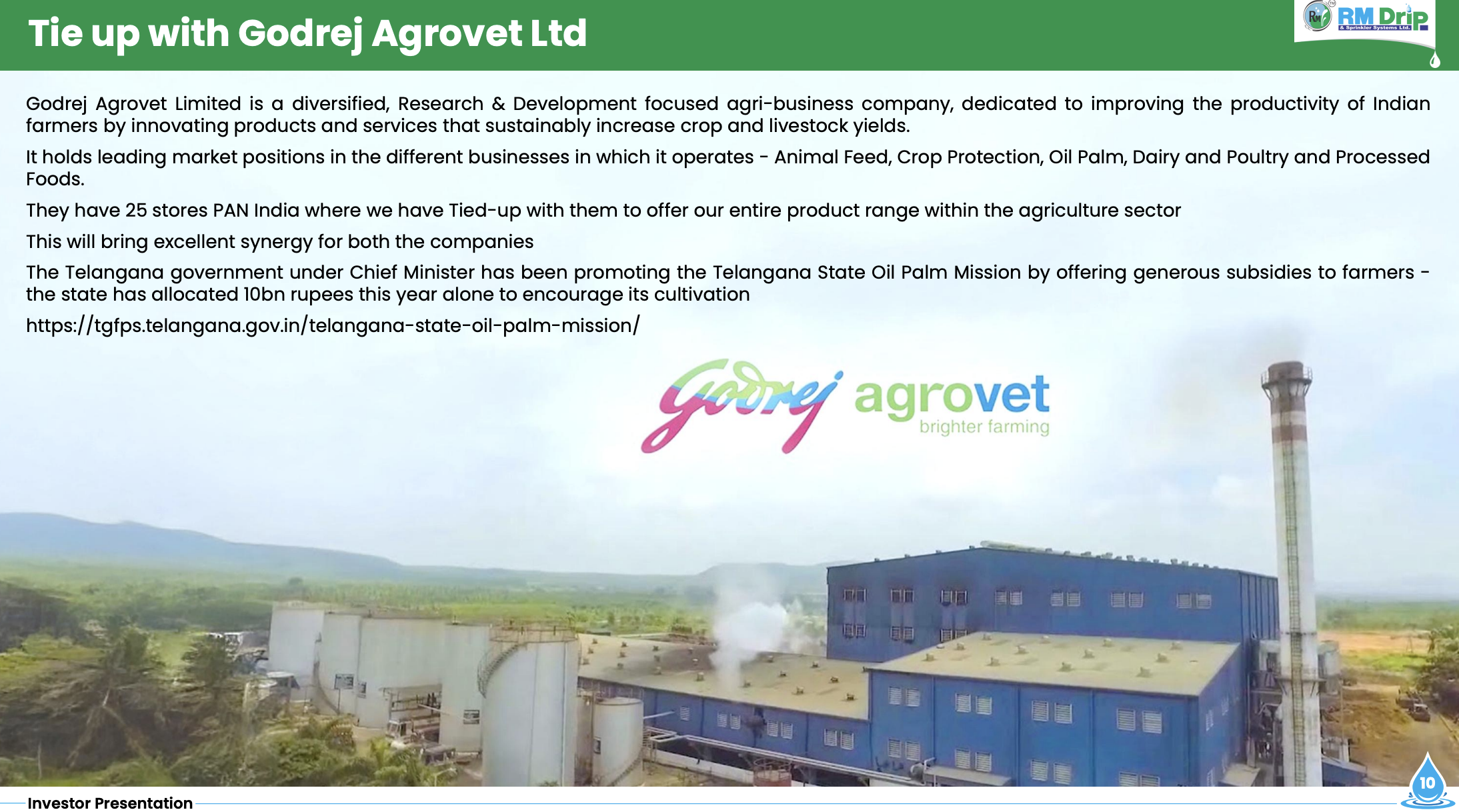
The company also runs a new IoT-based smart irrigation automation segment launched in partnership with Godrej Agrovet. This tied up across 25 Godrej stores to cross-sell micro irrigation products. Expected to contribute ~5% of revenue by FY27, with 30%+ growth from FY27 onwards.
Manufacturing sits at a 6-acre facility in Nashik with 1,25,000 sq. ft. of space. Installed capacity was 22,000 MT per annum in 9M FY26, running at ~90% utilization. With the new Brahmanand facility, that would jump to 34,000 MT by Q1 FY27.
The model is simple: manufacture low-cost, high-margin irrigation gear in India, sell it through a sprawling dealer network to price-conscious farmers, and now add software and services on top. The subsidy environment (PMKSY pays 45–55% of farmer costs) keeps demand hot.
4. Financials Overview
Figures are consolidated, in ₹ crore.
Metric
FY26
FY25
YoY
Revenue
197.4
130.3
+51.5%
EBITDA
51.9
35.2
+47.4%
PAT
35.2
23.9
+47.2%
EPS (annualised)
0.82
0.56
+46.4%
Earnings per share used full-year FY26 EPS (0.82 for the year) since FY26 is the complete fiscal year, not an interim period. Net profit was ₹35.2 Cr on ₹197.4 Cr revenue, yielding a PAT margin of 17.9%.
EBITDA worked out to ₹51.9 Cr, a margin of 26.3% (calculated from net profit + tax + interest + depreciation).
Capex was aggressive. Capital expenditure in FY26 came to ₹54.9 Cr (purchase of PPE and CWIP). Against that, free cash flow turned deeply negative: operating cash flow was ₹-11.4 Cr, and after capex, free cash flow landed at ₹-66.3 Cr.
The squeeze: the company is buying capacity (new facility, solar, machinery) while also funding a working capital explosion. Trade receivables jumped from ₹107.9 Cr to ₹135.2 Cr—a ₹27.3 Cr increase in just one year.
5. Market Expectations & Historical Multiples
This section describes how the market is currently pricing the company and how that compares with its own history and peer group. It is descriptive, not predictive.
Metric
Current
Historical Average (5Y)
Peer Median
P/E
23.4
12.1
20.3
EV/EBITDA
16.1
18.2
16.2
ROE
36.9%
30.6%
24.5%
ROCE
37.9%
22.0%
18.4%
The market currently pays 23.4x earnings here, compared to a peer median of 20.3x. Against its own 5-year average of 12.1x, the multiple has re-rated sharply.
EV/EBITDA sits at 16.1x versus the peer set at 16.2x—in line. But the company’s ROE (36.9%) and ROCE (37.9%) are well above the peer median (24.5% and 18.4%), suggesting the market is pricing in sustained high returns.
The company appears to be priced for growth. Revisions have been positive (51% revenue growth, 47% profit growth in FY26 alone). The multiple expansion signals the market is betting that strong ROCE and capex investments will drive future