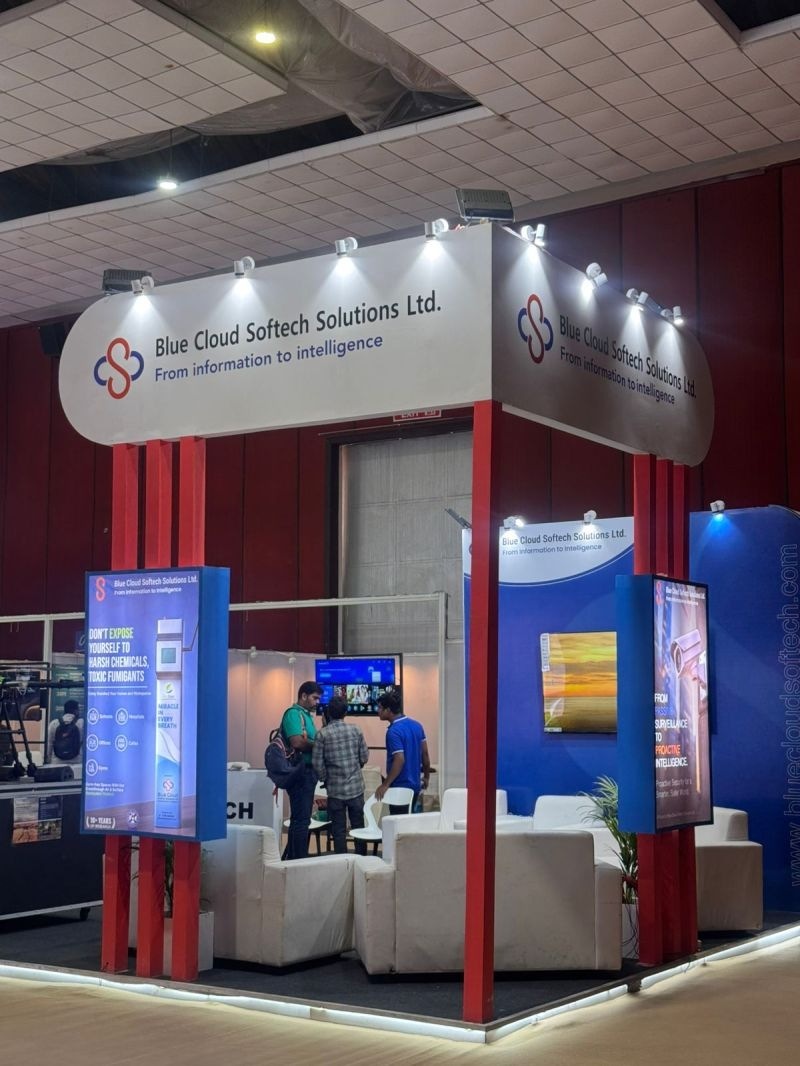
Blue Cloud Softech: ₹1,002 Cr Revenue & the ₹1,100 Cr Order Book Question
General information and entertainment, not investment advice. The author is not a SEBI-registered adviser or research analyst. No recommendation, no promised returns. Markets carry risk including loss of capital. Figures may not be current. Consult a registered adviser before acting.
FY26 closed with ₹1,002 Cr revenue and ₹60.5 Cr profit after tax—a 26% and 37% leap year-on-year, respectively. The stock sits at ₹18.1 (prices referenced are not live), valuing the company at ₹1,361 Cr or 22.5x annualised earnings.
The tension: management claims ₹1,100 Cr+ in confirmed recurring order book for next year (mostly 5-year contracts, 70% of revenue already recurring), yet the same executives guided to ₹3,000 Cr full-year FY27 revenue—a number that requires quarterly run-rates near ₹750 Cr by year-end. The near-term picture is stable; the gap is where the wires cross.
The balance sheet just absorbed ₹269 Cr in debt (a tripling year-on-year) to fund five acquisitions and data center capex. Receivables jumped to 141 days outstanding against a historical 76-day average, blamed partly on “geopolitical situations” and partly on management’s own billing model fix.
2. Introduction
Incorporated in 1991, Blue Cloud spent its first three decades as a low-profile IT services vendor. The last three years rewired it. Since March 2024, the company acquired AIS Anywhere (USA-based managed services, closed Dec 2025), announced Global Impex (renewable energy/EV order book, all-equity swap via 17 Cr share issuance, in-principle BSE approval received), set up SPV structures for healthcare (BluBio at 25%), and outlined a USD 1 billion, 800 MW phased data center buildout.
In parallel, the business shifted vocabulary. Where it was “services,” it now says “AI-first platforms,” “SaaS-based recurring,” “modular delivery,” and “payback from infrastructure investments.”
In February 2026, the founding CEO Vinod Babu Bollikonda elevated himself to Group Chief Executive Officer; a new MD took the helm. By June 2026—one month after FY26 results closed—the CFO resigned and a new one arrived.
The company just staged a May 4 shareholder meet to approve a capital hike (to accommodate the Global Impex swap) and other governance shifts.
3. Business Model: WTF Do They Even Do?
The company now operates across five labeled verticals.
Cybersecurity (~46–47% of FY26 revenue). Flagship product is BluTOR (incident tracking across dark web) and BluHawk (VAPT solution). The functional coverage spans IAM, data protection, API security, threat detection, attack surface management, behavioral analytics, continuous exposure management, incident response. Contracts typically run 5 years; management stated the latest runs through 2030.
Enterprise Smart Applications (~24–26% of revenue). This is AccessGenie, the facial recognition + video analytics product that integrates “legacy and advanced IP cameras” for anomaly detection. Deployed across state police, narcotics control, healthcare, border/national ID programs, airports, jewelry retail. Accuracy cited as “around 87% to 96%” depending on use case.
Healthcare (~14%+). BluHealth (face-based vital signs assessment in 60 seconds, management claims “totally patented”); BioSter (sterilization beyond OT grade); BluClinics and BluHealth Scanner. Recently deployed via Central Electronics Limited across the Telangana Arogyasree program.
Telecom/5G. Building 5G Fixed Wireless Access, Captive Non-Public Networks (CNPN), and Private Mobile Networks (PMN) infrastructure.
IT Consulting & Support. The balancing item. Includes infrastructure services, managed services (amplified by the AIS Anywhere acquisition which contributed ₹170–180 Cr to H1 FY26).
The real shift is how these move money. In FY24, the model was project-heavy, milestone-based, end-heavy billing. By FY26, management says ~70% of revenue is now recurring (long-tenor contracts), and it has begun a “modular, pro-rata billing” pivot to flatten cash realization across quarters. In plain English: the products are becoming platforms; the billing is becoming subscriptions; the capex is being front-loaded (hence the ₹269 Cr debt spike).
4. Financials Overview
Figures are consolidated, in ₹ crore.
Metric
FY24
FY25
FY26
YoY Growth (FY26 vs FY25)
Revenue
502
797
1,002
26%
EBITDA
27
70
125
79%
PAT
16
44
60.5
37%
EPS
0.36
1.01
0.80
-21%
EBITDA margin climbed to 12.5% (FY26) from 8.8% (FY25). PAT margin held at 6.0% (FY26) vs 5.5% (FY25), with tax outgo rising to 32% vs 25% prior year—an unusual inversion that management did not explicitly flag.
EPS fell to ₹0.80 from ₹1.01 because shares on issue expanded sharply: the May 2026 preferential allotment issued 31.68 Cr shares (valued at ₹23.06/share) for the AIS Anywhere swap. The denominator widened; the numerator did not catch up.
Q4 FY26 snapshot (Jan–Mar):
Sales in Q4 were ₹278 Cr (up 51% YoY from Q4 FY25’s ₹184 Cr), but profit fell 7% to ₹12.1 Cr from Q4 FY25’s ₹13 Cr. The tax rate in Q4 alone spiked to 47%, dragging down the bottom line despite the revenue jump. Management attributed margins to “unusual spikes” in receivables and one-time costs; the narrative on the call was bullish about normalization ahead.
Concall posture: management reiterated FY27 guidance of “around ₹3,000 Cr” and stated a “confirmed order book of close to 1,100 crores plus for next financial year” (recurring, largely tied to existing long-tenor contracts). Q1 FY27 is expected to