General information and entertainment, not investment advice. The author is not a SEBI-registered adviser or research analyst. No recommendation, no promised returns. Markets carry risk including loss of capital. Figures may not be current. Consult a registered adviser before acting.
1. At a Glance
Agarwal Industrial’s FY26 result reads like a cautionary tale about what happens when logistics, raw materials, and monsoons all decide to perform badly in the same year.
Revenue collapsed 31% to ₹1,652 crore. Net profit fell 62% to ₹44 crore. The operating margin compressed 140 basis points to 7%, while the company loaded up ₹30+ crore of fresh capex on the Karwar storage acquisition. ROCE plummeted to 8% from 17% the year prior.
The market is framing this as a cyclical stumble. Management is framing it as monsoon seasonality plus geopolitical disruption. The truth is probably both—with a growing question: does the company’s capex thesis (cheaper rentals, higher throughput) actually deliver the recovery it claims?
Liquidity is not a concern. The problem is the speed and scale of the earnings reset.
2. Introduction
Agarwal Industrial Corporation Ltd sells bitumen, ships it, stores it, and owns a fleet to move it. For most of the past decade, this worked: FY15–FY25 saw sales grow at a 13% CAGR and profit at 2% (troubled by inflation and cyclicality). The company built a reputation as India’s largest bitumen logistics player and an integrated supply-chain solver for infrastructure contractors.
FY26 broke the pattern.
The company reported results in May 2026 for the year ended March 31, 2026. The headline numbers—revenue ₹1,652 crore, net profit ₹44 crore, EPS ₹29.13—were worse than any year since FY20, despite the backdrop of Bharat Mala 2.0 and strong project announcements. In January, the company announced the acquisition of Konkan Storage Systems (Karwar), a port terminal operator, for ₹22 crore (with ~₹30 crore total capex). This was meant to fix two problems: leased tankage costs and storage bottlenecks. The timing raises a question: is management doubling down into weakness, or is this the right time to invest?
Quarterly Q4 (Jan–Mar 2026) was the worst: ₹405 crore revenue, ₹16 crore net profit, 8% margin, with bitumen volume at 124,600 MT—a fraction of seasonal expectations.
3. Business Model: WTF Do They Even Do?
Agarwal Industrial operates at the intersection of three things: where infrastructure budgets meet the logistics value chain.
The Core: The company manufactures and imports bitumen—the asphalt binder that sits under every highway. It imports mostly from Middle East suppliers (80–85% from top three), blends/grades it locally at facilities in Karnataka, Telangana, Maharashtra, and other states, and sells it on to road contractors, oil PSUs (HPCL, BPCL, IOCL), and private contractors. Revenue contribution is ~79% of the mix.
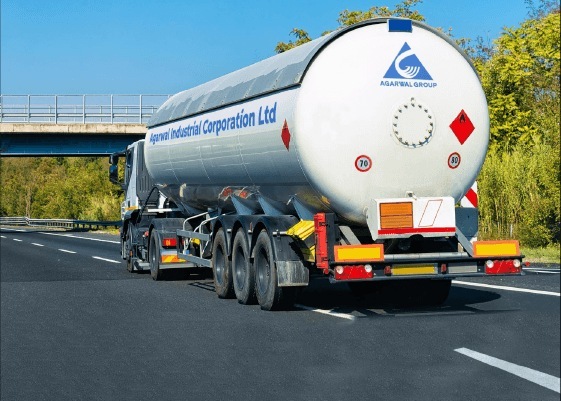
The Logistics Moat: The company owns 10 vessels (102,949 MT capacity, including one in dry dock) and 650+ road tankers (350 bitumen-specific, 300 LPG). It carries ~60–70% of its own bitumen volumes by sea, which cuts freight costs and de-risks supply. This vertical integration is the company’s claimed competitive edge.
The Shipping Side Bet: The company also charters vessels to third parties through its UAE subsidiary, AICL Overseas FZ LLC. Shipping revenue was 13% of the mix in FY24, climbing to higher percentages in strong capacity years. In FY26, it contributed ~12% of revenue (₹~200 crore) but profit margins collapsed because vessels were underutilized and fixed crew/operating costs didn’t decline with volumes.
The New Piece: Karwar storage facility (24,000 MT capacity, now wholly owned as of Jan 2026). The rationale: save on leased tankage costs at port terminals and enable higher throughputs during peak season.
The thesis is elegant: own the supply chain, control costs, absorb margin volatility. The problem is margin volatility isn’t just internal—it’s also seasonal, geopolitical, and tied to raw material inflation. FY26 exposed all three.
4. Financials Overview
Figures are consolidated, in ₹ crore.
Metric
FY26
FY25
YoY
FY24
FY24–FY26 CAGR
Revenue
1652.23
2398.93
-31.1%
2125.30
-12.5%
EBITDA
149
260
-42.7%
203
-16.6%
Net Profit
43.57
115.69
-62.3%
109.22
-36.2%
EPS (annualized)
29.13
77.34
-62.3%
73.02
-37.6%
Operating Margin
7.1%
8.4%
-130 bps
8.1%
—
Quarterly Collapse in Context
Q4 FY26 (Jan–Mar) alone saw revenue of ₹405 crore, operating profit ₹32 crore, net profit ₹16 crore, and 8% margin. This was the trough quarter. Q3 (Oct–Dec) was ₹408 crore revenue and a 5% margin. The first half (Apr–Sep) was marginally better: Q1 ₹594 crore and Q2 ₹594 crore. Bitumen volumes across the full year tracked to ~6 lakh MT (management’s guidance), down from 7+ lakh MT in FY25. Management attributed the shortfall to early and extended monsoons (which depressed construction demand), India–Pakistan trade disruptions in Q1 (15-day impact), and Middle East geopolitical disruptions impacting shipping lanes (up to 30 days in Q1).
On the concall in August 2025 (Q1 FY26), management acknowledged Q1 was “operationally abnormal” and pledged “better guidance in Q3.” It didn’t materialize. By February 2026 (Q3 results), management acknowledged a broad demand slowdown but stood by its capacity thesis.
EBITDA and Margin Trajectory
EBITDA fell from ₹260 crore (FY25) to ₹149 crore (FY26), a 43% drop. Per-ton EBITDA guidance was ₹4,300–4,500; FY26 delivered ~₹2,500/MT on lower throughput. Management blamed fixed-cost non-absorption (vessels, port terminals, warehousing still ran at full cost despite half the volume). Operating margin compressed to 7.1% from 8.4%, within the company’s historic 6–9% band but at the lower end.
5. Market Expectations & Historical Multiples
This section describes how the market is currently pricing the company and how that compares with its own history and peer group. It is descriptive, not predictive.
Metric
Current
Historical Avg (3-yr)
Peer Median
P/E
15.53
11.8
15.5
EV/EBITDA
6.4
5.2
7.0
ROE
6.62%
15.8%
9.55%
ROCE
7.92%
19.6%
10.9%
P/B
0.98
1.12
1.25
Parsing the Multiples
The market currently pays 15.5x earnings here versus a peer median of 15.5x (peers include Supreme Petrochemicals, Rain Industries, DCW, Manali Petrochemicals, and others in the petrochemical/trading space). The P/E sits unchanged year-on-year despite the earnings collapse, suggesting the market is discounting the hit as temporary.
The EV/EBITDA ratio (6.4x) sits below the peer median of 7.0x, implying the company is pricing in continued margin pressure or slower recovery. Historically, Agarwal Industrial traded at 5.2x EV/EBITDA over the past three years; the current 6.4x represents a modest re-rating upward, not a