Jyoti CNC Automation FY26: Capacity Cap Meets Margin Floor
General information and entertainment, not investment advice. The author is not a SEBI-registered adviser or research analyst. No recommendation, no promised returns. Markets carry risk including loss of capital. Figures may not be current. Consult a registered adviser before acting.
1. At a Glance
FY26 revenue grew 15%, hitting ₹2,093 crore. That’s the good news.
Profit after tax came in at ₹336 crore, an underwhelming 6% rise year-on-year. Operating profit stood at ₹527 crore. The issue: consolidated earnings were dragged down by ₹67 crore in deferred revenue at the France subsidiary (Huron) due to export-license delays tied to a French investigation. Standalone (India core), profit grew 20%.
The company ran installed capacity at over 100% utilization for peak months. That’s a bottleneck masquerading as a problem solved. Management is bringing 10,000 additional machines per year online by September 2026—a near doubling of capacity from 6,000 to 16,000 units.
The order book swelled to ₹4,732 crore as of year-end, representing roughly 18–20 months of delivery visibility. 62.5% promoter ownership. No dividend. Price referenced is ₹640, at which the stock trades at 43.3× trailing earnings.
One tension worth watching: Can management execute a 2.7× capacity scale-up without margin dilution while the export investigation shadows Huron’s recovery timeline?
2. Introduction
Jyoti CNC Automation, headquartered in Rajkot, Gujarat, is a capital-goods manufacturer. It designs and builds 5-axis CNC machines—precision metal-cutting tools used in aerospace, defense, automotive components, general engineering, and specialized industries. The company holds a 10–12% domestic market share and has shipped machines to over 60 countries.
The story for the past two years: a sharp operational inflection from margin recovery to capacity constraint. FY24 marked a turnaround (PAT ₹151 crore after years of losses). FY25 momentum accelerated (PAT ₹316 crore, +110% YoY). FY26 saw demand remain robust but the execution ceiling hit hard.
In November 2024, the company announced a ₹400 crore capex to expand manufacturing by 10,000 machines annually at Metoda, Rajkot. Expected to be operational by Q2 FY27 (September 2026). This expansion is the centerpiece of management guidance and the lynchpin of FY27 revenue and margin narrative.
Recent headwinds include an April 2026 disclosure: French authorities launched an investigation into Huron Graffenstaden SAS (Jyoti’s stepdown subsidiary in Strasbourg) regarding export controls and dual-use machinery documentation. EUR 4 million in bank accounts and two properties were seized. The company has retained legal counsel. No timeline for resolution has been provided.
3. Business Model: WTF Do They Even Do?
Jyoti makes CNC machines. Not all CNC machines—it specializes in high-precision, high-end simultaneous 5-axis machining centers. These are platforms where a cutting tool can move in five directions at once, enabling complex geometries in a single setup. Airframe parts, engine components, aerospace fasteners, automotive gearboxes, and die molds are the sweet spots.
The product portfolio spans 44 verticals and 200+ variants. Entry-level machines start around ₹50 lakh per unit. High-end aerospace-grade systems command ₹2 crore or more. In FY26, approximately 40% of the order book was high-end (aerospace-heavy); 60% was entry- and mid-level (auto, general engineering, EMS).
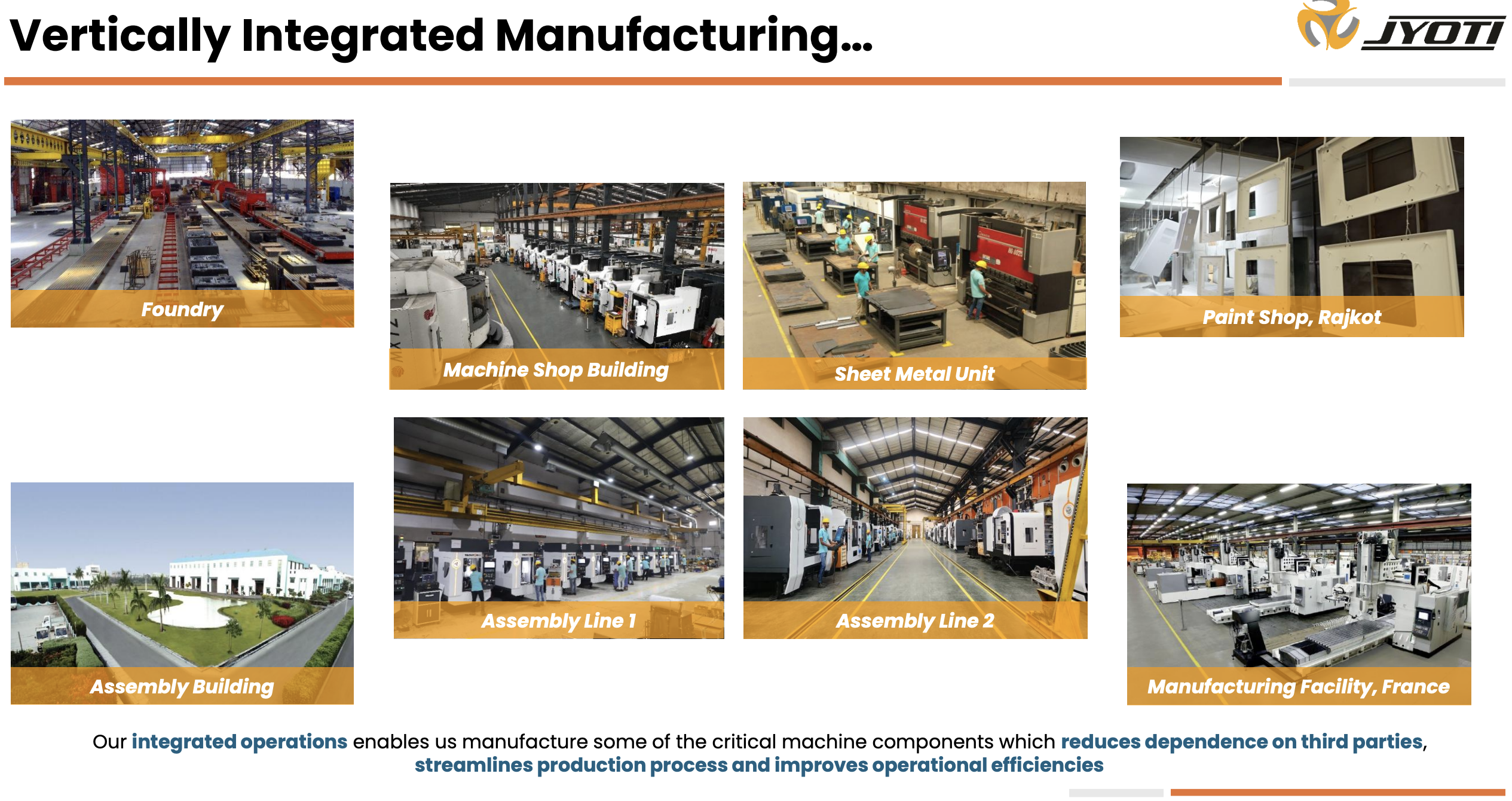
Manufacturing happens at two facilities in Rajkot (India) and one in Strasbourg, France (Huron). Current capacity is 6,000 machines annually in India, 121 in France. The company has installed over 130,000 machines globally since inception.
Revenue mix:
FY26 saw aerospace jump to 38% of order-book intake (up from 8% in FY22). This is a structural reorientation—geopolitical defense capex, commercial aircraft orders, and the “Atmanirbhar Bharat” manufacturing push driving it. Auto and auto components fell to 20% of order book. General engineering represents 19%. EMS (electronics manufacturing services) emerged as 4%.
Geography: Exports now account for 45% of business (H1 FY25), up from 17% in FY22. That diversification is real, but it also ties revenue to the Huron facility and, now, to the export-control investigation.
Margins: The company operates on a 25% EBITDA target (pre-exceptional items). FY26 consolidated EBITDA margin was 25.2% on ₹2,093 crore revenue. Standalone (India), EBITDA margin was 28.9%, implying Huron’s mix or tax drag compresses consolidated margin by 3.7 percentage points.
Spare parts and after-sale services account for ~7% of revenue, a stickier, higher-margin segment that also builds customer lifetime value.
4. Financials Overview
Figures are consolidated, in ₹ crore.
Metric
FY26
FY25
YoY Change
FY24
FY25 vs FY24
Revenue
2093
1818
+15.1%
1338
+35.9%
EBITDA
527
491
+7.3%
301
+63.1%
PAT
336
316
+6.3%
151
+109.3%
EPS (Reported)
14.77
13.90
+6.3%
6.63
+109.5%
Q4 FY26 (Dec 2025 – Mar 2026) Highlights
Revenue came in at ₹599 crore (+4.1% QoQ, +4.1% YoY). Operating profit was ₹147 crore (24.6% margin). PAT hit ₹91 crore (15.2% margin).
Management attributed the Q4 slowdown to two factors: (1) capacity constraints that “impacted our ability to fully execute orders”; and (2) the ₹67 crore revenue deferment at Huron due to export-license holds on certain machines.
Standalone (India Business) Performance
Q4 standalone revenue reached ₹599 crore (+13% YoY). EBITDA margin expanded to 31.9% (₹191 crore). PAT grew to ₹135 crore (+22.6% margin).
The India-only numbers show a healthier operational picture: margins are wider, growth is faster. This is the core business humming. Consolidated results are being dampened by Huron’s accounting adjustment and likely higher capex-related amortization.
Concall Clarifications (May 2026)
Management stated the ₹67 crore deferment is “not a write-off… just a deferment.” Revenue will be recognized once export licenses clear. The costs have already been incurred, hence the margin compression in Q4 consolidated results. No loss of orders, management asserted; just timing.
Regarding FY26 growth having moderated to 6% on a reported basis despite strong demand: management blamed order-booking discipline. “We have been considerate in the order booking to match our delivery obligations,” implying throttled intake to protect delivery commitments while capacity-constrained.
5. Market Expectations & Historical Multiples
This section describes how the market is currently pricing the company and how that compares with its own history and peer group. It is descriptive, not predictive.
Metric
Current (June 2026)
5-Yr Average
Peer Median
P/E
43.3
76.1
30.8
EV/EBITDA
26.0
—
—
P/B
7.27
—
3.79
ROE
18.2%
17.5%
11.52%
ROCE
21.3%
—
14.38%
The stock currently trades at 43.3× consolidated earnings. The peer median sits at 30.8×. Jyoti commands a 40% premium to peers despite lower absolute size (₹2,093 crore revenue vs. peer medians of ₹236 crore). That premium appears anchored to the company’s ROCE (21.3%, above peer median) and ROE (18.2%, also above) alongside near-term capacity ramp visibility.
Historically, the stock has traded at a 5-year average P/E of 76.1×, suggesting the current 43.3× is a marked compression from earlier valuations when growth was less certain. Book value stands at ₹88 per share (face value ₹2), implying the stock trades at 7.27× book, above its peer median of 3.79× but below earlier years.
The market appears to be pricing in capacity-constrained earnings recovery, a meaningful margin floor, and successful ramp-up to 16,000 machines without significant dilution. Early-stage macro uncertainty (tariff chatter, West Asia conflict, energy volatility) is likely being reflected in the multiple discount from historical highs.
6. What’s Cooking
Export Probe at Huron (April 2026) — French authorities initiated investigation into Huron Graffenstaden SAS regarding export controls and