Time Technoplast FY26: Record Revenue and PAT, but ROCE Stumbles
General information and entertainment, not investment advice. The author is not a SEBI-registered adviser or research analyst. No recommendation, no promised returns. Markets carry risk including loss of capital. Figures may not be current. Consult a registered adviser before acting.
1. At a Glance
Time Technoplast reported all-time high revenue, EBITDA, and PAT in FY26 (year ended March 31, 2026), with volumes expanding 13.5% and margins holding flat despite sharp input volatility.
The kicker: ROCE slipped to 18.9% from a 20% target, blamed on capex-heavy automation. The company identified ₹134 Cr of non-core assets for sale and pledged debt-free status in 12–18 months.
Value-added products (composites, IBCs, MOX films) grew 18% and now represent 29% of revenue—the portfolio’s creeping shift upward. But an order book that looks plump (₹600+ Cr across segments) carries execution risk tied to polymer pricing resets in pipes and government tenders.
The market has punished the stock—down 18% in one year—despite record profits.
2. Introduction
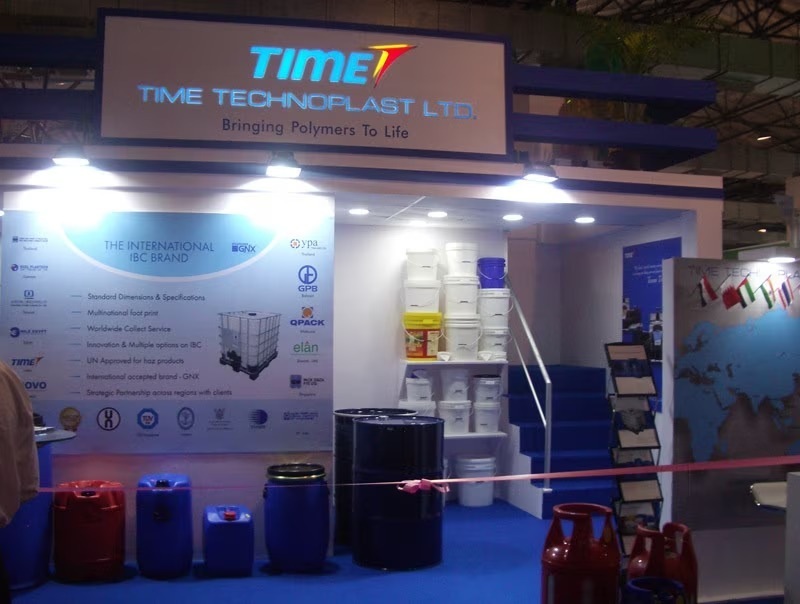
Time Technoplast manufactures polymer and composite products for industrial packaging, infrastructure, and energy storage. It holds over 55% market share in domestic industrial packaging, is the world’s largest maker of large-size plastic drums, and ranks second globally in composite cylinders.
The company operates 31 manufacturing sites across 11 countries. Its biggest customers include Godrej, L&T, Indian Oil, and TATA Motors—all industrial/chemical-focused.
In May 2025, management announced a ₹800 Cr QIP (qualified institutional placement) at ₹201.12 per share, oversubscribed. In November 2025, the allotment closed. The fresh capital funded capex and debt reduction.
Last year, two M&A moves: Ebullient Packaging (deferred pending price clarity) and Systoverse Pipes (16% equity, ₹25 Cr capex planned). Management is also divesting its Middle East business at a USD 25 Mn valuation (7.5% of revenue).
The company splits revenue into two regulatory buckets: Polymer Products (63% in FY26) and Composite Products (37%).
Polymer Products covers industrial drums, jerry cans, pails (branded Techpack), HDPE pipes (Max’M), polyethylene film, MOX multilayer cross-laminated film (Techpaulin), turf & matting, and lifestyle bins.
Composite Products include Intermediate Bulk Containers (IBCs; the GNX brand, globally sold), LPG/CNG/oxygen cylinders (LiteSafe, NEX-G), hydrogen cylinders for drones and vehicles, and emerging categories like composite fire extinguishers and lead-acid batteries (via subsidiary Power Build).
By usage: Industrial Packaging (drums, jerry cans, pails, IBCs) accounts for 73% of FY26 revenue, with the remaining 27% split across Infrastructure (PE pipes, batteries), Composites (cylinders), MOX Films, and Technical/Lifestyle goods.
The business model is 65% domestic, 35% overseas. Geographically, it’s a B2B play—92% operates under industrial contracts with monthly or quarterly price-reset clauses. The other 8% is OEM/retail (batteries, auto parts).
The tectonic shift: Value-added products (VAP—IBCs, composites, MOX) grew 18% in FY26 versus 10% for established products. VAP now sits at 29% of total revenue and claims EBITDA margins of 18.7% versus 13.2% for legacy products. That margin gap is the allure.
The roast: The company is chasing a “future” of high-margin composites while still deriving 71% of revenue from commodity-like plastic drums and pipes. Raw material volatility (polymer prices move with oil) means absolute EBITDA can be defended, but margin % swings remain. The shift is real but glacial.
4. Financials Overview
Figures are consolidated, in ₹ crore.
Annual Results (FY26 vs FY25)
Metric
FY25
FY26
YoY
YoY %
Revenue
5,457
6,105
+648
+11.9%
EBITDA
790
901
+111
+14.1%
EBITDA Margin
14.5%
14.7%
—
+20 bps
PAT
388
469
+81
+20.8%
EPS (annualised)
8.55
9.50
+0.95
+11.1%
Revenue grew at a crisp 11.9%, driven by 13.5% volume growth and a steady ₹1,18,766 per MT realisation (FY25: ₹1,17,944 per MT). EBITDA expanded 14% on 20 bps of margin expansion, a small win given polymer price volatility.
PAT growth (20.8%) outpaced revenue, a sign that lower interest costs (down from ₹92 Cr to ₹80 Cr) and tax discipline helped. EPS at ₹9.50 annualised.
Quarterly Performance (Q4 FY26 vs Q4 FY25)
Metric
Q4 FY25
Q4 FY26
YoY %
Revenue
1,471
1,677
+14.0%
Operating Profit
216
241
+11.6%
EBITDA
216
246
+14.0%
PAT
110
132
+20.0%
Q4 was called “highest-ever quarterly performance.” Revenue grew 14%, PAT jumped 20%. The momentum into the new fiscal year (FY27) looks sustained.
Concall Insights (May 2026)
Management disclosed the QIP impact bluntly. A ₹800 Cr capital raise diluted the share count (bonus 1:1 announced in Nov 2025, post-QIP allotment), but added cash for capex