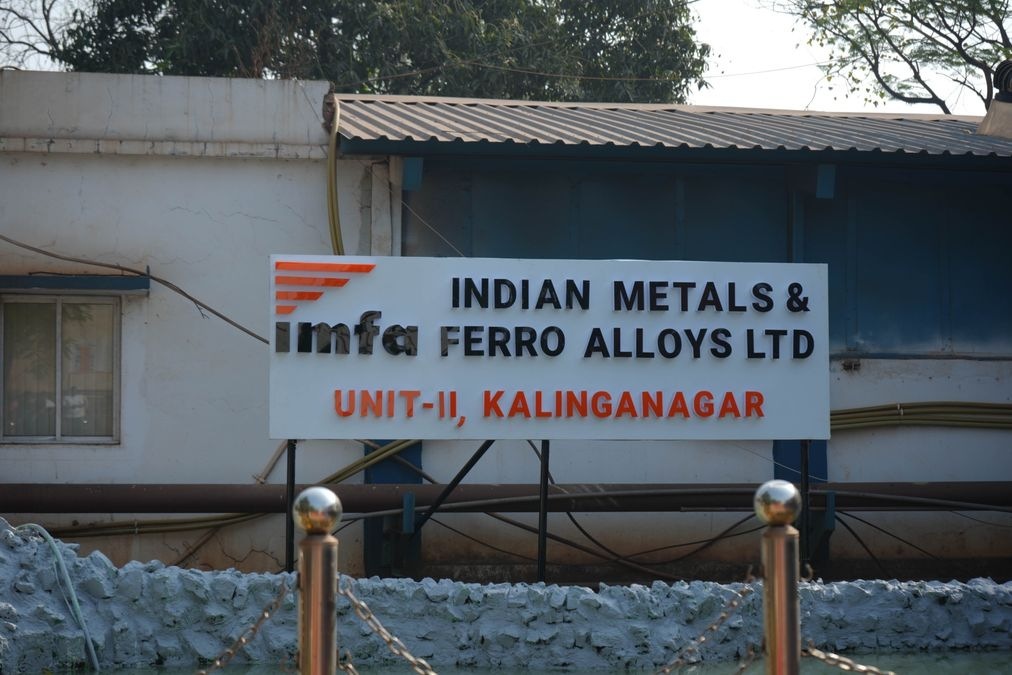
Indian Metals & Ferro Alloys Q4 FY26: The Kalinganagar Play Gets Real
General information and entertainment, not investment advice. The author is not a SEBI-registered adviser or research analyst. No recommendation, no promised returns. Markets carry risk including loss of capital. Figures may not be current. Consult a registered adviser before acting.
1. At a Glance
The number that matters: IMFA shipped Q4 PAT of ₹103 crore, up 118% year-on-year. Quarterly sales hit ₹763 crore, up 35% in the same span.
How it happened: ferro chrome realizations spiked to ~₹109,000/ton in Q4, vs ~₹87,000/ton a year prior. Costs moved only marginally. The gap—realizations higher, costs static—compresses into the bottom line.
The tension: two new ferrous furnaces (one acquired Feb 2026, one commissioning July 2026) will double installed capacity to >500,000 tpa by year-end. Execution risk is live. Demand for ferro chrome is firm because stainless steel output is stable and ferrochrome supply is tight globally. But cycles turn.
One wisdom line: a company’s acceleration means nothing without the supply chain to back it.
What you need to know: the Tata Steel acquisition and greenfield Kalinganagar plant will govern IMFA’s next two years. Margins are now the highest in its five-year history; the question is whether capacity ramps happen on time and at cost.
2. Introduction
IMFA was founded in 1961 and has grown into India’s largest fully integrated ferrochrome producer, accounting for roughly 20% of domestic output and 25% of exports. The business is simple: ore → furnaces → ferrochrome (chrome-rich iron alloy used in stainless steel production) → ship globally or sell domestically.
For 15 years after 2005, IMFA was a small play, growing volume slowly. Realizations moved sideways. Returns on capital lagged peers. Something shifted in 2020. Leveraging tight supply globally, firmer chrome ore pricing architecture, and management discipline, IMFA’s margins expanded. Profit growth over the past five years has been 22% CAGR while sales grew only 9%.
In Feb 2026, IMFA acquired Tata Steel’s ferrochrome unit at Kalinganagar for ₹610 crore (plus GST). The deal closed in under three months. Simultaneously, IMFA is commissioning a 100,000 tpa greenfield furnace—also at Kalinganagar—with a July 2026 furnace switch-on. Combined, these moves push installed capacity past 500,000 tpa, making IMFA the sixth-largest ferrochrome producer globally.
The macro undercurrent: western ferrochrome production is costly and shrinking; Chinese producers are hitting higher costs due to ore scarcity; Indian operators with captive mines are stepping up. IMFA is positioned as the lowest-cost large-scale producer in India.
3. Business Model: WTF Do They Even Do?
IMFA’s value chain starts underground. The company owns and mines chrome ore at Sukinda and Mahagiri in Odisha—two of India’s largest chromite reserves (allocated until 2049–2055). In FY26, it raised 8.3 lakh tonnes of ore. That ore feeds directly into three smelting complexes: Therubali and Choudwar (legacy, now stabilized), and Kalinganagar (the new dual-furnace complex coming online mid-2026). Each complex has a furnace, a power plant, and supporting infrastructure.
The intermediate product is ferrochrome—a material that is between ore and stainless steel in the value chain. IMFA sells ~65–67k tonnes per quarter historically. The buyer is a stainless steel mill: POSCO (South Korea), Tsingshan Group (Indonesia/China), Jindal Stainless, or commodity traders who redistribute to Japanese mills. About 90% of sales are exports; the company targets a 60/40 split (exports/domestic) once Kalinganagar stabilizes.
Two other ventures bubble in the background: a joint venture with POSCO (35,000 tpa capacity, long-term contract at quarterly resets), and an ethanol plant (120 klpd, commissioning expected Q2 FY27) which is revenue-diversification that management calls “adjacent to mining.”
The business model lives and dies on three levers: (1) ore cost (captive mines = competitive edge), (2) power cost (captive ~50 MW already, 135 MW renewable PPAs in the pipeline to cut tariffs long-term), (3) ferrochrome realizations (commodity, volatile). Margins are fat when realizations outpace cost inflation. They collapse when supply overshoots demand (as happened in H2 2024 when Chinese production surged and prices fell). The model is not defensible on tech or IP; it’s defensible on asset ownership (ore, power, location).
Q4 realizations clocked ~₹109,000/ton vs ~₹87,000/ton YoY. The jump was not accidental: global ferrochrome prices stayed elevated due to supply tightness (global output fell ~9.4% to 16 million tonnes in CY2025) and higher producer costs in China and South Africa. Management called Q1 FY27 margins “higher than Q4,” suggesting the price environment is holding or strengthening further.
Costs moved upward only marginally in Q4: raw material inflation (chrome royalties linked to ore scarcity) and thermal coal inched up. Focus remains “tight” per management. The gap between realization growth and cost inflation is the lever that drove PAT +118% YoY.
5. Valuation Discussion: Fair Value Range (Educational Only)
What follows is a walkthrough of how three valuation methods work, using this company’s numbers as the example — not a target, not a forecast, not advice.