Patel Retail Ltd Mar 2026: The 128-Day Cash Cycle Clog Inside a ₹610 Cr Supermarket
Date of Publishing -
Spotted a factual error — a wrong number, date, or fact? Tell us and we will check the source.
Section 1 — At a Glance
Patel Retail Ltd’s full-year FY26 results reveal an aggressive structural pivot that has fundamentally altered the company’s financial identity. Headline metrics indicate significant scale expansion, with annual revenue crossing the ₹1,048 crore milestone and net profit scaling to ₹39.05 crore. This growth has been catalyzed by a dual-engine model that attempts to marry regional brick-and-mortar value retail with a global agricultural processing and private-label export operation.
However, beneath the accelerating top-line momentum, a severe asset-efficiency mismatch has emerged. The company’s cash conversion cycle has lengthened drastically, deteriorating from 87 days in FY24 to an alarming 128 days in FY26. This working capital stretch is driven by an inventory pile-up that reached ₹260 crore and trade receivables that expanded to ₹162 crore by March 2026. While the newly completed ₹242.66 crore IPO in August 2025 provided an immediate capital cushion—allowing management to allocate ₹59 crore toward borrowing retirement—the core operational architecture is burning cash. Operating cash flow plummeted to a negative ₹83 crore for the full year.
Investors are left weighing a highly visible footprint expansion against a backend supply chain that is increasingly asset-heavy. Operational expansion can obscure structural inventory risk only until the credit cycle tightens. The primary narrative monitorable is no longer store count additions, but whether this massive working capital accumulation can convert back into liquid capital before funding costs erase reported margin gains.
Section 2 — Introduction
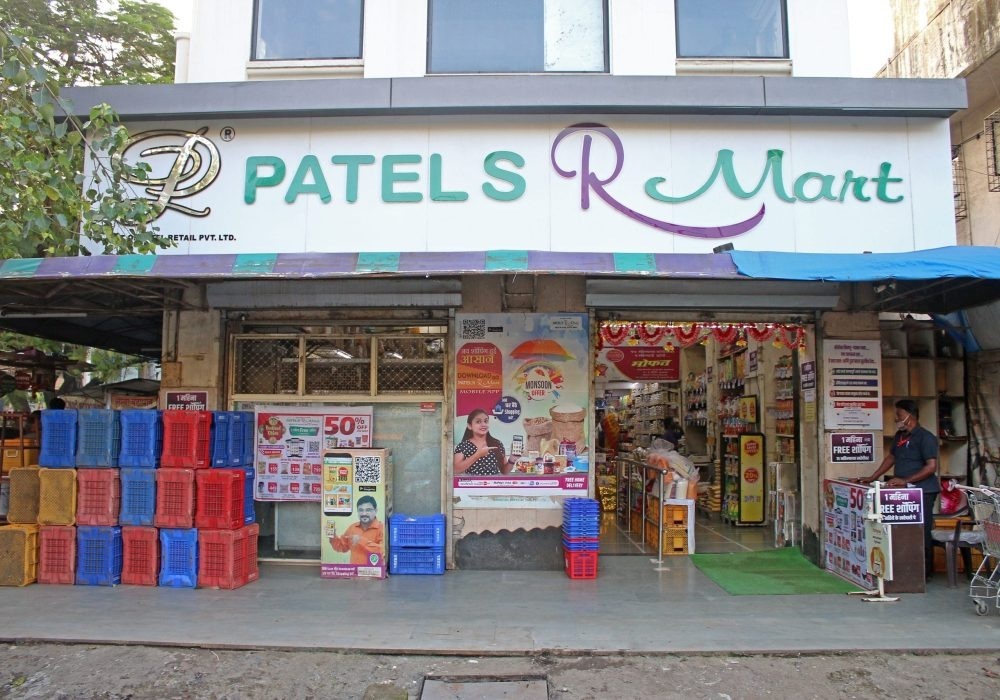
Patel Retail is an intriguing retail anomaly. It is a business trying to live two completely separate lives at the same time. On one hand, it operates 49 neighborhood value-supermarkets under the “Patel’s R Mart” banner, deeply embedded in the residential suburbs of Thane and Raigad districts in Maharashtra. On the other hand, it functions as a heavy-duty agro-processing house with manufacturing facilities in Ambernath and Kutch, shipping whole spices, pulses, and mango pulp to over 35 countries.
Evolving from a single grocery shop in 1990 to a publicly traded enterprise listed in August 2025, the company has staked its future on a high-risk, high-margin strategy: vertical integration. Instead of simply buying third-party FMCG goods and stacking them on shelves like traditional retailers, Patel Retail processes its own private labels like Patel Fresh and Indian Chaska. This strategy promises superior unit economics but demands massive capital layout, setting up a classic corporate detective story.
Section 3 — Business Model: WTF Do They Even Do?
To understand Patel Retail, you must abandon everything you know about clean, single-sector business models. The company splits its operations into an existential identity crisis: Retail (~45% of revenue) and Non-Retail (~55% of revenue).
The Twin Engines of Patel Retail
Operational Pillar
Retail Operations (45% of FY25 Revenue)
Non-Retail Operations (55% of FY25 Revenue)
Core Focus
Neighborhood value-supermarket chain catering to suburban Tier-3 catchments.
B2B bulk agro-processing, packaging, and international commodity trading.
Infrastructure
49 active “Patel’s R Mart” stores and 2 “R Choice” exclusive garment outlets.
Heavy-duty processing facilities in Ambernath (MH) and a massive 15.9-acre agri-cluster in Kutch (GJ).
Product Portfolio
Daily staples, third-party FMCG brands, and high-margin private labels like Blue Nation and Patel Essentials.
Value-added whole spices (Indian Chaska), processed pulses (Patel Fresh), peanuts, sesame, and fruit pulps.
Revenue Streams
Direct walk-in customer checkout, mobile app delivery orders, and display/kiosk rental income from internal vendors.
Global private-label processing for overseas aggregators across 35+ countries, alongside bulk domestic agricultural trading.
In short, the company splits its balance sheet down the middle to run two businesses with entirely different DNA: one is a local cash-and-carry retail operation, while the other is a capital-hungry international maritime logistics play.
In the retail segment, they operate a lease-heavy, cluster-based supermarket chain. They sell grocery staples alongside their own private-label menswear brand, Blue Nation, and home products under Patel Essentials. They even extract rent from local sandwich counters and ice cream stalls operating inside their store perimeters.
Flip over to the non-retail segment, and they are suddenly an international commodities powerhouse. They operate a massive 15.9-acre agro-cluster in Kutch, Gujarat, complete with cold storage facilities and fruit pulp processing units. They buy bulk agricultural commodities, process them, and export them to global aggregators in the UK, Canada, and Saudi Arabia. It is a corporate architecture where the left hand is selling a pack of papad to a homemaker in Badlapur, while the right hand is managing maritime container logistics for whole cumin seeds headed to London.
Section 4 — Financials Overview
Figures are consolidated, in ₹ crore.
Quarterly Performance Trend
Metric
Jun 2025
Sep 2025
Dec 2025
Mar 2026
Revenue
182.45
222.44
309.27
334.16
EBITDA
15.14
16.56
23.07
17.34
PAT
6.92
10.14
12.00
9.98
EPS (₹)
2.78
3.04
3.59
2.99
What is Management Promising in the Coming Quarters?
During the February 2026 management interaction, leadership exuded significant operational confidence, asserting that the private label mix will scale from the current 17% to