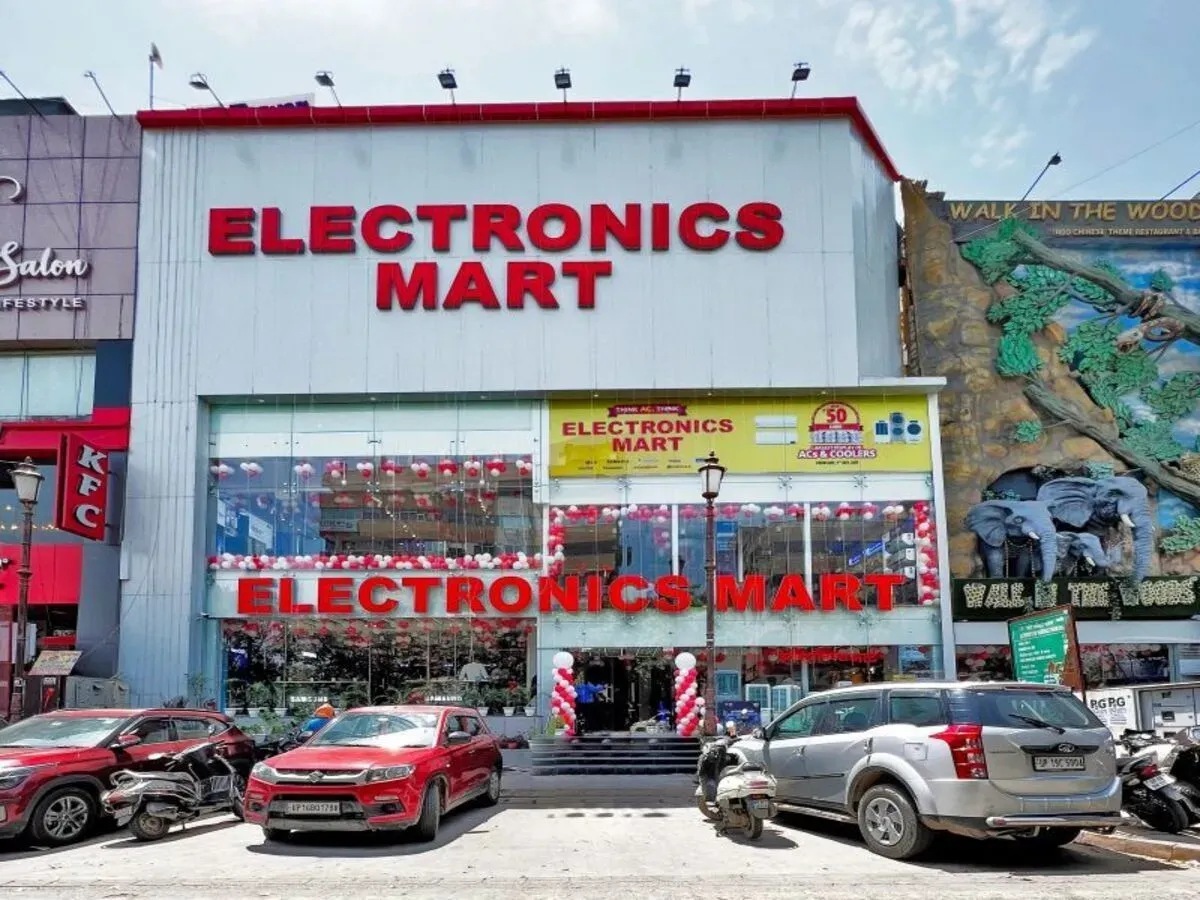
Electronics Mart FY26: The 223-Store Stand-up Routine Where the Margins Forgot the Punchline
Date of Publishing -
Spotted a factual error — a wrong number, date, or fact? Tell us and we will check the source.
Section 1 — At a Glance
When a retail empire spans 223 storefronts and blankets 1.94 million square feet of premium real estate, the headline numbers are expected to carry a distinct institutional swagger. Electronics Mart India Limited closed out the full financial year 2026 with a massive consolidated revenue top-line of ₹7,183.30 crore, representing a 6.7% year-on-year expansion over the previous year’s performance. Yet, right beneath this structural growth landscape, a different operational reality has taken root. The company’s full-year consolidated profit after tax witnessed a contraction of 33.2%, tumbling from ₹160.50 crore down to ₹107.10 crore.
This pronounced divergence between top-line scaling and bottom-line delivery has turned the company into a focal point of intense market scrutiny. Investor attention is sharply divided between two opposing structural forces: the aggressive regional expansion into the lucrative but highly competitive Delhi-NCR marketplace, and a severe working capital lock-up that has trapped significant capital on the balance sheet. With inventory lines holding stubbornly at ₹1,240.70 crore at the close of the financial year, the capital efficiency metrics that once anchored the bull case for this enterprise have faced significant structural erosion. Growth achieved by simply adding real estate footprint, rather than increasing organic volume per square foot, carries an incredibly high operational tax that inevitably shows up in the margin profile. The following analysis unpacks exactly how a business can sell more washing machines than ever before while somehow making significantly less money doing it.
Section 2 — Introduction
Electronics Mart India Limited has spent more than four decades positioning itself as an absolute brick-and-mortar powerhouse in the consumer durables sandbox. If you have bought an air conditioner or a smartphone in Telangana or Andhra Pradesh over the last generation, there is an overwhelmingly high statistical probability that your money flowed directly through their legacy multi-brand format, Bajaj Electronics.
The corporate blueprint here is deceptively straightforward: build massive, well-lit physical hubs, stock them to the rafters with every consumer appliance brand imaginable, and capture the immense structural transition of Indian households migrating toward higher-tier premium appliances. The regional dominance was historically unquestionable, but the corporate narrative shifted dramatically post-IPO. Management decided that the cozy home turf of the southern peninsula was no longer large enough to contain their ambitions. They embarked on an aggressive cross-country journey, planting flags across the highly urbanized, deeply competitive, and logistically distinct Delhi-NCR region. We are now witnessing the full financial fallout of that strategic pivot—a phase where the massive upfront costs of conquering new geographic clusters are meeting a highly uneven, weather-sensitive consumer demand cycle.
Section 3 — Business Model: WTF Do They Even Do?
To understand Electronics Mart, you must first accept the bizarre psychological reality of big-ticket appliance shopping in India. Despite the multi-billion-dollar marketing budgets of modern e-commerce platforms, when a consumer wants to drop fifty thousand rupees on a double-door refrigerator or a 4K television, they still possess an overwhelming urge to go to a physical store, tap the glass, open and close the doors, and aggressively cross-examine a retail sales executive about extended warranties.
Electronics Mart operates as the ultimate middleman for this tactile behavior. They run 215 Multi-Brand Outlets (MBOs) and 8 Exclusive Brand Outlets (EBOs), acting as the premier storefront for over 100 global consumer tech and appliance original equipment manufacturers. Their inventory is a diversified consumer basket: Mobiles make up 44% of the operational revenue pie, Large Appliances contribute another 43%, and Small Appliances and IT round out the remaining 13%. They are even attempting to build out high-margin niche formats like “Kitchen Stories” for modular cooking setups, and “Audio & Beyond” for home theatre enthusiasts who apparently believe a television speaker should cost as much as a small hatchback. The structural catch? They do not own the vast majority of their real estate; 189 of their stores are locked into long-term lease structures. They are essentially a massive collection of rented square feet across India, praying that the organic volume throughput of these storefronts stays comfortably ahead of the landlord’s escalating rental invoices.
Section 4 — Financials Overview
Figures are consolidated, in ₹ crore.
Metric
Latest Quarter (Q4 FY26)
YoY
QoQ
Revenue
1,913.20
15.0%
-1.4%
EBITDA / Operating Profit
128.70
19.8%
8.8%
PAT
39.70
49.0%
31.9%
EPS (in ₹)
1.03
49.3%
33.8%
The final operational lap of the year looked remarkably strong on paper, with Q4 revenue climbing 15% year-on-year to ₹1,913.20 crore, heavily assisted by an underlying policy shift as a recent GST rate cut acted as a major demand catalyst for higher-value large appliances. Quarterly operating profitability matched that upward stride, expanding nearly 20% to ₹128.70 crore. The quarterly earnings quality reflects an undeniable rebound from an otherwise painful winter phase, proving that the underlying structural demand from the Indian middle class is far from dead—it just requires specific structural tailwinds to unlock.
When looking at what management is promising in the coming quarters, the focus shifts entirely to tactical restraint and seasonal recovery. During the recent earnings conference call, management noted that they are implementing a conscious deceleration in their historical store rollout velocity, choosing to pause major geographic asset acquisitions up north to prioritize fixed-cost absorption. Furthermore, they revealed they have aggressively stacked up an operational arsenal of 250,000 air conditioning units ahead of the peak summer cooling cycle. After getting thoroughly bruised by erratic, cooler summer temperatures in the previous fiscal cycle, management is betting the farm on a brutal heatwave to clear out their working capital blocks, while relying on brand-funded promotions to protect their core retail margins.
Section 5 — Valuation Discussion: Fair Value Range Only
To derive a credible baseline for what Electronics Mart should actually be worth, we must move away from the backward-looking trailing metrics and look directly at the fully realized full-year performance. For the full year ended March 31, 2026, the company recorded a total reported Net Profit of ₹107.10 crore against an adjusted equity share base of 38.47 crore shares. This yields a full-year Reported EPS of ₹2.78. With the current market price sitting at ₹114, the stock is trading at a clear recalculated P/E multiple of 41.0x.
Applying our structured, multi-pronged valuation framework across the standard peer group operating bands, we observe the following fair value dynamics:
P/E Multiplicative Band Method: Looking across the organized retail universe, direct peers scale from lean micro-retail formats at 15x to premium consumer services commanding multiples north of 65x. Applying a justified corporate multiple range of 35x to 45x against the full-year core EPS of ₹2.78 yields an equity value corridor of ₹97.30 to ₹125.10 per share.
EV/EBITDA Multiple Corridor Method: The company closed the year with a full-year reported EBITDA of ₹438.20 crore. Against the calculated Enterprise Value of approximately ₹6,333 crore, the stock is resting at an EV/EBITDA multiple of 14.4x. Normalizing this against a standard industry envelope of 12x to 15x provides an implied baseline range of ₹95.00 to