Prabha Energy Ltd Mar 2026: A 3,774x P/E for 6 Crores of Sales?
Date of Publishing -
Spotted a factual error — a wrong number, date, or fact? Tell us and we will check the source.
Section 1 — At a Glance
Prabha Energy Ltd presents an extraordinary divergence between equity valuation and operational throughput. Listing on the exchanges as recently as March 19, 2025, under the T Group segment, the company has accumulated a market capitalization of ₹2,151 crore. This market value stands against a full-year FY26 revenue from operations of just ₹6.11 crore and a net profit after tax of ₹0.61 crore. The resulting trailing price-to-earnings multiple sits at an astronomical 3,774 times, indicating that the market is pricing in long-dated structural expectations or asset-revaluation triggers rather than current operational earnings.
The underlying structural driver of this valuation is the capital work-in-progress, which has expanded steadily from ₹186.50 crore in FY23 to ₹298.81 crore by March 2026. This reflects prolonged execution cycles in its core Coal Bed Methane exploration blocks, specifically the North Karanpura and Jharia assets. While operational income remains minimal, liquidity is heavily reliant on corporate restructuring actions and financing activities. Notably, during the final quarter of FY26, the company completed a rights issue of 96.67 lakh partly paid-up equity shares at ₹144 each to raise up to ₹139.21 crore, alongside liquidating its 70% stake in its material subsidiary, Deep Natural Resources Limited.
When the valuation of an enterprise travels multiple financial horizons ahead of its present revenue generation, the balance sheet ceases to be a reflector of current commercial business and becomes a speculative ledger of geological and regulatory permissions. Investors are facing an asset-heavy, cash-consuming development vehicle where execution delays act as an immediate compounding risk to capital efficiency.
Section 2 — Introduction
Welcome to Prabha Energy Ltd, a corporate entity that managed to break onto the public bourses in March 2025 like a tech unicorn, despite operating in the deep, mud-soaked world of extractive hydrocarbons. For an organization that dates back to 2009, its public footprint is fresh, and its corporate structural changes are frequent enough to keep legal draftsmen fully employed.
Through a recent composite scheme of arrangement approved by the NCLT Ahmedabad bench in late 2024, the company folded Deep Energy Resources and Savla Oil & Gas into its own identity. It is a business built entirely on the promise of the future, a characteristic that makes it either an exploration pioneer or an incredibly expensive accounting puzzle depending on which side of the ledger you choose to inspect on a Saturday morning.
Section 3 — Business Model: WTF Do They Even Do?
If you read the official business description, Prabha Energy looks like a grand energy supermarket. They claim to handle power generation via biomass, natural gas, nuclear, waste, thermal, solar, geothermal, wind, and tidal energy. If there is a way to shake electrons loose from nature, Prabha claims to have it on their menu.
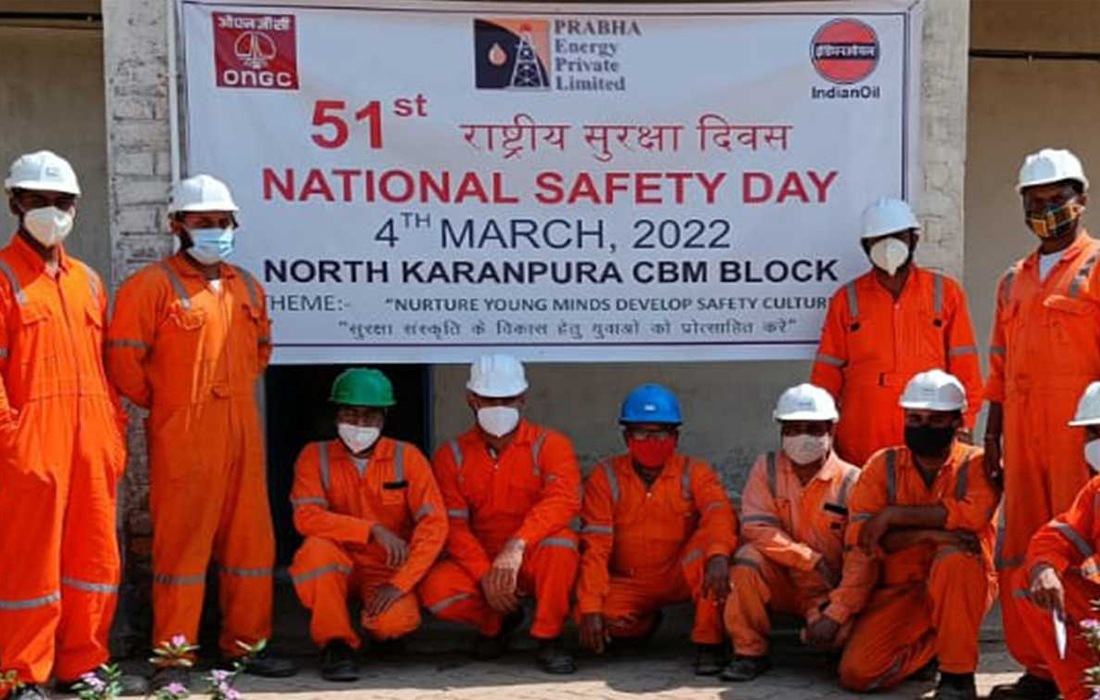
But back in the real world of commercial invoices, they are a Coal Bed Methane explorer focused on a 55:25:20 joint venture arrangement where ONGC plays the big brother with 55%, Prabha holds 25%, and Indian Oil Corporation takes the remaining 20% in the NK-CBM-2001/1 block in Jharkhand. They also hold a revenue-sharing contract with Bharat Coking Coal for the Jharia CBM block.
How does this grand vision convert to hard cash? Let us look at their FY24 revenue breakdown: 69% comes from selling services, 15% from selling goods, 2% from scrap sales, and a massive 14% from non-operating streams and interest on bank deposits. In short, they are an energy giant that makes a noticeable chunk of its lunch money from fixed deposit interest and selling old iron pipes.
Section 4 — Financials Overview
Figures are consolidated, in ₹ crore.
Quarterly Performance
Metric
March 2026
YoY (Mar 2025)
QoQ (Dec 2025)
Revenue
1.44
41.18%
-18.18%
EBITDA / Operating Profit
-0.03
NM
NM
PAT
0.10
NM
-89.13%
EPS (₹)
0.01
0.00%
-80.00%
NM = Not Meaningful due to low/negative base values.
Did Management Walk the Talk?
While there is no formal consensus tracking transcript for this freshly minted small-cap asset, the numbers themselves reveal a telling operational rhythm. In December 2025, the company posted a net profit of ₹0.92 crore, largely driven by an other income spike of ₹1.20 crore, which coincided with the announcement that they were divesting 70% of Deep Natural Resources.
By March 2026, the other income normalized back down to ₹0.19 crore, and the net profit followed it off the cliff to hit ₹0.10 crore. Operating profit lines have been pinned below zero for nearly eight consecutive quarters, moving from -₹1.66 crore in March 2025 to -₹0.03 crore today. When the core operations of a business consistently cost more than they bring in, the quality of earnings isn’t just low—it is entirely artificial, kept alive by accounting adjustments and non-operating windfalls.
Would you buy a baker’s stock if he lost money on every loaf of bread but made his rent by selling the flour sacks?
Section 5 — Valuation Discussion
To evaluate a company trading at ₹157 with an annual profit of ₹0.61 crore requires moving past traditional valuation instruments. Let us look at the structural reality.