E to E Transportation FY26: The ₹229 Cr Receivables Surge That Left the Cash Flow Stranded at the Station
Section 1 — At a Glance
A dramatic divergence between optical expansion and operational liquidity defines the full-year audited consolidated financial results of E to E Transportation Infrastructure Limited for the period ended March 31, 2026. On paper, the enterprise orchestrated a spectacular top-line expansion, with revenue surging 51.5% year-on-year to touch ₹379.99 crore. This scale-driven velocity, however, was violently checked by severe structural blockages in working capital management. Trade receivables exploded by an astonishing 143.6%, mounting from ₹93.53 crore to ₹228.86 crore within a single twelve-month cycle. This immense asset accumulation choked operational liquidity, plunging the net cash flow from operating activities into a staggering deficit of -₹102.05 crore.
The balance sheet expansion is fueled almost entirely by deferred collection cycles, forcing an aggressive reliance on leverage to sustain daily execution. Total borrowings rocketed from ₹66.31 crore to ₹163.58 crore to plug the widening cash deficit. While public markets remain transfixed by a multi-year consolidated sales CAGR of 41.31%, the underlying earnings quality has deteriorated under the weight of high execution concentration. A striking 48% of full-year revenue was billed exclusively in the final month of the financial year, precipitating a systemic cash crunch. Profit growth without parallel cash conversion is merely an accounting fiction. Investors are left to monitor whether a highly anticipated pivot into proprietary safety-critical engineering can mend a fundamentally broken cash cycle before escalating financing costs erode net interest coverage.
Section 2 — Introduction
E to E Transportation Infrastructure Limited entered public consciousness with its initial public offering on January 02, 2025, raising ₹80 crore to ostensibly grease its working capital gears. Operating from its corporate seat in Bengaluru, the company frames its identity around complex engineering and system integration solutions tailored specifically for the modern rail ecosystem.
The transition from a closely-held private contractor into a publicly traded corporate entity has subjected its operational mechanisms to intense, unyielding scrutiny. Management has spent the better part of the fiscal year attempting to reposition the narrative away from low-margin engineering, procurement, and construction (EPC) services toward a high-tech platform thesis. However, corporate public relations frequently collide with the rigid realities of sovereign execution cycles. The primary operational task facing the organization is no longer just winning massive tenders from zonal railways and urban metro networks, but proving it can extract real, tangible currency from its high-profile public sector clients.
Section 3 — Business Model: WTF Do They Even Do?
To understand E to E Transportation, one must look past the complex corporate lexicon of “integrated mobility platforms” and look directly at what they actually construct on the ground. At its core, the business model functions as a massive, outsourced assembly and engineering brain for the railway sector. They do not manufacture heavy locomotives; instead, they design, wire, configure, and install the sophisticated electronic nervous systems that prevent these massive metal machines from colliding with one another.
The revenue generation engine operates via two sharply contrasting business divisions:
Business-to-Government (B2G): Bidding for monolithic contracts issued by Indian Railways, regional metro rail corporations, and public sector undertakings. This division represents the premium, high-margin side of the house, capturing gross margins north of 60%. The catch? You must wait indefinitely to be paid, with Days Sales Outstanding frequently stretching past the 120-day horizon.
Business-to-Business (B2B): Servicing private industrial sidings, ports, steel units, and cement complexes that require dedicated rail connectivity to transport freight. This segment is the absolute antithesis of the government business—operating on a low-margin, high-volume scale model with wafer-thin 12% gross margins, but extracting cash with lightning speed, keeping collection cycles under 45 days.
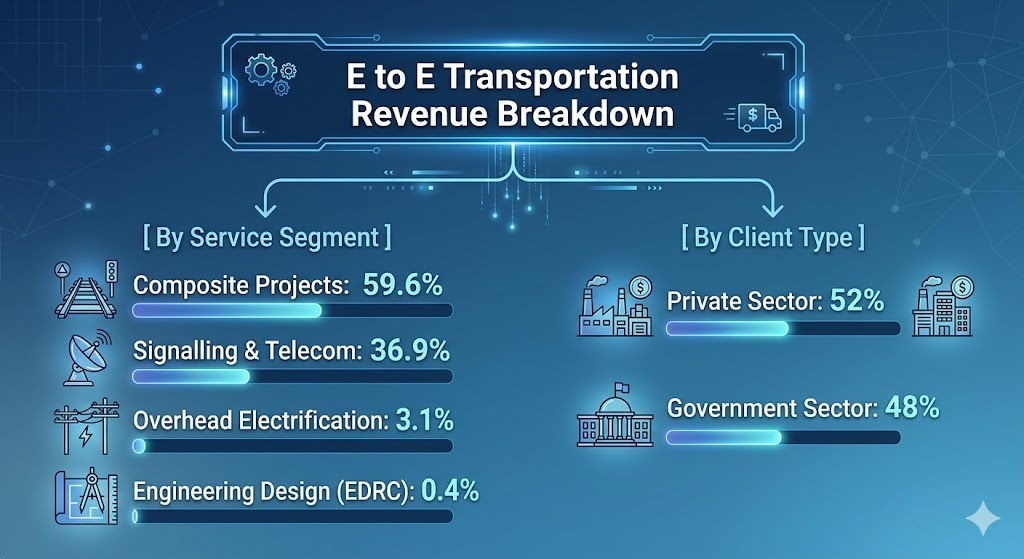
The current segment matrix illustrates the tension of this operational split:
The underlying irony is supreme: while private industrial clients hold a slight majority in the historical revenue mix at 52%, the top 10 individual customers command an iron-clad 97% concentration of total billings. It is an asset-light, turnkey execution architecture that attempts to run a design-led engineering business while carrying the concentrated client risk of a bespoke regional subcontractor.